

Researchers at the University of Hong Kong discovered Dirac spinons in the material YCu3-Br, providing evidence of a quantum spin liquid state and potentially advancing applications in quantum computing and high-temperature superconductivity.
Quasiparticles are fascinating entities that arise from collective behavior within materials and can be treated as a group of particles. Specifically, Dirac spinons are anticipated to exhibit unique characteristics similar to Dirac particles in high-energy physics and Dirac electrons in graphene and quantum moiré materials, such as a linear dispersion relation between energy and momentum. However, spin-½ charge-neutral quasiparticles had not been observed in quantum magnets until this work.
‘“To find Dirac spinons in quantum magnets has been the dream of generations of condensed matter physicists; now that we have seen the evidence of them, one can start to think about the countless potential applications of such highly entangled quantum material. Who knows, maybe one-day people will build quantum computers with it, just as people have been doing in the past half-century with silicon,’” said Professor Meng, HKU physicist and one of the corresponding authors of the paper.
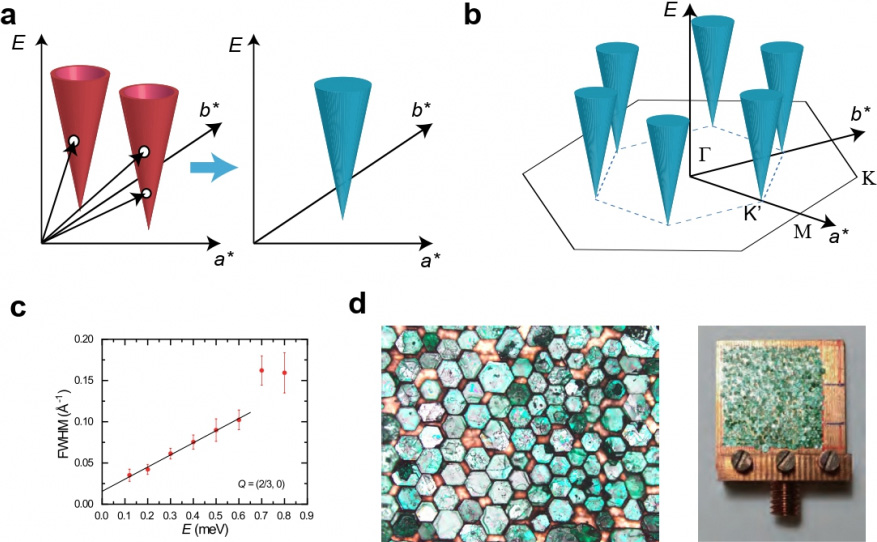
Using advanced techniques like inelastic neutron scattering, the team probed the material’s spin excitations and observed intriguing conical spin continuum patterns, reminiscent of the characteristic Dirac cone. While directly detecting single spinon proved challenging due to experimental limitations, the team compared their findings with theoretical predictions, revealing distinct spectral features indicative of the presence of spinons in the material.

Finding spectral evidence of Dirac spinon excitations has always been a challenge. This discovery provides compelling evidence for the existence of a Dirac quantum spin liquid state, which can be akin to a clear cry cutting through the fog of spectral investigation on the quantum spin liquid state. The findings not only advance our fundamental understanding of condensed matter physics but also open doors for further exploration into the properties and applications of YCu3-Br.
![Spin Excitations in YCu3(OD)6[Br0.33(OD)0.67]](https://scitechdaily.com/images/Spin-Excitations-in-YCu3OD6Br0.33OD0.67.jpg)
Reference: “Spectral evidence for Dirac spinons in a kagome lattice antiferromagnet” by Zhenyuan Zeng, Chengkang Zhou, Honglin Zhou, Lankun Han, Runze Chi, Kuo Li, Maiko Kofu, Kenji Nakajima, Yuan Wei, Wenliang Zhang, Daniel G. Mazzone, Zi Yang Meng and Shiliang Li, 9 May 2024, Nature Physics.
DOI: 10.1038/s41567-024-02495-z
The study was supported by the Ministry of Science and Technology of China, the Chinese Academy of Sciences, and grants from the Hong Kong Research Grants Council. Neutron scattering measurements were performed on AMATERAS, J-PARC.
Never miss a breakthrough: Join the SciTechDaily newsletter.
Follow us on Google and Google News.