
Close Menu
    Facebook X (Twitter) Instagram
    SciTechDaily
    • Biology
    • Chemistry
    • Earth
    • Health
    • Physics
    • Science
    • Space
    • Technology
    Facebook X (Twitter) Pinterest YouTube RSS
    SciTechDaily
    Home»Earth»Popocatépetl Keeps On Puffing – One of Mexico’s Most Active Volcanoes
    Earth

    Popocatépetl Keeps On Puffing – One of Mexico’s Most Active Volcanoes

    By Kathryn Hansen, NASA Earth ObservatoryMay 9, 2023No Comments3 Mins Read
    Facebook Twitter Pinterest Telegram LinkedIn WhatsApp Email Reddit
    Share
    Facebook Twitter LinkedIn Pinterest Telegram Email Reddit
    Popocatépetl Volcano 2023 Annotated
    Satellite image of Popocatépetl volcano acquired on April 14, 2023, by the Operational Land Imager (OLI) on Landsat 8.

    One of Mexico’s most active volcanoes continues to put on a show for satellites and astronauts.

    Popocatépetl, an active stratovolcano 43 miles southeast of Mexico City, is one of Mexico’s most active volcanoes. During the mountain’s current period of eruption, ongoing since 2005, volcanic emissions frequently billow from its summit crater. In spring 2023, striking plumes were captured in images acquired by satellites and astronauts, both orbiting hundreds of kilometers above Earth’s surface.

    The Operational Land Imager (OLI) on Landsat 8 acquired this image (above) on April 14, 2023. Monitoring systems on that day detected water vapor, volcanic gases, and ash, according to Mexico’s National Center for Disaster Prevention (CENAPRED).

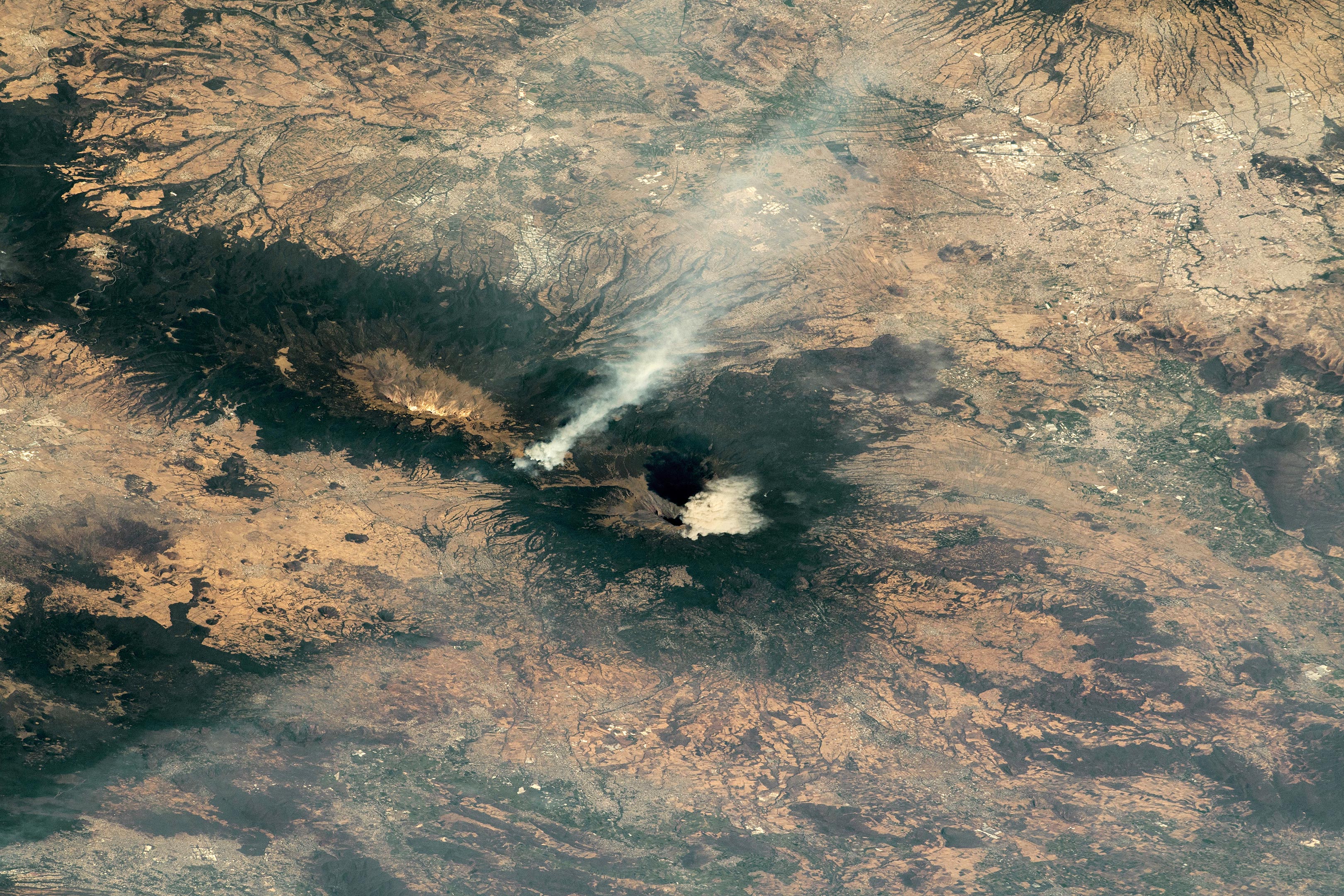
    The volcano still puffed on May 2, 2023, when an astronaut on the International Space Station took this photograph (below). It shows a wider view of the region that includes Iztaccihuatl—a dormant volcanic mountain—and the nearby town of Puebla. Mexico City (not pictured) is about 70 kilometers (40 miles) northwest of Popocatépetl.
    Popocatépetl Volcano Mexico Annotated
    Photo of Popocatépetl volcano taken on May 2, 2023, by an astronaut aboard the International Space Station.

    The source of the other plume, located between the two volcanoes, is unclear based on this photograph. Past research has suggested that satellite-detected hotspots on the volcano’s slopes could be due to fire. Also notice the green vegetated areas surrounding the peaks. Conifer forests and high-mountain prairies are an important part of the area’s ecosystem.

    Around the time of these images, volcanic plumes rose as high as 7.3 kilometers (24,000 feet), according to the Washington Volcanic Ash Advisory Center. As of May 4, the volcanic alert level remained yellow (the middle level of a three-color scale).

    NASA Earth Observatory image by Lauren Dauphin, using Landsat data from the U.S. Geological Survey. Astronaut photograph ISS069-E-8304 was acquired on May 2, 2023, with a Nikon D5 digital camera using a 400 millimeter lens and is provided by the ISS Crew Earth Observations Facility and the Earth Science and Remote Sensing Unit, Johnson Space Center. The image was taken by a member of the Expedition 69 crew. The image has been cropped and enhanced to improve contrast, and lens artifacts have been removed. The International Space Station Program supports the laboratory as part of the ISS National Lab to help astronauts take pictures of Earth that will be of the greatest value to scientists and the public, and to make those images freely available on the Internet.

    Never miss a breakthrough: Join the SciTechDaily newsletter.
    Follow us on Google and Google News.

    NASA NASA Earth Observatory Volcano
    Share. Facebook Twitter Pinterest LinkedIn Email Reddit

    Related Articles

    NASA Satellite Captures a Nighttime Volcanic Eruption on Iceland’s Reykjanes Peninsula

    Volcanic Eruption Lights Up Iceland Following Swarms of Small Earthquakes

    A Nighttime Glow Over Mount Etna – Highly Active Italian Volcano

    Socked in Stratovolcano: Astronaut on ISS Captures Incredible View of Uninhabited Atlasov Island

    Kilauea’s Lava Lake Returns – Hawaii’s Most Active Volcano Is Erupting Again

    “Smoking Mountain” – An Outburst From Popocatépetl Volcano in Mexico

    Newberry Volcano Photographed by Astronaut Onboard the International Space Station

    Young Volcanic Island Nishinoshima Belches Ash and Lava As It Grows in the Pacific

    Unusual “Volcano Track” Clouds Investigated

    Leave A Reply Cancel Reply

    • Facebook
    • Twitter
    • Pinterest
    • YouTube

    Don't Miss a Discovery

    Subscribe for the Latest in Science & Tech!

    Trending News

    Why Popular Diabetes Drugs Like Ozempic Don’t Work for Everyone: The “Genetic Glitch”

    Scientists Stunned After Finding Plant Thought Extinct for 60 Years

    Scientists Discover Tiny New Spider That Hunts Prey 6x Its Size

    Natural Component From Licorice Shows Promise for Treating Inflammatory Bowel Disease

    Scientists Warn: Popular Sweetener Linked to Dangerous Metabolic Effects

    Monster Storms on Jupiter Unleash Lightning Beyond Anything on Earth

    Scientists Create “Liquid Gears” That Spin Without Touching

    The Simple Habit That Could Help Prevent Cancer

    Follow SciTechDaily
    • Facebook
    • Twitter
    • YouTube
    • Pinterest
    • Newsletter
    • RSS
    SciTech News
    • Biology News
    • Chemistry News
    • Earth News
    • Health News
    • Physics News
    • Science News
    • Space News
    • Technology News
    Recent Posts
    • Trees Emit Tiny Lightning Flashes During Storms and Scientists Finally Prove It
    • Forget Chemicals. This Plant Removes Microplastics From Water
    • Breakthrough Crystal Lets Scientists “Write” Nanoscale Patterns With Light
    • Pomegranate Compound Could Help Protect Against Heart Disease
    • Your Blood Test Might Already Show Alzheimer’s Risk
    Copyright © 1998 - 2026 SciTechDaily. All Rights Reserved.
    • Science News
    • About
    • Contact
    • Editorial Board
    • Privacy Policy
    • Terms of Use

    Type above and press Enter to search. Press Esc to cancel.