

A unique 24-year study on freshwater fish subjected to warm water pollution reveals alterations in growth and mortality rates, along with size modifications, however, the results don’t completely conform to initial predictions.
A new study recently published in the journal eLife challenges the theory that aquatic creatures like fish will diminish in size due to global warming.
The research indicated that while warmer water pollutants raised both the growth and mortality rates, the outcome was a population of younger, albeit larger fish. This discovery partially contradicts the general predictions about the impact of global warming on natural ecosystems, underscoring the need for these hypotheses to undergo rigorous, large-scale experimental validation.
As aquatic ecosystems become warmer, it is predicted that animals such as fish will grow faster at a young age but reach smaller body sizes as adults. This pattern has mainly been observed in small-scale experiments, and although some studies have tested this prediction in natural environments, these have mostly been carried out on fish species subjected to fishing, where the process of fishing itself can influence growth rates and body size.
“Studies into the effects of warming waters on fish from large-scale, semi-controlled experiments in natural settings are rare, yet they can provide unique insights,” says lead author Max Lindmark, researcher at the Swedish University of Agricultural Sciences, Department of Aquatic Resources, Lysekil, Sweden. “We used a unique study system to investigate how warm water pollution has changed the death rates, growth rates, and size of fish over many generations.”
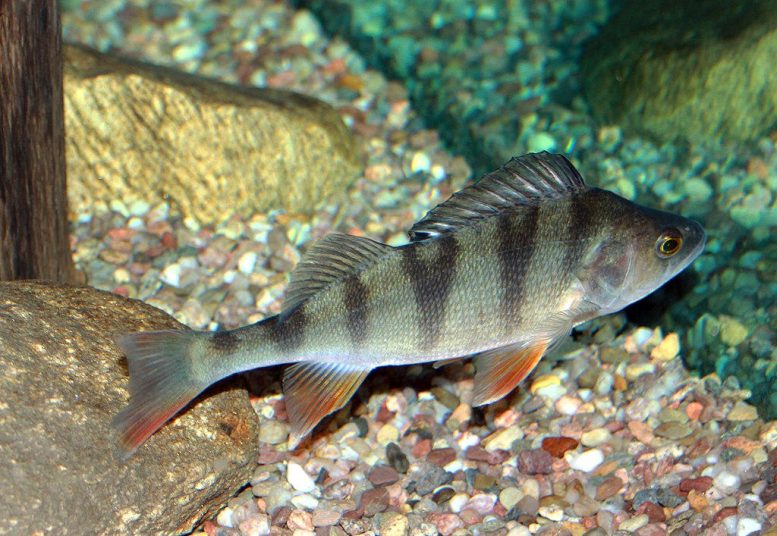
The team carried out their study in an enclosed coastal bay that has received cooling water from a nuclear power plant, making it 5–10°C (41–50°F) warmer than the surrounding waters. They compared the fish species Eurasian perch from the enclosed bay and from a reference area in the adjacent archipelago over a 24-year time period. They combined data on catches with measurements of the fishes’ length-at-age (back-calculated throughout their life from “age rings” in hard structures), and then analyzed these using statistical models to investigate how the warm water pollution affected the age and size of the fish populations, as well as their growth and death rates.
Unexpected Growth Patterns in Warmer Waters
While the researchers found statistically notable differences in estimated growth rates, death rates, and sizes of the fish populations between the heated and reference areas, not all of these changes were as they expected. Although female perch in the warm area grew faster, as the team anticipated, they continued to do so throughout life.
These fish, therefore, reached a large size-at-age – approximately 7–11% larger in the heated area at any age, when compared with the reference area. Moreover, the authors say the increase in the growth rate of younger fish due to warm water was so pronounced that even if death rates were higher because of warming, and resulted in a younger overall population of fish, the average size and relative abundance of larger fish was still higher in the heated area. This trend conflicts with the prediction that global warming would shrink fish over time, especially the large and old ones. In essence, ecosystem warming instead led to younger, but larger fish in this study.
“Our study provides strong evidence for warming-induced differences in growth and death rates among a natural population of an unexploited temperate fish species exposed to 5–10°C water temperature increases for more than two decades. These effects largely, but not completely, counteract each other – while the fish are younger, they are also larger on average,” says co-author Malin Karlsson, Water Manager at the Department of Nature and Environment, County Administrative Board of Västmanland, Sweden.
“These findings highlight that generalized predictions based on theories such as the temperature-size rule may have limited use for predicting changes at a population level and that both death rates and growth rates are important when studying temperature effects,” concludes senior author Anna Gårdmark, Professor at the Swedish University of Agricultural Sciences, Department of Aquatic Resources, Uppsala, Sweden.
“Although we only studied a single species, this unique climate change experiment suggests the effects of heating at the scale of a whole ecosystem, making its findings highly relevant in the context of global warming.”
Reference: “Larger but younger fish when growth outpaces mortality in heated ecosystem” by Max Lindmark, Malin Karlsson and Anna Gårdmark, 9 May 2023, eLife.
DOI: 10.7554/eLife.82996
Never miss a breakthrough: Join the SciTechDaily newsletter.
Follow us on Google and Google News.