

Close Menu
    Facebook X (Twitter) Instagram
    SciTechDaily
    • Biology
    • Chemistry
    • Earth
    • Health
    • Physics
    • Science
    • Space
    • Technology
    Facebook X (Twitter) Pinterest YouTube RSS
    SciTechDaily
    Home»Health»Potential New Diagnostic and Therapeutic Target for Lung Cancer
    Health

    Potential New Diagnostic and Therapeutic Target for Lung Cancer

    By Chinese Academy of SciencesJanuary 20, 2022No Comments3 Mins Read
    Facebook Twitter Pinterest Telegram LinkedIn WhatsApp Email Reddit
    Share
    Facebook Twitter LinkedIn Pinterest Telegram Email Reddit
    Lung Cancer Illustration
    LCDR, a long noncoding RNA, has been linked to lung cancer survival by regulating lysosomal integrity. Its inhibition could serve as a therapeutic approach to trigger cancer cell death.

    A new study highlights the role of LCDR, a long noncoding RNA, in promoting lung cancer cell survival by maintaining lysosomal membrane integrity. Knockdown of LCDR leads to increased apoptosis, suggesting it as a potential target for lung cancer therapy.

    Chinese scientists recently reported the key role of histone acetylation-regulated long noncoding RNA termed as lysosome cell death regulator (LCDR) in tumor survival, providing a potential diagnostic and therapeutic target for lung cancer.

    Led by Prof. GAO Shan from the Suzhou Institute of Biomedical Engineering and Technology of the Chinese Academy of Sciences (CAS), these scientists revealed that knockdown of the LCDR in lung cancer cells could promote apoptosis. Results were published in PNAS.

    The Role of Lysosome and LncRNAs in Cancer

    Lysosome is involved in cellular homeostasis and its dysregulation has been linked to various human diseases, including cancer. LncRNAs are noncoding RNAs with lengths longer than 200 nucleotides, whose dysregulation is associated with cancer hallmarks. They drive cancer growth and survival by interacting with DNA, RNA, and protein assemblies, including the heterogeneous ribonucleic acid protein (hnRNP) family, which functions as alternative splicing, RNA stability, translation, etc.

    However, whether lncRNAs and/or hnRNPs are involved in lysosome-mediated cancer survival has not been elucidated.
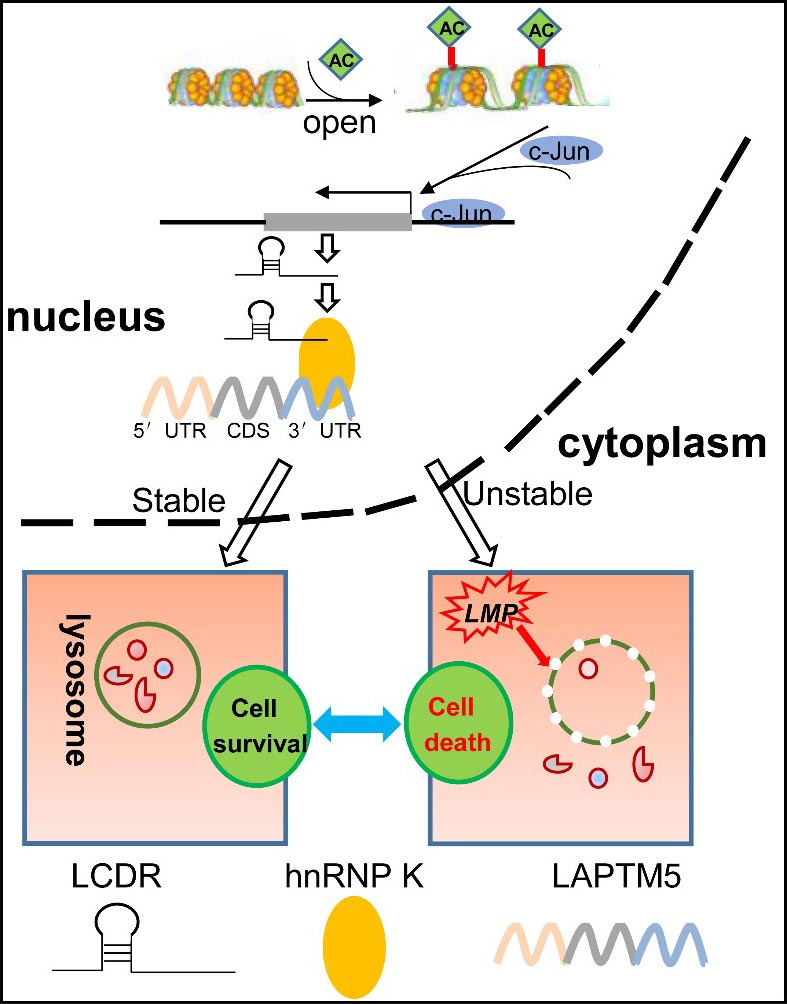
    Proposed Model for the LCDR/hnRNP K/LAPTM5 Axis
    Proposed model for the LCDR/hnRNP K/LAPTM5 axis promoting the pathogenesis of lung cancer. Credit: GAO Shan

    Investigating the LCDR Mechanism

    In this study, LCDR binds to heterogeneous nuclear ribonucleoprotein K (hnRNP K) to regulate the stability of lysosomal-associated protein transmembrane 5 (LAPTM5) transcript that maintains the integrity of the lysosomal membrane.

    According to the researchers, knockdown of LCDR, hnRNP K, or LAPTM5 promoted lysosomal membrane permeabilization and lysosomal cell death, thus resulting in apoptosis. LAPTM5 overexpression or cathepsin B inhibitor partially restored the effects of this axis on lysosomal cell death in vitro and in vivo.

    Implications for Lung Cancer Treatment

    Similarly, targeting LCDR significantly decreased tumor growth of patient-derived xenografts of lung adenocarcinoma (LUAD) and led to significant cell death using nanoparticles (NPs)-mediated systematic siRNA delivery.

    Moreover, LCDR/hnRNP K/LAPTM5 were upregulated in LUAD tissues, and their co-expression showed increased diagnostic value for LUAD.

    These findings shed light on LCDR/hnRNP K/LAPTM5 as potential therapeutic targets and lysosome targeting is a promising strategy in cancer treatment.

    Reference: “LCDR Q:0 regulates the integrity of lysosomal membrane by hnRNP K–stabilized LAPTM5 transcript and promotes cell survival” by Xiwang Yang, Ya Wen, Shaomin Liu, Liqiang Duan, Tongfeng Liu, Zhou Tong, Zhuo Wang, Yinmin Gu, Yibo Xi, Xiaodong Wang, Dingsan Luo, Ruobing Zhang, Yajuan Liu, Yang Wang, Tianyou Cheng, Siyuan Jiang, Xiaofeng Zhu, Xiaohui Yang, Yongbo Pan, Shuwen Cheng, Qinong Ye, Jinfei Chen, Xiaoding Xu and Shan Gao, 28 January 2022, Proceedings of the National Academy of Sciences.
    DOI: 10.1073/pnas.2110428119

    This work was supported by the National Natural Science Foundation of China and the Strategic Pilot Science and Technology Project of CAS etc.

    Never miss a breakthrough: Join the SciTechDaily newsletter.
    Follow us on Google and Google News.

    Cancer Chinese Academy of Sciences Lung Cancer
    Share. Facebook Twitter Pinterest LinkedIn Email Reddit

    Related Articles

    Rapid Decrease in Lung Cancer and Melanoma Deaths in the United States

    Artificial Intelligence Program Accurately Predicts Lung Cancer Risk

    New Platelet-Based Formulation Developed for Combination Anticancer Therapy

    Blocking Sugar Metabolism Slows the Growth of Lung Cancer Tumors

    Mesothelioma Trial Suggests Immunotherapy as an Alternative to Chemotherapy

    Blood Test Can Replace Invasive Biopsy for More Patients With Lung Cancer

    Study Shows Thirdhand Smoke Increases Lung Cancer Risk

    New Breath Test Provides Non‐Invasive Lung Cancer Diagnosis

    Rare ALK Genetic Mutation Extends Cancer Survival

    Leave A Reply Cancel Reply

    • Facebook
    • Twitter
    • Pinterest
    • YouTube

    Don't Miss a Discovery

    Subscribe for the Latest in Science & Tech!

    Trending News

    Chimpanzees Keep Throwing Stones at the Same Trees – Scientists Want To Know Why

    Coffee May Protect the Liver in More Ways Than Scientists Realized

    AI Just Uncovered a Hidden Secret Inside Water

    Scientists Catch a “Jumping Gene” Moving Between Species

    This Tiny-Bead Procedure Is Helping Patients Avoid Knee Replacement

    Neanderthals Nearly Vanished 75,000 Years Ago – Then One Group Repopulated Europe

    AI Detects Hidden Warning Signs Before Major Earthquakes

    Scientists Have Found Evidence That Dark Matter May Not Be Playing by the Rules

    Follow SciTechDaily
    • Facebook
    • Twitter
    • YouTube
    • Pinterest
    • Newsletter
    • RSS
    SciTech News
    • Biology News
    • Chemistry News
    • Earth News
    • Health News
    • Physics News
    • Science News
    • Space News
    • Technology News
    Recent Posts
    • 567-Million-Year-Old Fossils Suggest Animals Evolved Earlier Than We Thought
    • Scientists Discover a 5-Million-Year-Old Whale Graveyard Deep Beneath the Indian Ocean
    • Ancient DNA Reveals the Hidden Origins of China’s Mysterious Shimao Civilization
    • Scientists Finally Solve a 50-Year Mystery Hidden in Solid Nitrogen
    • Saturn’s Largest Moon May Hold the Resources for a Space Colony
    Copyright © 1998 - 2026 SciTechDaily. All Rights Reserved.
    • Science News
    • About
    • Contact
    • Editorial Board
    • Privacy Policy
    • Terms of Use

    Type above and press Enter to search. Press Esc to cancel.