
Close Menu
    Facebook X (Twitter) Instagram
    SciTechDaily
    • Biology
    • Chemistry
    • Earth
    • Health
    • Physics
    • Science
    • Space
    • Technology
    Facebook X (Twitter) Pinterest YouTube RSS
    SciTechDaily
    Home»Space»Powerful X-Class Solar Flare Erupts From Sun – NASA’s Solar Dynamics Observatory Captures Image
    Space

    Powerful X-Class Solar Flare Erupts From Sun – NASA’s Solar Dynamics Observatory Captures Image

    By NASAMay 11, 20221 Comment2 Mins Read
    Facebook Twitter Pinterest Telegram LinkedIn WhatsApp Email Reddit
    Share
    Facebook Twitter LinkedIn Pinterest Telegram Email Reddit
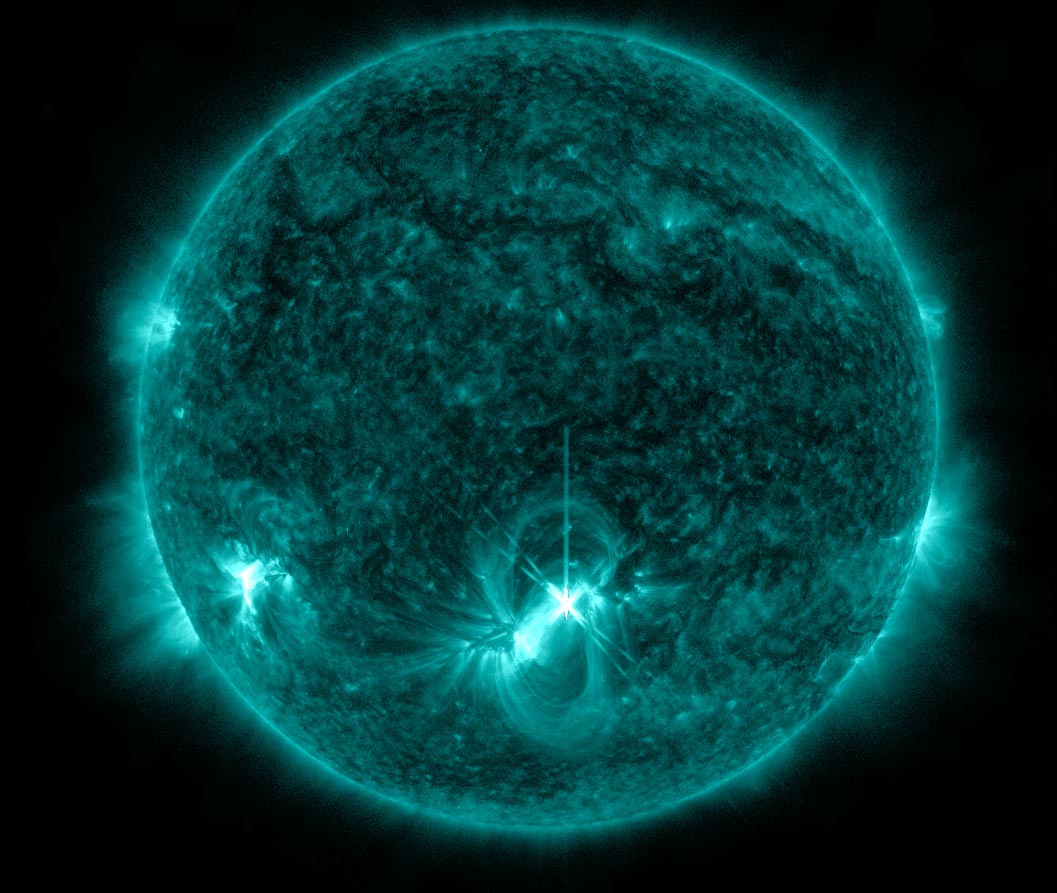
    SDO Solar Flare May 10, 2022
    NASA’s Solar Dynamics Observatory captured this image of a solar flare – as seen in the bright flash towards the middle of the Sun – on Tuesday, May 10, 2022. The image shows a subset of extreme ultraviolet light that highlights the extremely hot material in flares and which is colorized in teal. Credit: NASA/SDO

    The Sun emitted a strong X-class solar flare on Tuesday, May 10, 2022, peaking at 9:55 a.m. EDT. NASA’s Solar Dynamics Observatory, which watches the Sun constantly, captured an image of the event.

    Activity on the sun has picked up dramatically in recent days, with many strong and moderate solar flares erupting.

    This flare is classified as an X-class flare. X-class denotes the most intense flares, while the number provides more information about its strength. Solar flares are powerful bursts of energy. Flares and solar eruptions can impact radio communications, electric power grids, and navigation signals. They also pose risks to spacecraft and astronauts. More info on how flares are classified can be found here.
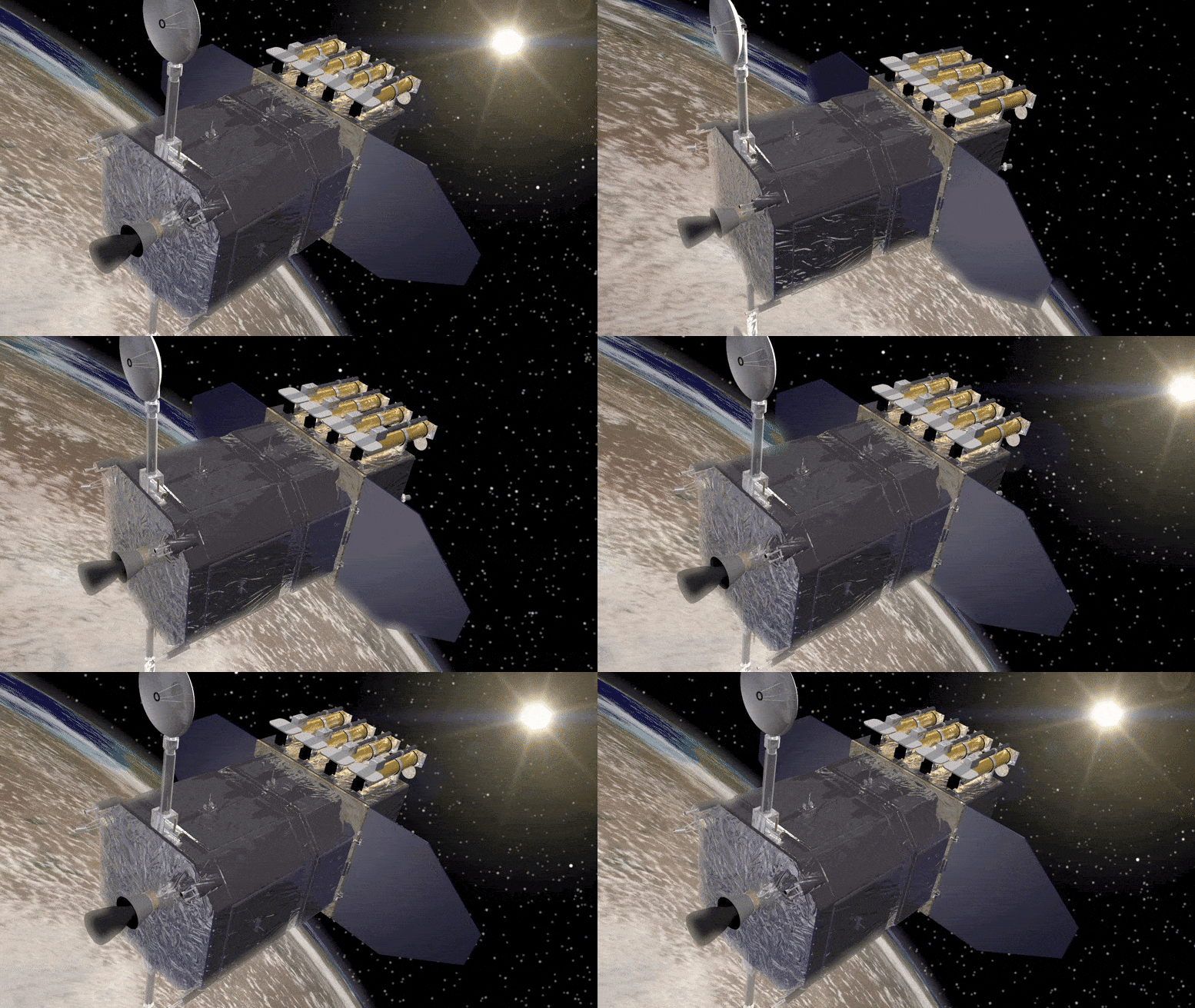
    NASA Solar Dynamics Observatory
    This animation of the Solar Dynamics Observatory shows it above the earth as it faces toward the Sun. SDO is designed to help us understand the Sun’s influence on Earth and Near-Earth space by studying the solar atmosphere on small scales of space and time and in many wavelengths simultaneously. Credit: NASA/Goddard Space Flight Center Conceptual Image Lab

    Please visit NOAA’s Space Weather Prediction Center, the U.S. government’s official source for space weather forecasts, watches, warnings, and alerts, to see how space weather can affect Earth. NASA serves as the nation’s space weather research arm. NASA constantly monitors the Sun and our space environment with a network of spacecraft that investigate everything from the Sun’s activity to the solar atmosphere, as well as the particles and magnetic fields in the space surrounding Earth.

    Never miss a breakthrough: Join the SciTechDaily newsletter.
    Follow us on Google and Google News.

    NASA Solar Dynamics Observatory Solar Flares Sun
    Share. Facebook Twitter Pinterest LinkedIn Email Reddit

    Related Articles

    NASA Just Found the Sun’s Secret Warning Before Massive Solar Flares

    Solar Fury Erupts: Sun Rings In the New Year With X1.8 Flare

    Sun Releases a Powerful Burst of Radiation – An X1-Class Solar Flare

    Powerful X-class Solar Flare Erupts From Sun

    NASA’s Solar Dynamics Observatory Spots Burst of Light and Energy on the Sun: A B-Class Flare

    NASA’s Solar Dynamics Observatory Views M-Class Solar Flare

    NASA’s SDO Reveals Images of X4.9-Class Solar Flare

    NASA’s Solar Dynamics Observatory Views Two New Solar Flares

    New Light Shed on the Origins of Extreme Space Storms

    1 Comment

    1. Patricia Boswell on April 26, 2023 10:50 pm

      WE have had a solar event recently in the news reporting that 30 states in the US have bee observing the Aurora Borealis. In Jacksonville Florida my son and I researched the internet about why–because this usually means possible dangerous solar activity. Our frustration was that none of the news channels taught the science behind the auroras. Not one channel that we watched. Please start giving this information that SDO is receiving to news channels. Citizens and especially students, need to know what these things are and not be called just “pretty!” They need to know the significance of having auroras appear in skies where you rarely or never see them!
      Thank you and a shout out to NASA for all the great things you are doing. Florida Teacher

      Reply
    Leave A Reply Cancel Reply

    • Facebook
    • Twitter
    • Pinterest
    • YouTube

    Don't Miss a Discovery

    Subscribe for the Latest in Science & Tech!

    Trending News

    New “Nanozyme Hypothesis” Could Rewrite the Story of Life’s Origins

    Anatomy Isn’t Finished: The Human Body Still Holds Secrets

    “Pretty Close to Home”: The Hidden Earthquake Threat Beneath Seattle

    The Surprising Reason You Might Want To Sleep Without a Pillow

    Scientists Say This Natural Hormone Reverses Obesity by Targeting the Brain

    35-Million-Year-Old Mystery: Strange Arachnid Discovered Preserved in Amber

    Is AI Really Just a Tool? It Could Be Altering How You See Reality

    JWST Reveals a “Forbidden” Planet With a Baffling Composition

    Follow SciTechDaily
    • Facebook
    • Twitter
    • YouTube
    • Pinterest
    • Newsletter
    • RSS
    SciTech News
    • Biology News
    • Chemistry News
    • Earth News
    • Health News
    • Physics News
    • Science News
    • Space News
    • Technology News
    Recent Posts
    • Scientists Freeze a Spinning Nanoparticle to Its Quantum Limit
    • A 100x Faster Breakthrough Could Fix Quantum Computers’ Biggest Problem
    • New Memory Chip Survives 1300°F, Hotter Than Lava
    • Scientists Unveil Microscopy Breakthrough That Reveals “Invisible” Molecular States
    • Scientists Finally Crack the Mystery of Water’s Strangest Behavior After Decades of Research
    Copyright © 1998 - 2026 SciTechDaily. All Rights Reserved.
    • Science News
    • About
    • Contact
    • Editorial Board
    • Privacy Policy
    • Terms of Use

    Type above and press Enter to search. Press Esc to cancel.