
Close Menu
    Facebook X (Twitter) Instagram
    SciTechDaily
    • Biology
    • Chemistry
    • Earth
    • Health
    • Physics
    • Science
    • Space
    • Technology
    Facebook X (Twitter) Pinterest YouTube RSS
    SciTechDaily
    Home»Biology»Predicting Effects of Genetic Mutations: For Tomato Genes, One Plus One Doesn’t Always Make Two
    Biology

    Predicting Effects of Genetic Mutations: For Tomato Genes, One Plus One Doesn’t Always Make Two

    By Cold Spring Harbor LaboratoryApril 12, 20213 Comments3 Mins Read
    Facebook Twitter Pinterest Telegram LinkedIn WhatsApp Email Reddit
    Share
    Facebook Twitter LinkedIn Pinterest Telegram Email Reddit
    Tomato Mutations
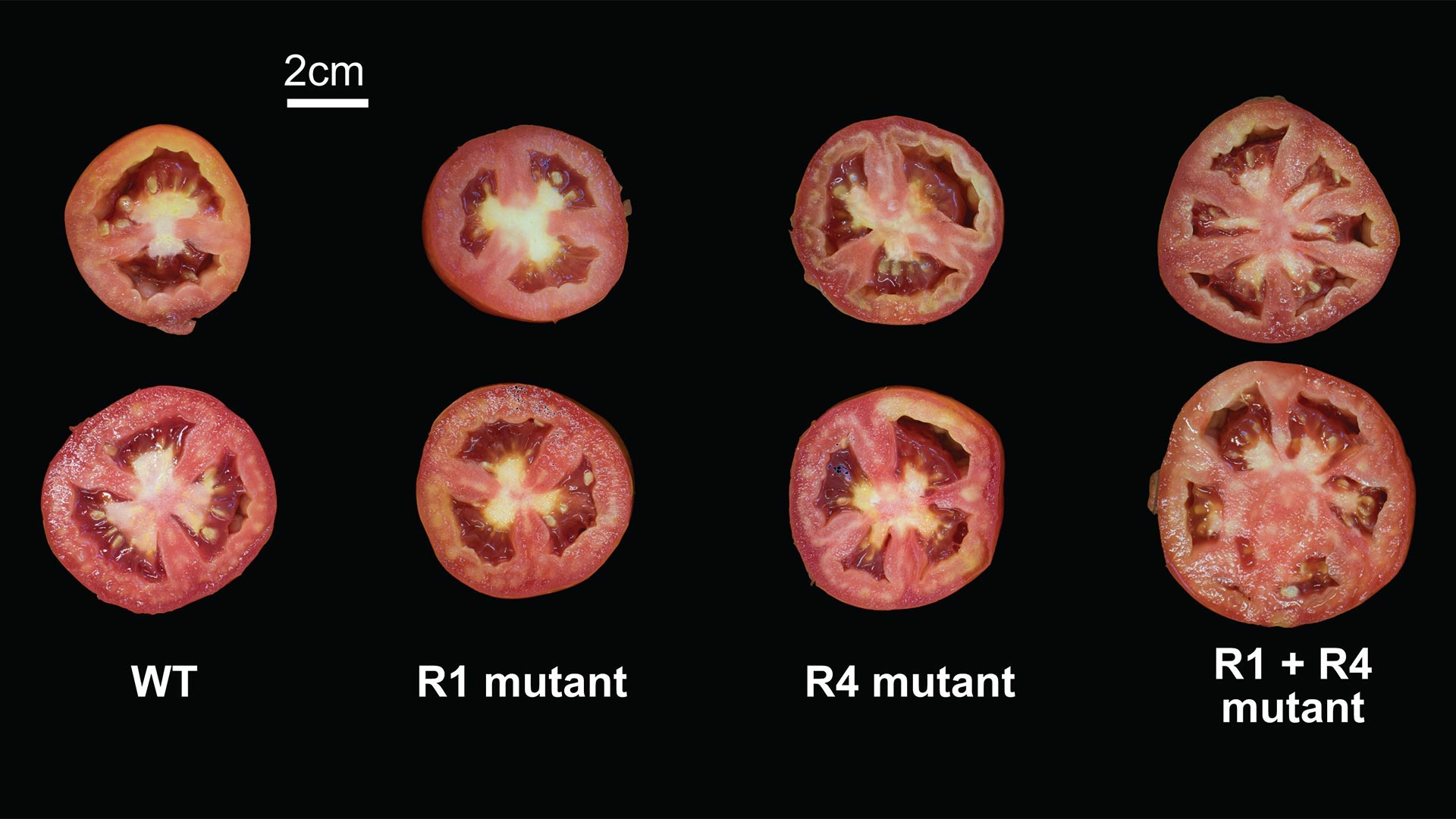
    Different combinations of mutations can affect the size of tomatoes unpredictably. In this image, the first column shows an unmutated (WT) tomato. The second and third columns show tomatoes with a single mutation in a region of the promoter (R1 or R4) for fruit size gene SlCV3. The individual mutations have little effect on fruit size. But the combination of these two mutations (R1 + R4) yields a much bigger fruit. Credit: Xingang Wang/Lippman lab, CSHL/2021

    Tomato mutations impact fruit size in unpredictable ways due to underlying genetic variation. CRISPR experiments reveal the complex interactions that make crop trait prediction difficult but essential for efficient breeding.

    Both people and tomatoes come in different shapes and sizes. That is because every individual has a unique set of genetic variations — mutations — that affect how genes act and function. Added together, millions of small genetic variations make it hard to predict how a particular mutation will impact any individual. Cold Spring Harbor Laboratory (CSHL) Professor and Howard Hughes Medical Institute Investigator Zach Lippman showed how genetic variations in tomatoes can influence the way a specific mutation affects the plant. He is working toward being able to predict the effects of mutations on different tomato varieties.

    In this study, Lippman and his team used CRISPR, a highly accurate and targeted gene-editing tool, on two tomato genes that control fruit size, SlCV3 and SlWUS. They generated over 60 tomato mutants by removing little pieces of DNA in the promoter regions, areas near the genes that control their expression. In some cases, individual mutations increased the size of the tomatoes by a little bit. Some pairs of mutations did not change fruit size at all. A few synergistic combinations caused a dramatic, unpredicted increase in fruit size. Lippman says:

    “The real Holy Grail in all this for crop breeding is predictability. If I mutate this sequence, I’m going to get this effect. Because there is this sea of other variants that nature has accumulated nearby the mutation that you’re engineering, as well as scattered throughout the genome, many of which could be influencing the specific mutation that you’re creating.”

    Mutations and Genetic Background Interactions

    This range of interactions for any two mutations models the consequences of a single mutation occurring in different genetic backgrounds. The effect is comparable to those found in some human diseases, where some people might have certain pre-existing mutations that protect them from disease-causing mutations.

    Lippman and his team will continue quantifying how individual and combined mutations affect certain crop traits. So far, they have measured interactions between two individual mutations, but genomes have millions of variations. Lippman hopes to study enough measurable interactions to make breeding more predictable and efficient.

    Reference: “Dissecting cis-regulatory control of quantitative trait variation in a plant stem cell circuit” by Xingang Wang, Lyndsey Aguirre, Daniel Rodríguez-Leal, Anat Hendelman, Matthias Benoit and Zachary B. Lippman, 12 April 2021, Nature Plants.
    DOI: 10.1038/s41477-021-00898-x

    Never miss a breakthrough: Join the SciTechDaily newsletter.
    Follow us on Google and Google News.

    Agriculture Cold Spring Harbor Laboratory Food Science Genetics Plant Science
    Share. Facebook Twitter Pinterest LinkedIn Email Reddit

    Related Articles

    This Tiny Plant Has Huge Potential for Food, Fuel, and Climate Solutions

    For Plant Geneticists Looking To Improve Crop Yields, Some Genes Are Double the Trouble

    Lychee Genome Tells a Colorful Story About an Ancient Tropical Fruit

    Citrus Mystery: Juicy Past of Favorite Okinawan Fruit Revealed

    New and Improved CRISPR 3.0 System for Highly Efficient Gene Activation in Plants

    Tomato’s Hidden DNA Mutations Revealed in Genetic Study of 100 Varieties

    Possible On/Off Switch for Plant Growth Identified

    New Tomato Ideal for Urban Gardens and Even Outer Space Created Through Genetic Editing

    Plants Harness ‘Bad’ Molecules for Good Ends – Here’s How

    3 Comments

    1. xABBAAA on April 13, 2021 1:20 am

      … I would go for more diverse offspring, rather than big one… Smaller fruits can ripe faster, and if you have more of smaller ones, then you get bigger overall amount of pulp…

      Reply
      • xABBAAA on July 31, 2021 1:22 am

        … by the way, could AI predict the outcome after it has been trained with data…

        Reply
    2. Akhtar Zaman on April 13, 2021 11:05 pm

      Hi!
      I’m from Pakistan.
      Anyone who help me conceptually…
      I’m really so sorry for not to know correctly about mutation… also I mean as a student, what is mutation to getting Botany otherwise…
      I shall be thankful to…

      Regards Akhtar.

      Reply
    Leave A Reply Cancel Reply

    • Facebook
    • Twitter
    • Pinterest
    • YouTube

    Don't Miss a Discovery

    Subscribe for the Latest in Science & Tech!

    Trending News

    Breakthrough Bowel Cancer Trial Leaves Patients Cancer-Free for Nearly 3 Years

    Natural Compound Shows Powerful Potential Against Rheumatoid Arthritis

    100,000-Year-Old Neanderthal Fossils in Poland Reveal Unexpected Genetic Connections

    Simple “Gut Reset” May Prevent Weight Gain After Ozempic or Wegovy

    2.8 Days to Disaster: Scientists Warn Low Earth Orbit Could Suddenly Collapse

    Common Food Compound Shows Surprising Power Against Superbugs

    5 Simple Ways To Remember More and Forget Less

    The Atomic Gap That Could Cost the Semiconductor Industry Billions

    Follow SciTechDaily
    • Facebook
    • Twitter
    • YouTube
    • Pinterest
    • Newsletter
    • RSS
    SciTech News
    • Biology News
    • Chemistry News
    • Earth News
    • Health News
    • Physics News
    • Science News
    • Space News
    • Technology News
    Recent Posts
    • After 37 Years, the World’s Longest-Running Soil Warming Experiment Uncovers a Startling Climate Secret
    • NASA Satellite Captures First-Ever High-Res View of Massive Pacific Tsunami
    • ADHD Isn’t Just a Deficit: Study Reveals Powerful Hidden Strengths
    • Scientists Uncover “Astonishing” Hidden Property of Light
    • Scientists Discover Stem Cells That Could Regrow Teeth and Bone
    Copyright © 1998 - 2026 SciTechDaily. All Rights Reserved.
    • Science News
    • About
    • Contact
    • Editorial Board
    • Privacy Policy
    • Terms of Use

    Type above and press Enter to search. Press Esc to cancel.