
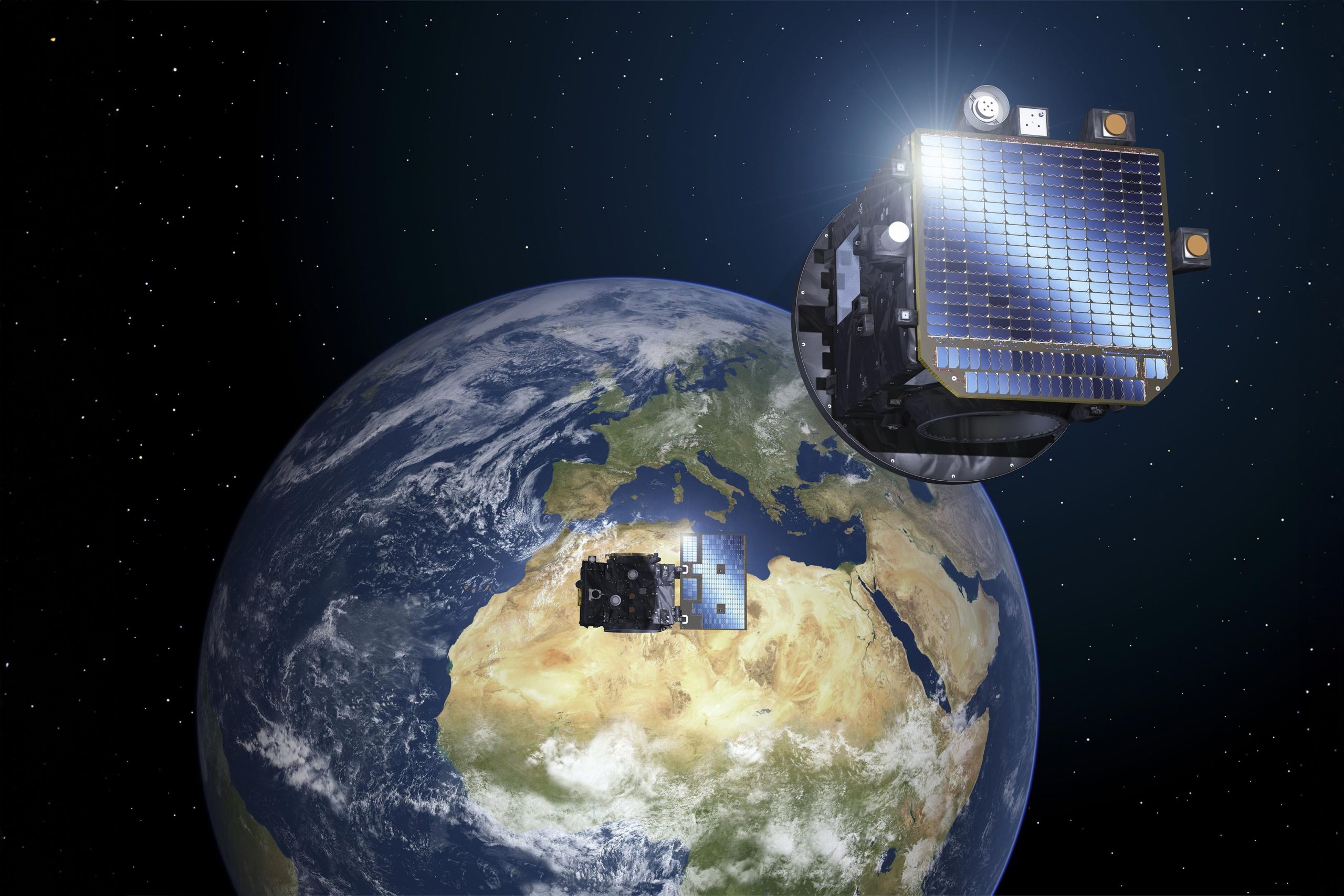
Proba-3 is a groundbreaking mission that relies on the teamwork of two spacecraft to unlock the Sun’s secrets.
While the Coronagraph spacecraft captures the faint glow of the Sun’s outer atmosphere, the Occulter spacecraft acts as a shield, blocking the intense light of the solar disk. But the Occulter does more than just assist; it becomes a science platform of its own, housing an innovative instrument to continuously measure the Sun’s total energy output.
Proba-3 is an extraordinary mission that requires two spacecraft working in tandem to succeed. The Coronagraph spacecraft is tasked with observing the Sun’s faint outer atmosphere, but to do so, its partner, the disk-bearing Occulter spacecraft, must precisely block the Sun’s intense light. This setup results in the Occulter constantly facing the Sun, turning it into a valuable scientific platform in its own right.

On the Sun-facing side of the Occulter, a specialized instrument is installed to continuously measure the Sun’s total energy output, known as total solar irradiance. This measurement is a crucial factor for understanding Earth’s climate, as it represents the dominant energy input to our planet.
The mission’s instrument for this task, the shoebox-sized Davos Absolute Radiometer (DARA), was developed and provided by the Physical Meteorological Observatory Davos (PMOD) in Switzerland.

“Researchers used to talk about the ‘solar constant’ but in fact it is always changing slightly,” explains Wolfgang Finsterle, DARA Principal Investigator at PMOD. “And it’s essential to keep track of the total solar irradiance, because it is the dominant energy input to the surface of the Earth. It amounts to something like 99.978% of the energy available on Earth, including the conserved solar energy stored in coal and oil. It drives all the dynamic processes of Earth’s climate, so even the tiniest variations are hugely significant.”
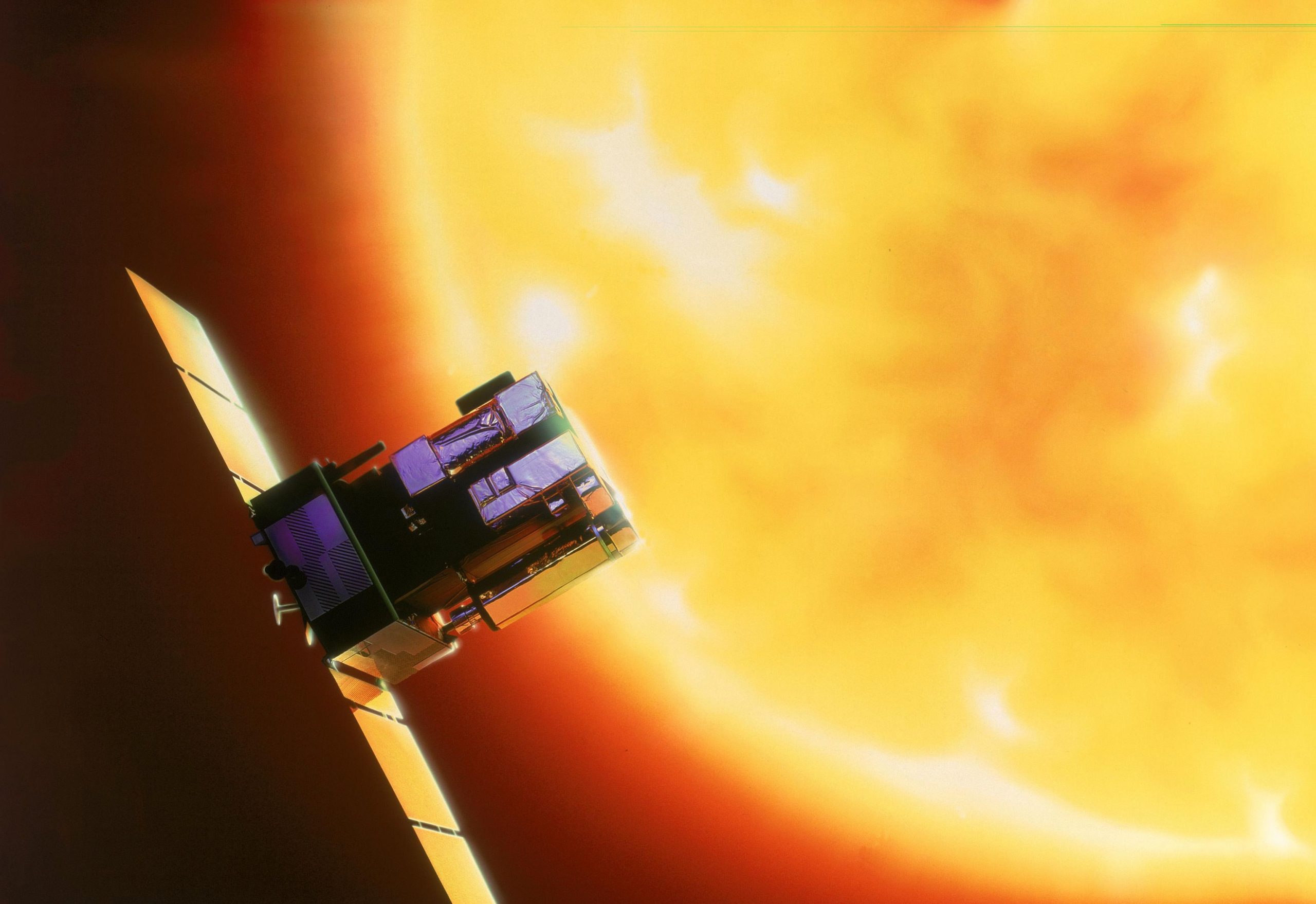
The mountain-based PMOD has been studying total solar irradiance for more than a century, initially with ground-based instruments and then from the 1970s deploying space-based radiometers to acquire a continuous dataset. The World Meteorological Organization has mandated PMOD as the World Radiation Centre to calibrate radiation measurements across global UN monitoring programs.
Wolfgang adds: “Total solar irradiance varies along with the 11-year cycle of solar activity, and one of the most obvious ways to look for long-term energy drift is to compare total solar irradiance between consecutive solar minima.

“This requires a long time-series of data, ideally coming from multiple instruments because single radiometers will undergo degradation in sensitivity from the hard ultraviolet in the Sun’s rays they are continuously exposed to. That said any degradation is very gradual: the radiometer aboard the ESA-NASA SOHO solar observatory for instance, which was launched in back 1995, is still working satisfactorily.”
DARA’s basic operating principle is simple. The radiometer possesses a 5-mm diameter cavity made from black-painted silver, possessing low-temperature emissivity. For 15 seconds at a time, sunlight warms the interior of the cavity, then a shutter blade automatically closes at its entrance.

For the next 15 seconds electric heat maintains the cavity’s previous temperature – and the energy needed to maintain this temperature is extrapolated to the unit of total solar irradiance which is watts per metre squared.
This process continues for the entire lifetime of the instrument – the actuated shutter design employed in DARA has been tested for millions of opening and closings in PMOD’s vacuum chamber.

“DARA is an improvement on previous radiometer designs with an optimized cavity design to minimize unwanted stray light and a multi-channel measuring system for self-calibration,” adds Wolfgang. “This generation of instrument also possesses a fully digital control loop, allowing the possibility of experimenting with higher frequency observations.
Two versions of this radiometer design have already flown, notes Werner Schmutz of PMOD, who oversaw its development: “A compact version called CLARA flew on Noway’s NorSat-1 CubeSat in 2017, remaining operational to this day, while a previous DARA is serving aboard the Chinese FY-3E weather satellite, launched in 2021. So we have high confidence in the design, which can operate whenever the Proba-3 Occulter is pointed at the Sun within half a degree of accuracy.”
The main difference between Proba-3’s DARA and previous radiometers will be its very elongated orbit, which will carry it 60,000 km above Earth’s surface. DARA can automatically adjust to slight changes in the size of the solar disk based on how far it is away – which are also due to Earth’s yearly elliptical orbit around the Sun. All the radiometer needs to know is its position in space and its data gathering compensates for the shift.
Never miss a breakthrough: Join the SciTechDaily newsletter.
Follow us on Google and Google News.