
Close Menu
    Facebook X (Twitter) Instagram
    SciTechDaily
    • Biology
    • Chemistry
    • Earth
    • Health
    • Physics
    • Science
    • Space
    • Technology
    Facebook X (Twitter) Pinterest YouTube RSS
    SciTechDaily
    Home»Space»Rare Solar Eruptions Explode From the Sun in New Space Time Lapse
    Space

    Rare Solar Eruptions Explode From the Sun in New Space Time Lapse

    By European Space Agency (ESA)January 24, 2026No Comments3 Mins Read
    Facebook Twitter Pinterest Telegram LinkedIn WhatsApp Email Reddit
    Share
    Facebook Twitter LinkedIn Pinterest Telegram Email Reddit
    Proba-3 Occulter Eclipsing Sun for Coronagraph Spacecraft
    The two spacecraft of Proba-3 fly in precise formation about 150 m apart to form an external coronagraph in space, one spacecraft eclipsing the Sun to allow the second to study the otherwise invisible solar corona. Credit: ESA-P. Carril

    A new time-lapse reveals the Sun’s inner corona glowing a faint yellow, offering a rare look at the hottest layer of our star’s atmosphere. The footage was created using images from the ASPIICS coronagraph aboard Proba-3, capturing a region of the Sun that is normally hidden from view.

    How Proba-3 Creates Solar Eclipses in Space

    Proba-3 is a European Space Agency mission made up of two spacecraft that fly in extremely precise formation. By aligning perfectly in orbit, the pair can block the Sun’s bright surface and create artificial solar eclipses, allowing scientists to observe the Sun’s inner corona directly.

    The animation combines observations from two space instruments. Proba-3’s ASPIICS coronagraph shows the inner solar corona in yellow, while NASA’s Solar Dynamics Observatory provides images of the solar disc in dark orange using its Atmospheric Imaging Assembly (AIA).
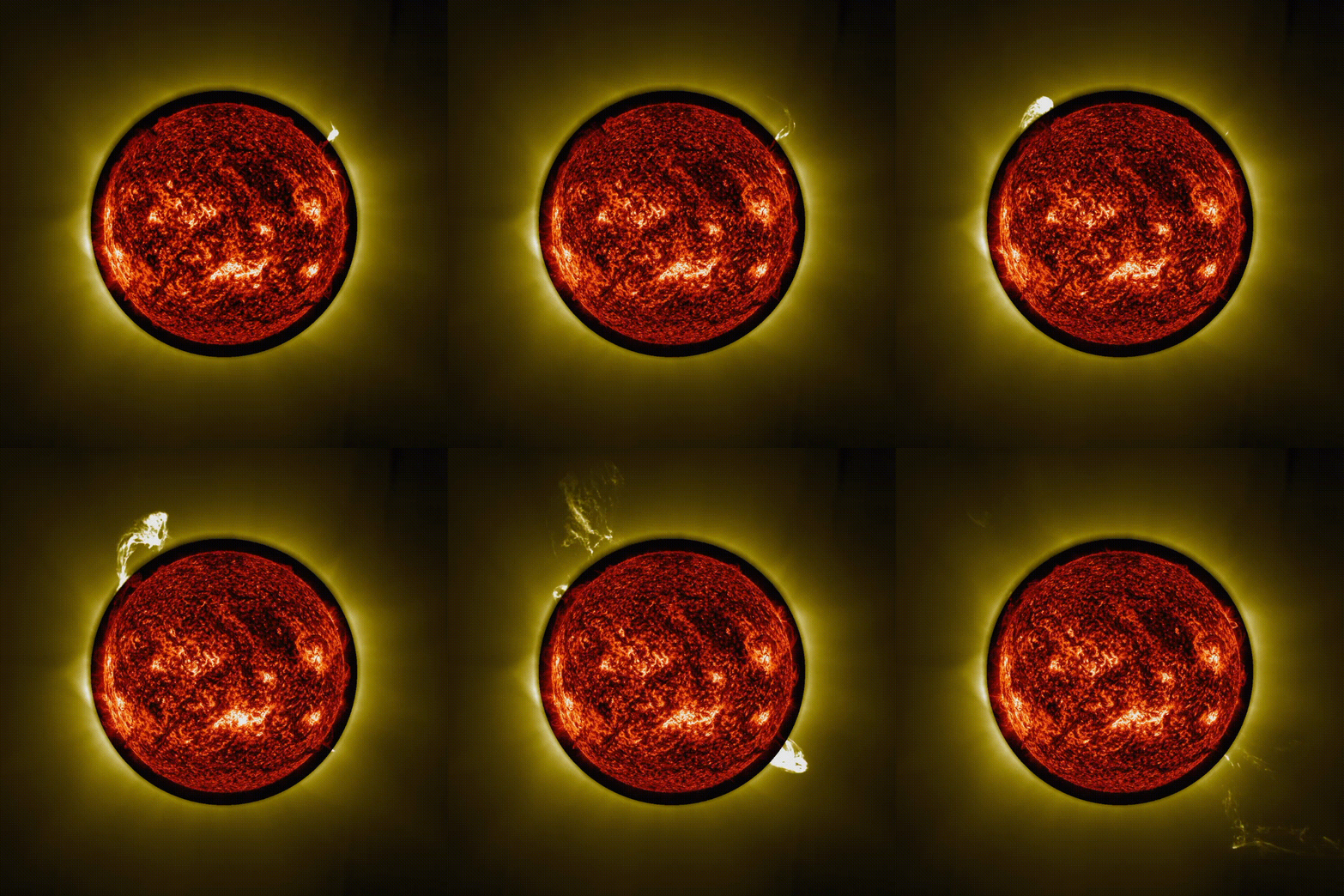
    Proba-3 Sun's Inner Corona
    This animation combines data from Proba-3’s ASPIICS coronagraph (inner solar corona in yellow) and from the Atmospheric Imaging Assembly (AIA) aboard NASA’s Solar Dynamics Observatory (solar disc in dark orange). Credit: ESA/Proba-3/ASPIICS, NASA/SDO/AIA

    Extreme Heat and Cooler Structures Near the Sun

    “The corona is extremely hot, about two hundred times hotter than the Sun’s surface,” explains Andrei Zhukov from the Royal Observatory of Belgium, Principal Investigator for ASPIICS.

    “Sometimes, structures made of relatively cold plasma (charged gas) are observed near the Sun – although these are still around 10,000 degrees Celsius, they are much colder than the surrounding million-degree hot corona – creating what we call ‘a prominence’.”

    These prominences are made of dense plasma suspended above the Sun’s surface. Over time, they can stretch outward, break apart, and erupt, sending solar material flying into space in multiple directions.

    A Rare Burst of Solar Activity Captured

    The time-lapse was recorded during a particularly active phase on 21 September 2025. ASPIICS captured one image every five minutes, documenting three separate prominence eruptions within just five hours.

    “Seeing so many prominence eruptions in such a short timeframe is rare, so I’m very happy we managed to capture them so clearly during our observation window,” adds Andrei.

    Seeing the Sun Through Different Filters

    ASPIICS studies the solar corona using several filters, including two distinct ‘spectral lines’. Each spectral line corresponds to a specific chemical element present in the Sun’s atmosphere.

    The prominence eruptions in this animation were recorded using a spectral line emitted by helium atoms. This allows the solar atmosphere to appear much like it would to the human eye during a total solar eclipse when viewed through a yellow ASPIICS filter. The AIA image also shows helium emission, but in a different spectral line.

    Why the Corona Glows Yellow

    The faint yellow background glow seen in the corona comes from visible sunlight scattering off electrons in the Sun’s outer atmosphere. This subtle light reveals the structure of the corona even when no eruptions are taking place.

    Completing a Missing Piece of Solar Observation

    Advanced onboard positioning systems allow the two Proba-3 spacecraft to maintain their precise alignment and repeatedly generate eclipses in orbit. This capability lets scientists observe the innermost portion of the Sun’s corona consistently for the first time, filling a long-standing gap in solar research and offering new insight into how our star behaves.

    Never miss a breakthrough: Join the SciTechDaily newsletter.
    Follow us on Google and Google News.

    Astronomy European Space Agency Proba-3 Sun
    Share. Facebook Twitter Pinterest LinkedIn Email Reddit

    Related Articles

    ESA Just Faked a Solar Eclipse – And Caught the Sun’s Hidden Halo

    Solar Eclipses on Demand: Proba-3’s Precision Satellites Enter Orbit

    Behind the Cosmic Veil: Proba-3’s Pioneering Solar Eclipse Technology

    Massive Solar Eruption Captured by Solar Orbiter Spacecraft

    Solar Orbiter Has Already Made a Wealth of Science Discoveries

    First Light From Sun-Watching Sunstorm CubeSat

    Science Made Simple: Anatomy of Our Sun

    “Campfires” on the Sun Offer Clue to Solar Heating Mystery

    Dancing With the Stars: Corridor Test of Proba-3’s Formation Flying Sensors

    Leave A Reply Cancel Reply

    • Facebook
    • Twitter
    • Pinterest
    • YouTube

    Don't Miss a Discovery

    Subscribe for the Latest in Science & Tech!

    Trending News

    Popular Supplement Ingredient Linked to Shorter Lifespan in Men

    Scientists May Have Found a Way To Repair Nerve Damage in Multiple Sclerosis

    “Totally Unexpected” – Scientists Discover Pancreatic Cancer’s Fatal Addiction

    A Strange Quantum Effect May Explain One of Biology’s Greatest Mysteries

    James Webb Telescope Reveals the Universe’s Hidden Cosmic Web in Stunning Detail

    Scientists Identify Simple Supplement That Greatly Reduces Alzheimer’s Damage

    You May Have a Dangerous Type of Cholesterol Even if Your Tests Look Normal

    Your Blood Pressure Reading Could Be Wrong Because of One Simple Mistake

    Follow SciTechDaily
    • Facebook
    • Twitter
    • YouTube
    • Pinterest
    • Newsletter
    • RSS
    SciTech News
    • Biology News
    • Chemistry News
    • Earth News
    • Health News
    • Physics News
    • Science News
    • Space News
    • Technology News
    Recent Posts
    • New Research Reveals Certain Fats Can Either Trigger or Suppress Cancer
    • After 50 Years of Mystery, Researchers Identify New Human Blood Group
    • Leading Climate Scientist Rebuts “Factually Incorrect” US Government Climate Claims
    • You’re Breathing Plastic: Study Finds 4% of City Air Pollution Is Microplastics
    • Cancer Mystery Solved: Scientists Discover How Melanoma Becomes “Immortal”
    Copyright © 1998 - 2026 SciTechDaily. All Rights Reserved.
    • Science News
    • About
    • Contact
    • Editorial Board
    • Privacy Policy
    • Terms of Use

    Type above and press Enter to search. Press Esc to cancel.