

ESA’s Proba-3 mission has achieved a spacefaring marvel: two satellites flying in perfect formation to mimic total solar eclipses on demand.
Their first artificial eclipse delivered breathtaking images of the Sun’s outer atmosphere, offering scientists an unprecedented glimpse into the solar corona. These images not only deepen our understanding of solar storms and coronal mysteries but also prove the viability of autonomous formation flying.
Proba-3 Unveils First Solar Corona Images
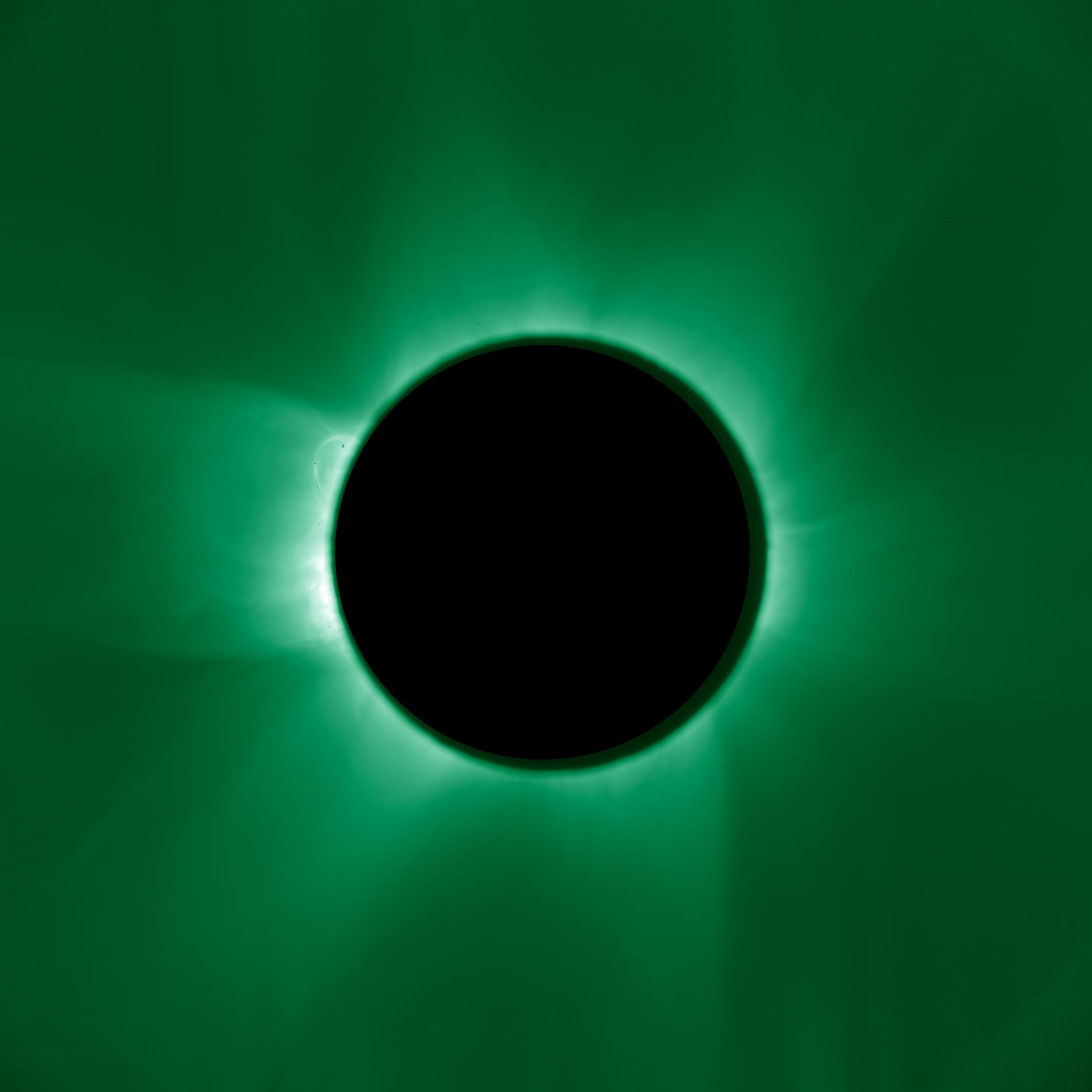
On June 16, the European Space Agency’s Proba-3 mission revealed something truly spectacular: its very first images of the Sun’s outer atmosphere, known as the solar corona. Using two synchronized satellites flying in perfect harmony, the mission created an artificial total solar eclipse in space—no Moon required. This breakthrough not only produced stunning images, but also delivered valuable scientific data that could deepen our understanding of the Sun and its strange, super-hot atmosphere.

This image, captured in the visible light spectrum, shows the solar corona similarly to how a human eye would see it during an eclipse through a green filter. The hair-like structures were revealed using a specialised image processing algorithm. Credit: ESA/Proba-3/ASPIICS/WOW algorithm
Flying in Perfect Synchrony
Back in March, Proba-3 pulled off a world first. Its two satellites, named the Coronagraph and the Occulter, flew in flawless formation just 150 meters apart. Even more impressive, they did it entirely without help from ground controllers.
Thanks to advanced navigation technology, the satellites kept their positions aligned with millimeter-level precision. While flying in this exact configuration, they blocked the Sun’s bright center by aligning a circular disc on the Occulter spacecraft in front of the Sun—creating a small but powerful shadow.
That tiny shadow, only 8 centimeters wide, landed directly on an instrument aboard the Coronagraph satellite called ASPIICS. This device, designed to study the Sun’s corona in fine detail, was developed by a European team led by the Centre Spatial de Liège in Belgium. When the shadow hits just right, ASPIICS is able to image the faint outer glow of the Sun without interference from the blinding central light.

Peering Into the Sun’s Wind and Storms
Observing the corona is crucial for revealing solar wind, the continuous flow of matter from the Sun into outer space. It is also necessary for understanding the workings of coronal mass ejections (CMEs), explosions of particles sent out by the Sun almost every day, especially during high activity periods.
Such events can create stunning auroras in the night sky but also pose serious threats to modern technology. They can significantly disrupt communications, power transmission, and navigation systems on Earth, as they did in May 2024.
The coronal images resulting from the first rounds of ASPIICS’s observations offer a glimpse of the valuable data we can expect from this eclipse-making mission.
Dietmar Pilz, ESA Director of Technology, Engineering and Quality, comments: “Many of the technologies which allowed Proba-3 to perform precise formation flying have been developed through ESA’s General Support Technology Programme, as has the mission itself. It is exciting to see these stunning images validate our technologies in what is now the world’s first precision formation flying mission.”
The Sun’s Mysterious Million-Degree Halo
The Sun’s fiery corona reaches temperatures above a million degrees Celsius, much hotter than the surface beneath it. This counterintuitive temperature difference has long been a topic in the scientific community.
Proba-3’s ASPIICS is tackling this mystery by studying the corona very close to the Sun’s surface. It can also see more detail, detecting fainter features than traditional coronagraphs thanks to a drastic reduction in how much ‘stray’ light reaches the detector.
Joe Zender, Proba-3 project scientist, adds: “Seeing the first data from ASPIICS is incredibly exciting. Together with the measurements made by another instrument on board, DARA, ASPIICS will contribute to unravelling long-lasting questions about our home star.”
The Digital Absolute Radiometer (DARA) will measure the total solar irradiance – exactly how much energy the Sun is putting out at any one time. A third scientific instrument on Proba-3, the 3D Energetic Electron Spectrometer (3DEES), will detect electrons in Earth’s radiation belts, measuring their direction of origin and energy levels.

Building a Six-Hour Eclipse in Orbit
“I was absolutely thrilled to see the images, especially since we got them on the first try,” comments Andrei Zhukov, Principal Investigator for ASPIICS at the Royal Observatory of Belgium. “Now we are working on extending the observation time to six hours in every orbit.”
The images were processed by the ASPIICS Science Operations Centre (SOC) hosted by the Royal Observatory of Belgium. Here, a dedicated team of scientists and engineers creates operational commands for the coronagraph based on requests from the scientific community and shares the resulting observations.
Andrei explains: “Each full image – covering the area from the occulted Sun all the way to the edge of the field of view – is actually constructed from three images. The difference between those is only the exposure time, which determines how long the coronagraph’s aperture is exposed to light. Combining the three images gives us the full view of the corona.
“Our ‘artificial eclipse’ images are comparable with those taken during a natural eclipse. The difference is that we can create our eclipse once every 19.6-hour orbit, while total solar eclipses only occur naturally around once, very rarely twice a year. On top of that, natural total eclipses only last a few minutes, while Proba-3 can hold its artificial eclipse for up to 6 hours.”

Precision Formation and Mission Autonomy
Proba-3 mission manager Damien Galano notes: “Having two spacecraft form one giant coronagraph in space allowed us to capture the inner corona with very low levels of stray light in our observations, exactly as we expected.
“Although we are still in the commissioning phase, we have already achieved precise formation flying with unprecedented accuracy. This is what allowed us to capture the mission’s first images, which will no doubt be of high value to the scientific community.
“The formation flying we have achieved so far was performed autonomously, but under supervision of the ground control team, who were ready to intervene to correct any potential deviations. Our one remaining task is to achieve full autonomy, when our confidence in the system will be such that we will not even routinely monitor from the ground.”

Feeding the Solar Simulation Revolution
Proba-3’s breathtaking images are also sparking a small revolution in the way computer models simulate the solar corona and create ‘digital eclipses’.
Over the past years, several institutes around Europe have developed models to simulate these observations and give scientists the means to look at the Sun, but the source material needed to create these simulations is lacking.
“Current coronagraphs are no match for Proba-3, which will observe the Sun’s corona down almost to the edge of the solar surface. So far, this was only possible during natural solar eclipses,” says Jorge Amaya, Space Weather Modelling Coordinator at ESA.

“This huge flow of observations will help refine computer models further as we compare and adjust variables to match the real images. Together with the team at KU Leuven, which is behind one such model, we have been able to create a simulation of Proba-3’s first observations.”
KU Leuven’s ‘COCONUT’ software is one of multiple solar coronal models integrated within ESA’s Virtual Space Weather Modelling Centre (VSWMC). It can be combined with a vast array of computer models describing other physical processes connecting the Sun to Earth. All together, they help to offer a comprehensive image of the solar phenomena impacting our planet and help citizens and industry prepare against them.
About Proba-3
Proba-3 is a pioneering mission led by the European Space Agency (ESA), designed to study the Sun’s outer atmosphere with unprecedented precision. It consists of two spacecraft flying in ultra-precise formation to create artificial solar eclipses in orbit, allowing scientists to observe the Sun’s elusive corona without the blinding glare of its central disk.
Launched on December 5, 2024, aboard a PSLV-XL rocket from the Satish Dhawan Space Centre in Sriharikota, India, Proba-3 is the result of a major international collaboration. The mission is managed by Sener in Spain and involves more than 29 companies from 14 countries. Key partners include GMV and Airbus Defence and Space in Spain, as well as Redwire Space and Spacebel in Belgium.
This ambitious project not only advances our understanding of solar physics but also showcases cutting-edge technology in autonomous formation flying and space-based coronagraphy.
Never miss a breakthrough: Join the SciTechDaily newsletter.
Follow us on Google and Google News.