
Space scientists and sky-watchers were treated to a stunning display of the northern lights.
The strongest geomagnetic storm in over 20 years occurred in May 2024, resulting in stunning worldwide displays of the aurora borealis. Captured by satellite and ground-based photographers, these events have provided critical data for scientific studies and have marked a significant period of increasing solar activity.
In May 2024, the strongest geomagnetic storm in over two decades dazzled scientists and skywatchers alike. The G5 storm culminated in a remarkable display of the aurora borealis overnight on May 10-11, visible from many areas worldwide, including latitudes where sightings of auroras are uncommon.
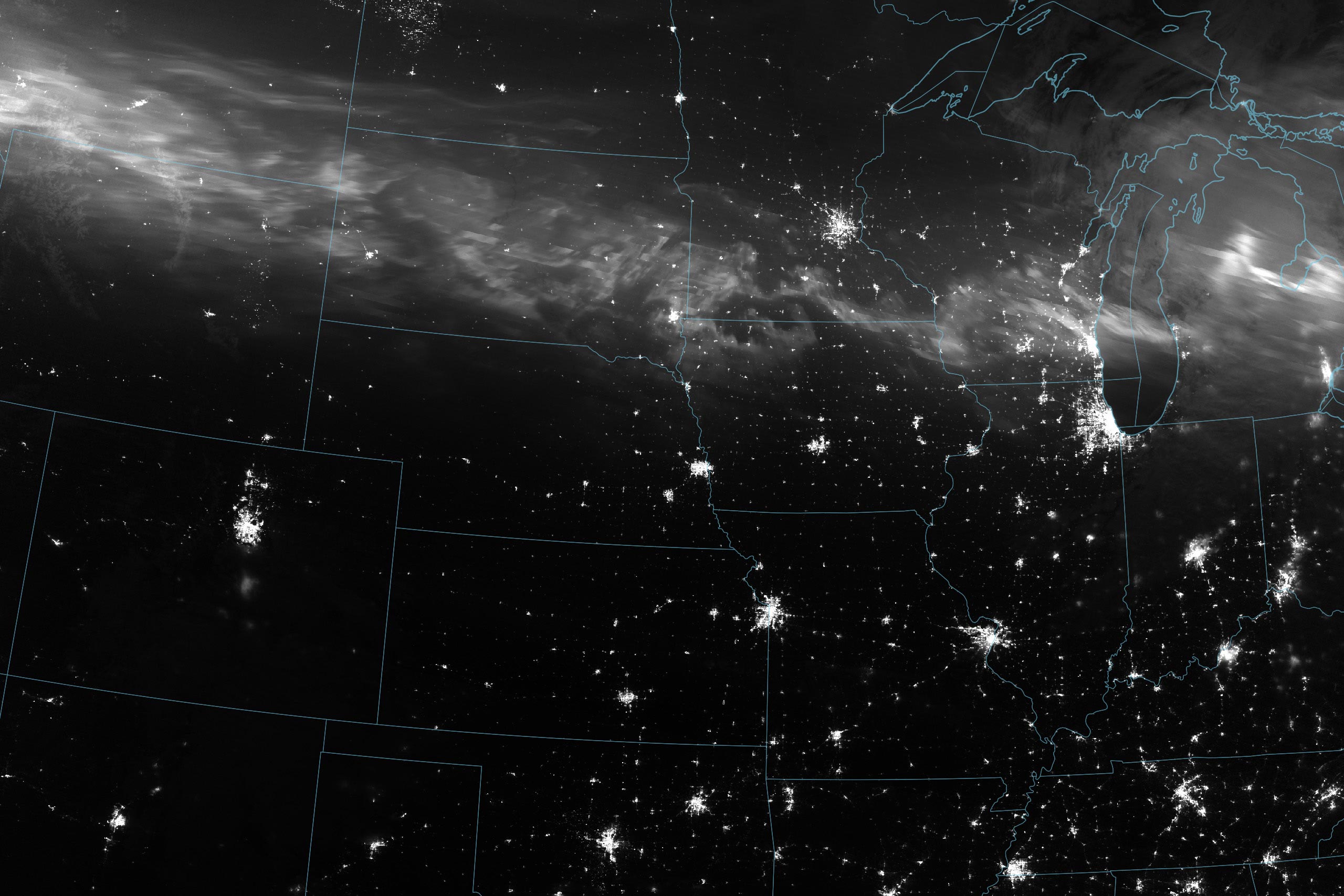
The VIIRS (Visible Infrared Imaging Radiometer Suite) on the Suomi NPP satellite acquired this image of the aurora at 3:20 a.m. Central Time (08:20 Universal Time) on May 11, 2024. The VIIRS day-night band detects nighttime light in a range of wavelengths from green to near-infrared and uses filtering techniques to observe signals such as city lights, reflected moonlight, and auroras.
> See Photos: Stunning Aurora Light Up the Night During Epic Geomagnetic Storm
In this view, the northern lights appear as a bright white strip across parts of Montana, Wyoming, the Dakotas, Minnesota, Wisconsin, Iowa, and Michigan. But auroras are dynamic, and different coverage and patterns of light would have been visible at other times of the night. And while these satellite data are shown in grayscale, viewers on the ground saw colors from green (the most common) to purple to red. An aurora’s color is influenced by atmospheric compounds found at different altitudes.
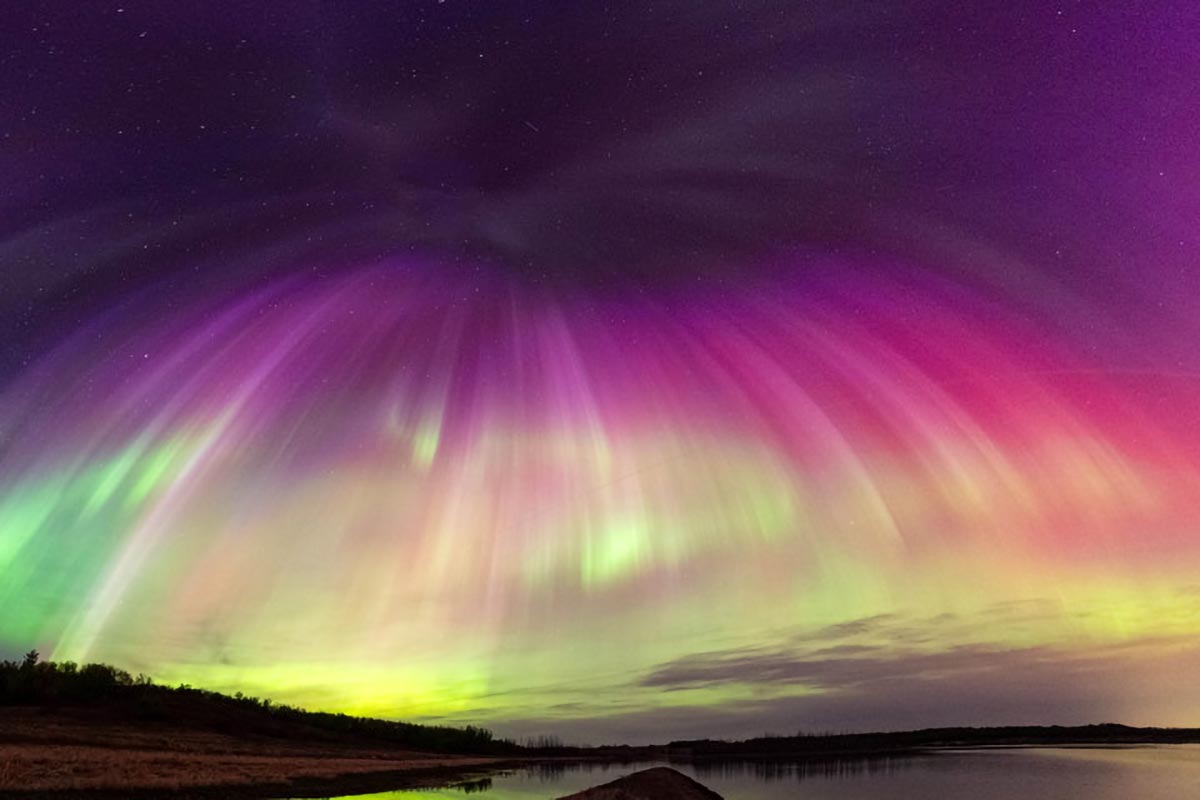
Photographers and aurora chasers captured the striking range of colors in ground-based photos, some of which they shared with NASA’s Aurorasaurus project. The citizen science effort crowdsources eyewitness accounts that scientists can then use to verify, or ground truth, models of where the aurora will be visible from the ground. Auroras occur high in the atmosphere, so observers on the ground can potentially witness them from very far away.
Aurorasaurus launched in 2014 around the time of the last solar maximum—the middle of an approximately 11-year cycle when the Sun is most active and produces more sunspots, flares, and coronal mass ejections. Data collected by citizen scientists were highly useful, but the 2014–2015 solar maximum turned out to be relatively “wimpy,” noted Liz MacDonald, a space scientist at NASA’s Goddard Space Flight Center and lead of Aurorasaurus. When auroras did light up the sky, most smartphones could not capture them.
Ten years later, the Sun’s activity has been ramping up again, around the middle of the ongoing solar cycle 25. Photos acquired on May 10–11 show aurora associated with what NOAA called the most extreme geomagnetic storm since 2003. The image above, shot by Aurorasaurus ambassador Gunjan Sinha, shows the sky on May 11, looking south from near Saskatoon in Saskatchewan, Canada.
“This event was really the pinnacle of our vision for the program,” MacDonald said. “Large storms visible this far south are so rare, and we have few chances to study them. Photos from citizen scientists can help us with that.”
NASA Earth Observatory image by Wanmei Liang, using VIIRS day-night band data from the Suomi National Polar-orbiting Partnership. Photo by Gunjan Sinha. Story by Kathryn Hansen.
Never miss a breakthrough: Join the SciTechDaily newsletter.
Follow us on Google and Google News.
3 Comments
You would think science Tech Daily would acknowledge the Souther lights too. Not just Aurora Borealis.
We should put a reflective ring orbiting around the earth for extra protection along with the ozone layer since these events in the past have taken out star link satalites.
Thank you for the report !