
Close Menu
    Facebook X (Twitter) Instagram
    SciTechDaily
    • Biology
    • Chemistry
    • Earth
    • Health
    • Physics
    • Science
    • Space
    • Technology
    Facebook X (Twitter) Pinterest YouTube RSS
    SciTechDaily
    Home»Space»Probing Deeper Into the Origins of Cosmic Rays With Geometric Brownian Motion
    Space

    Probing Deeper Into the Origins of Cosmic Rays With Geometric Brownian Motion

    By American Institute of PhysicsJune 20, 2021No Comments3 Mins Read
    Facebook Twitter Pinterest Telegram LinkedIn WhatsApp Email Reddit
    Share
    Facebook Twitter LinkedIn Pinterest Telegram Email Reddit
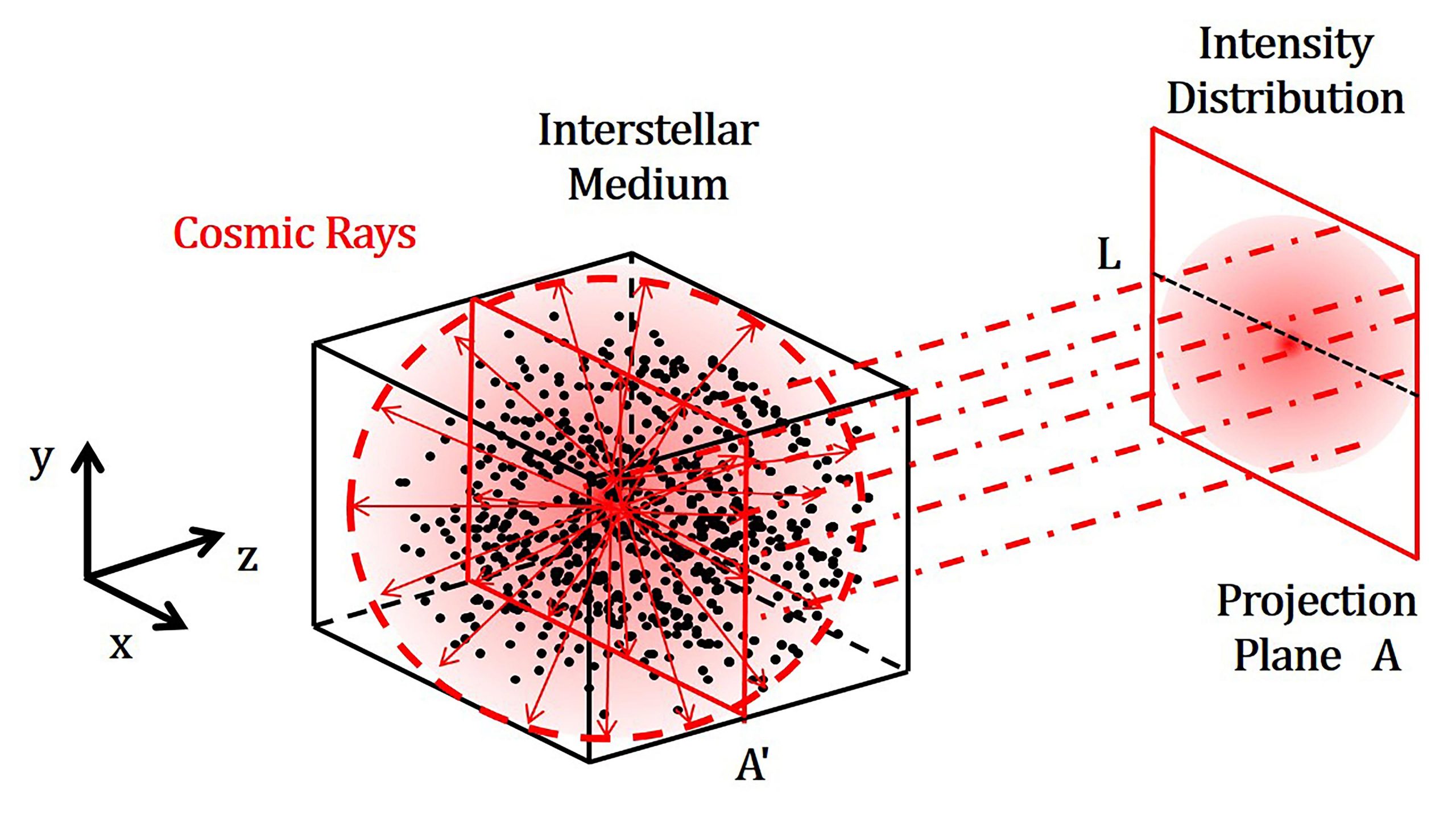
    Cosmic Rays Propagating Through Magnetic Clouds
    Schematic representation of cosmic rays propagating through magnetic clouds. Credit: Salvatore Buonocore

    Simulation model provides first step in developing algorithms to enhance detection methods.

    Cosmic rays are high-energy atomic particles continually bombarding Earth’s surface at nearly the speed of light. Our planet’s magnetic field shields the surface from most of the radiation generated by these particles. Still, cosmic rays can cause electronic malfunctions and are the leading concern in planning for space missions.

    Researchers know cosmic rays originate from the multitude of stars in the Milky Way, including our sun, and other galaxies. The difficulty is tracing the particles to specific sources, because the turbulence of interstellar gas, plasma, and dust causes them to scatter and rescatter in different directions.

    In AIP Advances, by AIP Publishing, University of Notre Dame researchers developed a simulation model to better understand these and other cosmic ray transport characteristics, with the goal of developing algorithms to enhance existing detection techniques.

    Brownian motion theory is generally employed to study cosmic ray trajectories. Much like the random motion of pollen particles in a pond, collisions between cosmic rays within fluctuating magnetic fields cause the particles to propel in different directions.

    But this classic diffusion approach does not adequately address the different propagation rates affected by diverse interstellar environments and long spells of cosmic voids. Particles can become trapped for a time in magnetic fields, which slow them down, while others are thrust into higher speeds through star explosions.

    A New Approach: Stochastic Scattering Simulation

    To address the complex nature of cosmic ray travel, the researchers use a stochastic scattering model, a collection of random variables that evolve over time. The model is based on geometric Brownian motion, a classic diffusion theory combined with a slight trajectory drift in one direction.

    In their first experiment, they simulated cosmic rays moving through interstellar space and interacting with localized magnetized clouds, represented as tubes. The rays travel undisturbed over a long period of time. They are interrupted by chaotic interaction with the magnetized clouds, resulting in some rays reemitting in random directions and others remaining trapped.

    Monte Carlo Analysis Reveals Superdiffusive Behavior

    Monte Carlo numerical analysis, based on repeated random sampling, revealed ranges of density and reemission strengths of the interstellar magnetic clouds, leading to skewed, or heavy-tailed, distributions of the propagating cosmic rays.

    The analysis denotes marked superdiffusive behavior. The model’s predictions agree well with known transport properties in complex interstellar media.

    “Our model provides valuable insights on the nature of complex environments crossed by cosmic rays and could help advance current detection techniques,” author Salvatore Buonocore said.

    Reference: “Anomalous diffusion of cosmic rays: A geometric approach” by Salvatore Buonocore and Mihir Sen, 25 May 2021, AIP Advances.
    DOI: 10.1063/5.0049401

    Never miss a breakthrough: Join the SciTechDaily newsletter.
    Follow us on Google and Google News.

    American Institute of Physics Astrophysics
    Share. Facebook Twitter Pinterest LinkedIn Email Reddit

    Related Articles

    Simulating Supernova Remnants and Star Formation With a High-Power Laser in Earthbound Lab

    Physicist Quantifies Amount of Information in Entire Visible Universe

    Cosmic Rays – Originating From Supernova Remnants and Pulsars – May Be Key to Understanding Galactic Dynamics

    Space Chemistry Billions of Years Ago: Polymers in Meteorites Provide Clues to Early Solar System

    VENUS Apparatus: Device Mimics Life’s First Steps in Outer Space

    Researchers Develop New Technique to Forecast Geomagnetic Storms

    3D Model Provides New Insight into the Turbulent Death Throes of Supernovas

    Black Hole Fires Cosmic Bullets of Ionized Gases

    Hubble Observes Rare Blue Stars in Andromeda’s Core

    Leave A Reply Cancel Reply

    • Facebook
    • Twitter
    • Pinterest
    • YouTube

    Don't Miss a Discovery

    Subscribe for the Latest in Science & Tech!

    Trending News

    New Study Reveals Why Ozempic Works Better for Some People Than Others

    Climate Change Is Altering a Key Greenhouse Gas in a Way Scientists Didn’t Expect

    New Study Suggests Gravitational Waves May Have Created Dark Matter

    Scientists Discover Why the Brain Gets Stuck in Schizophrenia

    Scientists Engineer “Tumor-Eating” Bacteria That Devour Cancer From Within

    Even “Failed” Diets May Deliver Long-Term Health Gains, Study Finds

    NIH Scientists Discover Powerful New Opioid That Relieves Pain Without Dangerous Side Effects

    Collapsing Plasma May Hold the Key to Cosmic Magnetism

    Follow SciTechDaily
    • Facebook
    • Twitter
    • YouTube
    • Pinterest
    • Newsletter
    • RSS
    SciTech News
    • Biology News
    • Chemistry News
    • Earth News
    • Health News
    • Physics News
    • Science News
    • Space News
    • Technology News
    Recent Posts
    • New Research Challenges 30-Year-Old Theory of Eye Development
    • The Protein “Sabotaging” Aging Muscle Recovery Could Be Key to Surviving Aging
    • This Diet–Gut Interaction Could Transform Fat Into a Calorie-Burning Machine
    • Why Some People Reach 100: New Study Reveals Key Biological Differences
    • This Is How Ovarian Cancer Spreads Before Doctors Can Detect
    Copyright © 1998 - 2026 SciTechDaily. All Rights Reserved.
    • Science News
    • About
    • Contact
    • Editorial Board
    • Privacy Policy
    • Terms of Use

    Type above and press Enter to search. Press Esc to cancel.