
New research shows without a doubt that white dwarf stars can reignite and explode as supernovae.
Astronomers using ESA’s Integral gamma-ray observatory have demonstrated beyond doubt that dead stars known as white dwarfs can reignite and explode as supernovae. The finding came after the unique signature of gamma rays from the radioactive elements created in one of these explosions was captured for the first time.
The explosions in question are known as Type Ia supernovae, long suspected to be the result of a white dwarf star blowing up because of a disruptive interaction with a companion star. However, astronomers have lacked definitive evidence that a white dwarf was involved until now. The ‘smoking gun’ in this case was evidence of radioactive nuclei being created by fusion during the thermonuclear explosion of the white dwarf star.
“Integral has all the capabilities to detect the signature of this fusion, but we had to wait for more than ten years for a once-in-a-lifetime opportunity to catch a nearby supernova,” says Eugene Churazov, from the Space Research Institute (IKI) in Moscow, Russia and the Max Planck Institute for Astrophysics, in Garching, Germany.
Although Type Ia supernovae are expected to occur frequently across the Universe they are rare occurrences in any one galaxy, with typical rates of one every few hundred years.
Integral’s chance came on 21 January 2014, when students at the University College London’s teaching observatory at Mill Hill, UK, detected a type Ia supernova, later named SN2014J, in the nearby galaxy M82.
According to the theory of such explosions, the carbon and oxygen found in a white dwarf should be fused into radioactive nickel during the explosion. This nickel should then quickly decay into radioactive cobalt, which would itself subsequently decay, on a somewhat longer timescale, into stable iron.
Because of its proximity – at a distance of about 11.5 million light-years from Earth, SN2014J is the closest of its type to be detected in decades – Integral stood a good chance of seeing the gamma rays produced by the decay. Within one week of the initial discovery, an observing plan to use Integral had been drawn up and approved.
Using Integral to study the aftermath of the supernova explosion, scientists looked for the signature of cobalt decay – and they found it, in exactly the quantities that the models predicted.
“The consistency of the spectra, obtained by Integral 50 days after the explosion, with that expected from cobalt decay in the expanding debris of the white dwarf was excellent,” says Churazov, who is the lead author of a paper describing this study and reported in the journal Nature.
With that confirmation in hand, other astronomers could begin to look into the details of the process. In particular, how the white dwarf is detonated in the first place.
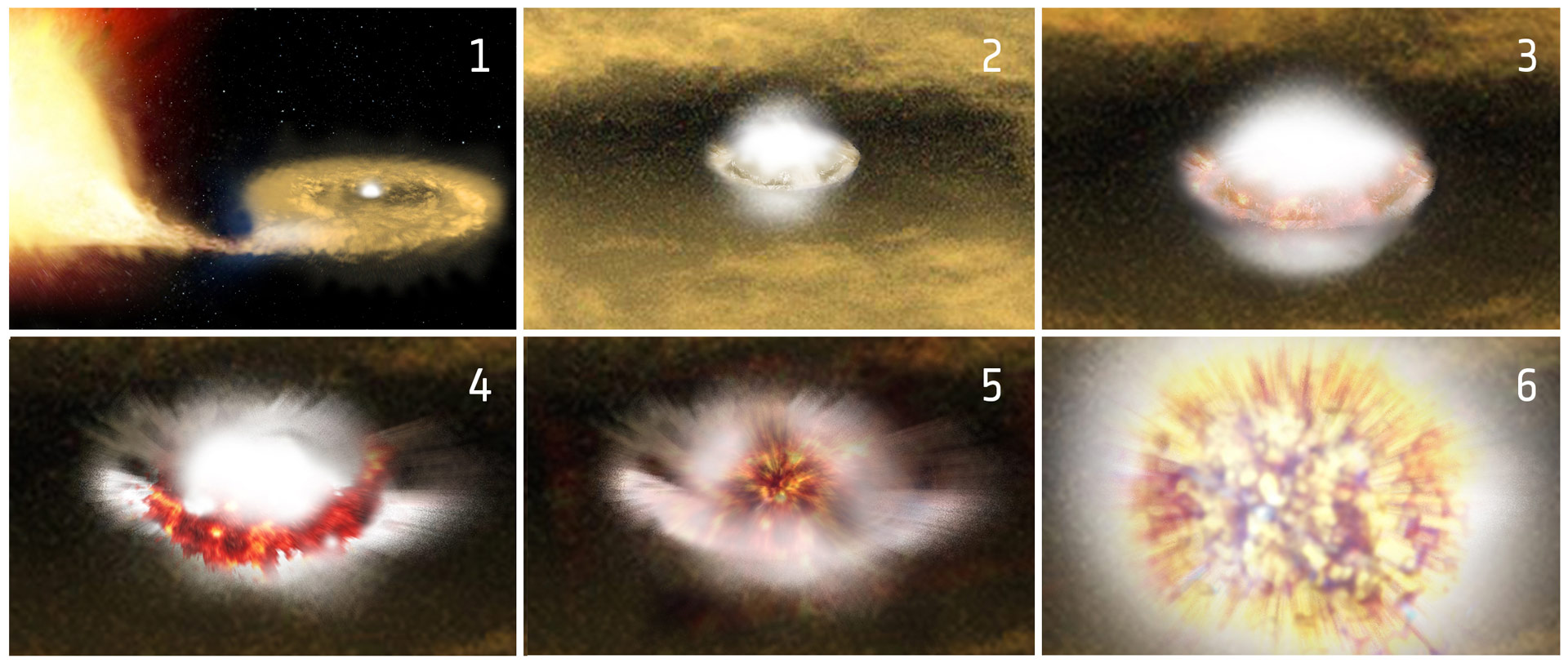
White dwarfs are inert stars that contain up to 1.4 times the mass of the Sun squeezed into a volume about the same size as the Earth. Being inert, they can’t simply blow themselves up. Instead, astronomers believe that they leech matter from a companion star, which builds up on the surface until a critical total mass is reached. At that point, the pressure in the heart of the white dwarf triggers a catastrophic thermonuclear detonation.
Early Integral observations of SN2014J tell a somewhat different story, and have been the focus of a separate study, reported online in Science Express by Roland Diehl from the Max Planck Institute for Extraterrestrial Physics, Germany, and colleagues.
Diehl and his colleagues detected gamma rays from the decay of radioactive nickel just 15 days after the explosion. This was unexpected, because during the early phase of a Type Ia supernova, the explosion debris is thought to be so dense that the gamma rays from the nickel decay should be trapped inside.
“We were puzzled by this surprising signal, and some from the group even thought it must be wrong,” says Diehl. “We had long and ultimately very fruitful discussions about what might explain these data.”
A careful examination of the theory showed that the signal would have been hidden only if the explosion had begun in the heart of the white dwarf. Instead, Diehl and colleagues think that what they are seeing is evidence of a belt of gas from the companion star that must have built up around the equator of the white dwarf. This outer layer detonated, forming the observed nickel and then triggering the internal explosion that became the supernova.
“Regardless of the fine details of how these supernovae are triggered, Integral has proved beyond doubt that a white dwarf is involved in these stellar cataclysms,” says Erik Kuulkers, ESA’s Integral Project Scientist. “This clearly demonstrates that even after almost twelve years in operation, Integral is still playing a crucial role in unraveling some of the mysteries of the high-energy Universe.”
References:
“Cobalt-56 γ-ray emission lines from the type Ia supernova 2014J” by E. Churazov, R. Sunyaev, J. Isern, J. Knödlseder, P. Jean, F. Lebrun, N. Chugai, S. Grebenev, E. Bravo, S. Sazonov and M. Renaud, 27 August 2014, Nature.
DOI: 10.1038/nature13672
arXiv: 1405.3332
“Early 56Ni decay γ rays from SN2014J suggest an unusual explosion” by Roland Diehl, Thomas Siegert, Wolfgang Hillebrandt, Sergei A. Grebenev, Jochen Greiner, Martin Krause, Markus Kromer, Keiichi Maeda, Friedrich Roepke and Stefan Taubenberger, 31 July 2014, Science.
DOI: 10.1126/science.1254738
arXiv: 1407.3061
Never miss a breakthrough: Join the SciTechDaily newsletter.
Follow us on Google and Google News.
2 Comments
It’s proof of nothing. More a case of “We invested our careers into this, we HAVE to be right”.
And here I am excited just being able to see the galaxy in question with my 10″ dobsonian 🤣 What an interesting article.