
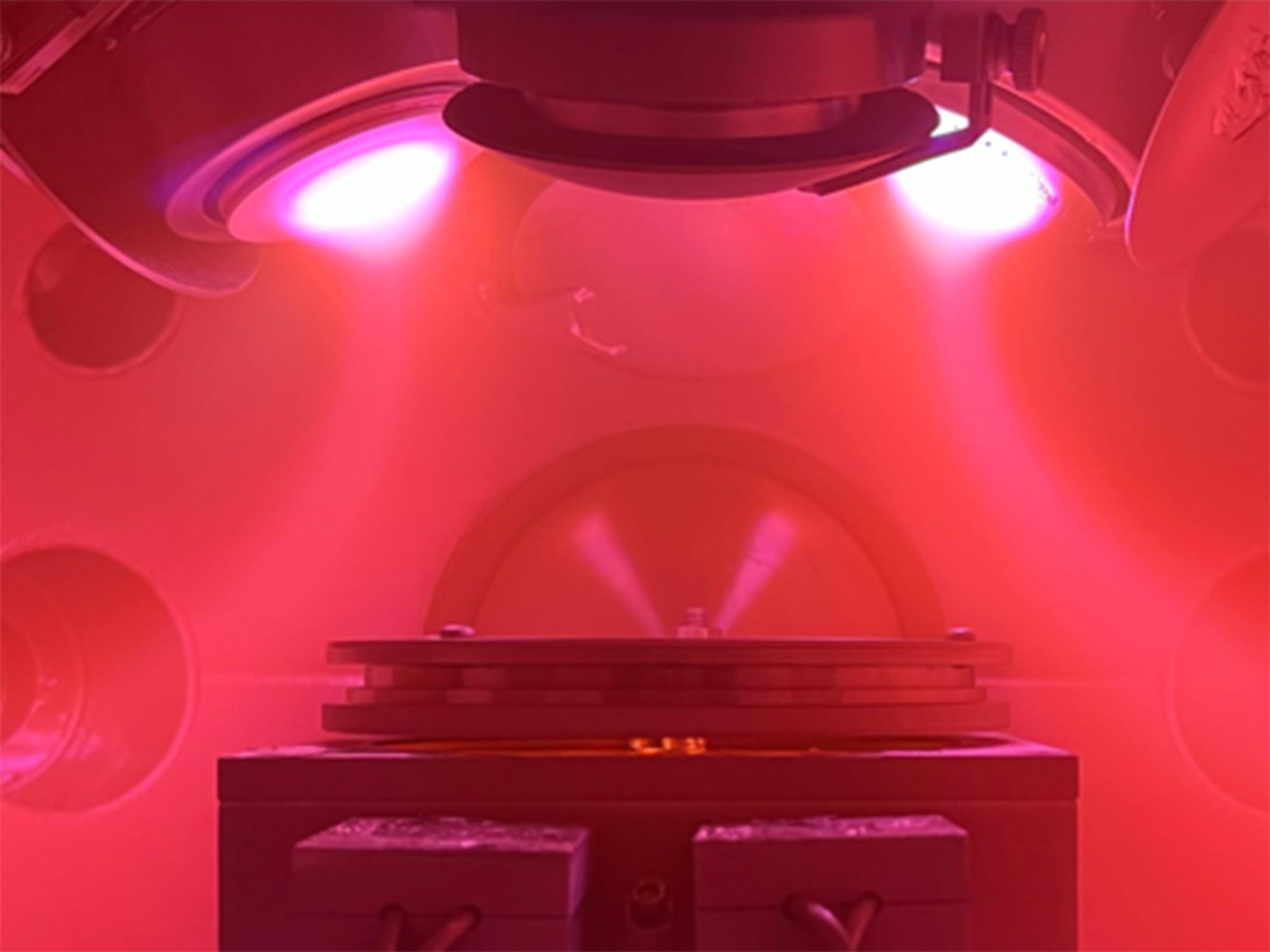
Scientists at Penn State have discovered a method to induce ferroelectric properties in non-ferroelectric materials by layering them with ferroelectric materials, a phenomenon termed proximity ferroelectricity.
This breakthrough offers a novel approach to creating ferroelectric materials without altering their chemical composition, preserving their intrinsic properties, and potentially revolutionizing data storage, wireless communication, and the development of next-generation electronic devices.
New Ferroelectric Materials Without Chemical Alterations
Ferroelectric materials possess a unique property: they have positive and negative charges that are polarized, similar to the north and south poles of a magnet. What sets them apart is their ability to reverse this polarization when external electricity is applied. Once reversed, these materials retain their state until more power is introduced, making them invaluable for data storage and wireless communication technologies.
Now, researchers at Penn State have found a way to transform non-ferroelectric materials into ferroelectric ones by simply stacking them with ferroelectric materials. This process, known as proximity ferroelectricity, eliminates the need for chemical modifications.
This breakthrough introduces a novel method for creating ferroelectric materials while preserving their essential properties, which are often compromised by chemical alterations. The discovery could pave the way for advancements in next-generation processors, optoelectronics, and quantum computing. The team’s findings were published on January 8 in the journal Nature.
Proximity Ferroelectricity Explored
“This work shows we can generate ferroelectricity in a material that does not have those properties just by stacking it with a material that is ferroelectric,” said Jon-Paul Maria, professor of materials science and engineering at Penn State and lead author of the study. “And, so, it has to be that the two materials are talking to each other. We call it proximity ferroelectricity because it is an effect of being in contact.”
In recent years, scientists at the University of Kiel in Germany and at Penn State have developed new families of nitride and oxide ferroelectric materials — respectively — with comparable properties but with much simpler structures and preparation methods that can be integrated directly into mainstream semiconductors, like silicon, thus maximizing the technology impact, the scientists said.
Simplifying Ferroelectric Fabrication
The new work builds on those discoveries, demonstrating a method to create similar materials but without needing the chemical modifications previously required for fabrication, the scientists said.
“The community got very excited in the last few years about two new emergent families of ferroelectrics that show very promising future impacts on electronic devices,” Maria said. “This is now another step in that process. It’s a second time that we’ve been stunned about what we did not know about ferroelectricity after 100 years of research.”
Maria and his team previously developed one such ferroelectric material that offers enticing performance but requires trade-offs: magnesium-substituted zinc oxide thin films. The zinc oxide has desirable properties, but it is not ferroelectric by itself. Adding magnesium allows scientists to make the material ferroelectric but degrades important properties such as heat dissipation during device operation and the ability to transmit light over very long distances.
Using proximity ferroelectricity, the researchers found they could now turn pure zinc oxide ferroelectric by stacking it with a ferroelectric material like the magnesium-substituted zinc oxide thin films.
“Imagine that I have the ability to stack these layers on top of each other, where one is ferroelectric and the other is normally not, but through proximity ferroelectricity,” Maria said. “It can exhibit the polarization reversal in its pure state. That’s the real appeal.”
In addition, the ferroelectric layer can represent as little as 3% of the total volume of the stack, meaning the vast majority is material with the most desired properties. The ferroelectric, or switching layer, can be placed on the top or bottom or as an isolated internal layer, the scientists said.
The researchers observed proximity ferroelectricity in oxide, nitride, and combined nitride-oxide systems, suggesting that there is a generic mechanism and that the technique could provide new avenues for ferroelectric property engineering and material discovery.
Maria said the work only scratches the surface of what’s possible with the technique and that future research should explore other possible compositions.
Implications for Optoelectronics and Computing
The technology could be especially useful for developing next-generation optics applications for electronics. A major challenge in computing involves finding ways to use less energy — and one option is changing the way processors talk to each other using light instead of electronics, Maria said.
“And a big part of that may be this next generation of opto-electronic materials,” Maria said. “Our findings could be one candidate. Alternatively, this could mean that other enabling materials are already known, and exciting functional properties like ferroelectric switching just need unlocking using this proximity effect.”
Reference: “Proximity ferroelectricity in wurtzite heterostructures” by Chloe H. Skidmore, R. Jackson Spurling, John Hayden, Steven M. Baksa, Drew Behrendt, Devin Goodling, Joshua L. Nordlander, Albert Suceava, Joseph Casamento, Betul Akkopru-Akgun, Sebastian Calderon, Ismaila Dabo, Venkatraman Gopalan, Kyle P. Kelley, Andrew M. Rappe, Susan Trolier-McKinstry, Elizabeth C. Dickey and Jon-Paul Maria, 8 January 2025, Nature.
DOI: 10.1038/s41586-024-08295-y
Also contributing from Penn State were: Chloe Skidmore, a graduate student and lead author; Devin Goodling, John Hayden, R. Jackson Spurling, Steven Baksa, Albert Suceava and Joshua Nordlander, who contributed as graduate students; and Joseph Casamento, a post-doctoral scholar. Contributing faculty members include Susan Trolier-McKinstry, Evan Pugh University Professor and Steward S. Flaschen Professor of Ceramic Science and Engineering; Venkatraman Gopalan, professor of materials science and engineering and physics; and Betul Akkopru-Akgun, assistant research professor in the Materials Research Institute.
Also contributing were: Elizabeth Dickey, distinguished professor; Ismaila Dabo, professor; and Sebastian Calderon, special faculty, at Carnegie Mellon University; Andrew Rappe, professor, and Drew Behrendt, doctoral student, at the University of Pennsylvania; and Kyle Kelley, research and development associate at Oak Ridge National Laboratory.
The U.S. Department of Energy, the U.S. National Science Foundation and the Department of Defense provided support to researchers on this project.
Never miss a breakthrough: Join the SciTechDaily newsletter.
Follow us on Google and Google News.
1 Comment
There’s an Internet physics trick where they SHRINK coins, by placing them inside of a magnetic solenoid coil, and hitting it with a MASSIVELY powerful high voltage zap from stepped up transformers. KABOOM! The sudden EMP, Electro-Magnetic Pulse, physically compressed the coins into smaller versions of them. I think I read about experiments to make strong magnets WITHOUT rare earth elements, by just using the basic iron to remake it into, I think it was called Tetraferrite, because rare earth elements cost more than Gold these days! But the manufacturing process cost too much to make that an economically feasible investment. Anyway, if these researchers are experimenting with layering alternative metal elements together, perhaps making a less explosive version of that coin shrinking physics trick, to combine these different metal layers like that. Also, by rewiring the electrical grounding cables of tall buildings and towers lightning rods, to channel that-not-duplicated-charge-in-the-lab, SUPER ZAP through a very reinforced magnetic solenoid coil, we could routinely place stacked metal layers batches inside it, to mass-manufacture such specialized new materials, and be able to $afford$ doing that in the first place. EOJ