

Nuclear physicists have achieved a groundbreaking measurement in electron beam polarization using a Compton polarimeter, drastically reducing uncertainty in electron spin to just 0.36%.
This advance not only surpasses previous records but also meets the precision required for upcoming experiments intended to test and potentially expand the Standard Model of particle physics. These experiments aim to explore fundamental constituents of matter and the forces that interact between them, promising to refine our understanding of the universe’s fabric.
Electron Spin and Polarization
Spin, like mass or electric charge, is a fundamental property inherent to electrons. When electrons spin in the same direction at a given time, this is referred to as polarization. Knowledge of that parallel spin is vital for scientists probing the nature of matter on the tiniest scales. In particular, it sheds light on the structure of nuclei of heavy atoms such as lead.
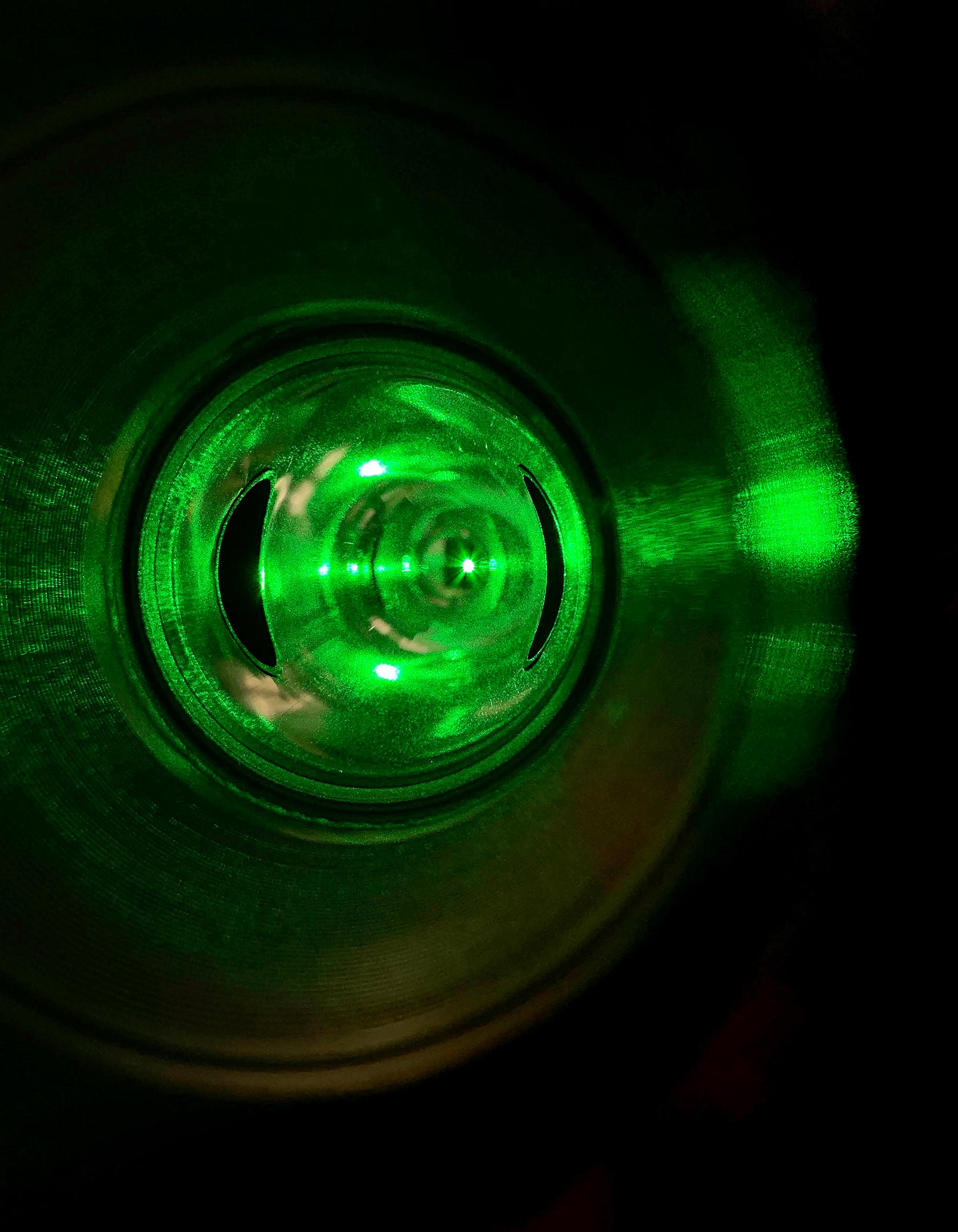
Now, nuclear physicists have measured the polarization of an electron beam more precisely than ever before. They achieved the record measurement by sending laser light and electrons on a collision course and detecting the photons, or particles of light, that bounce off. This interaction is known as the Compton effect.
Advancing the Standard Model
The Standard Model of particle physics attempts to describe the most basic constituents of atoms, such as quarks and gluons, along with three of the four fundamental forces: the strong force, the weak force, and the electromagnetic force. But it isn’t complete. That’s why scientists are planning a series of novel experiments to test this theory and possibly help reshape their description of the universe. The recent Compton polarization measurement has surpassed the level of precision required for those future studies.
Precision in Polarization Measurement
When weighing experiment against theory, it is crucial that scientists understand the uncertainties these comparisons reveal. Otherwise, those tests would have no scientific value. In many studies involving electron beams, knowledge of the energized particles’ spin is the main source of uncertainty. To reduce this uncertainty, scientists at the Thomas Jefferson National Accelerator Facility (Jefferson Lab) developed a device to measure polarization more precisely than ever.
Breakthrough in Polarization Precision
The scientists used the device, called a Compton polarimeter, in Hall A of the Continuous Electron Beam Accelerator Facility, a Department of Energy Office of Science user facility. The system diverts the electron beam into an optical cavity, where it collides with laser light. The photons that the electron beam knocks out hurtle into a detector that passes their signals to a suite of data collectors. The Compton polarimeter was part of the Calcium Radius Experiment (CREX), which probed the nuclei of medium-weight atoms for insight on their structure.
During CREX, the research team reduced the uncertainty of the energized electrons’ spin to 0.36%. This broke a record of 0.5% that was set with much higher beam energy at the SLAC National Accelerator Laboratory in 1995. This new measurement also crossed the 0.4% threshold needed for the flagship MOLLER experiment, which will measure the weak charge on an electron as a test of the Standard Model.
Reference: “Ultrahigh-precision Compton polarimetry at 2 GeV” by A. Zec, S. Premathilake, J. C. Cornejo, M. M. Dalton, C. Gal, D. Gaskell, M. Gericke, I. Halilovic, H. Liu, J. Mammei, R. Michaels, C. Palatchi, J. Pan, K. D. Paschke, B. Quinn and J. Zhang, 23 February 2024, Physical Review C.
DOI: 10.1103/PhysRevC.109.024323
This work was supported in part by the Department of Energy Office of Science, Office of Nuclear Physics.
Never miss a breakthrough: Join the SciTechDaily newsletter.
Follow us on Google and Google News.
5 Comments
“Reality, what a concept!”
Hopefully this can aid in improving yhe accuracy of the direct measurement of the fine structure constant, measuring how much the polarization of light rotates as it passes through a magnetic topological insulator.
When physics uses imagined things as the Formal Base and Evidential Base for research. What is the difference between physics and religion?
Physics should not ignore the analyzable physical properties of topological vortices.
(1) Traditional physics: based on mathematical formalism, experimental verification and arbitrary imagination.
(2) Topological Vortex Theory: Although also based on mathematics (such as topology), it focuses more on non intuitive geometry and topological structures, challenging traditional physical intuition.
Topological Vortex Theory points out the limitations of the Standard Model in describing the large-scale structure of the universe, and suggests that topological vortices and their fractal structures are the key to understanding these phenomena. The interaction and balance of topological vortices encompass all long-range and short-range contributions of spatiotemporal motion, and are the driving force behind the endless growth and life of spatiotemporal motion in nature.
Let us continue to witness together the dirtiest and ugliest era in the scientific and humanistic history of human society. The laws of nature will not change due to misleading of so-called academic publications.
Today, so-called official (such as PRL, Nature, Science, PNAS, etc.) in physics stubbornly believes that two sets of cobalt-60 rotating in opposite directions can become two sets of objects that mirror each other, is a typical case that pseudoscience is rampant and domineering. Let us continue to witness together the dirtiest and ugliest era in the scientific and humanistic history of human society. The laws of nature will not change due to misleading of so-called academic publications.
When physics uses imagined things as the Formal Base and Evidential Base for research. What is the difference between physics and religion?
Please ask researchers to think deeply:
1. What is the difference between imagined particles and imagined God?
2. What are you exploring and searching for?
3. What does the physical phenomenon you observed explain?
4. What is the dirtiness and ugliness in academic activities?
and so on.
Scientific research guided by correct theories can help people avoid detours, failures, and exaggeration. The physical phenomena observed by researchers in experiments are always appearances, never the natural essence of things. The natural essence of things needs to be extracted and sublimated based on mathematical theories via appearances , rather than being imagined arbitrarily.
Everytime scientific revolution, the scientific research space brought by the new paradigm expands exponentially. Physics should not ignore the analyzable physical properties of topological vortices.
(1) Traditional physics: based on mathematical formalism, experimental verification and arbitrary imagination.
(2) Topological Vortex Theory: Although also based on mathematics (such as topology), it focuses more on non intuitive geometry and topological structures, challenging traditional physical intuition.
Extension of the Standard Model: Topological Vortex Theory points out the limitations of the Standard Model in describing the large-scale structure of the universe, proposes the need to consider non-standard model components such as dark matter and dark energy, and suggests that topological vortex fields may be key to understanding these phenomena.
Topological vortex theory heralds innovative technologies such as topological electronics, topological smart batteries, topological quantum computing, etc., which may bring low-energy electronic components, almost inexhaustible currents, and revolutionary computing platforms, etc.
Topology tells us that topological vortices and antivortices can form new spacetime structures via the synchronous effect of superposition, deflection, or twisting of them. In fact, mathematics does not tell us that there must be God particles, ghost particles, fermions, or bosons present. When physics and mathematics diverge, arbitrary imagination will make physics no different from theology. Topological vortex research reflections on the philosophy and methodology of science help us understand the nature essence of science and the limitations of scientific methods. This not only has guiding significance for scientific research itself, but also has important implications for science education and popularization.
Today, so-called official (such as PRL, Nature, Science, PNAS, etc.) in physics stubbornly believes that two sets of cobalt-60 rotating in opposite directions can become two sets of objects that mirror each other, is a typical case that pseudoscience is rampant and domineering. Please witness the exemplary collaboration between theoretical physicists and experimentalists (https://scitechdaily.com/microscope-spacecrafts-most-precise-test-of-key-component-of-the-theory-of-general-relativity/#comment-854286).
Let us continue to witness together the dirtiest and ugliest era in the scientific and humanistic history of human society. The laws of nature will not change due to misleading of so-called academic publications.