
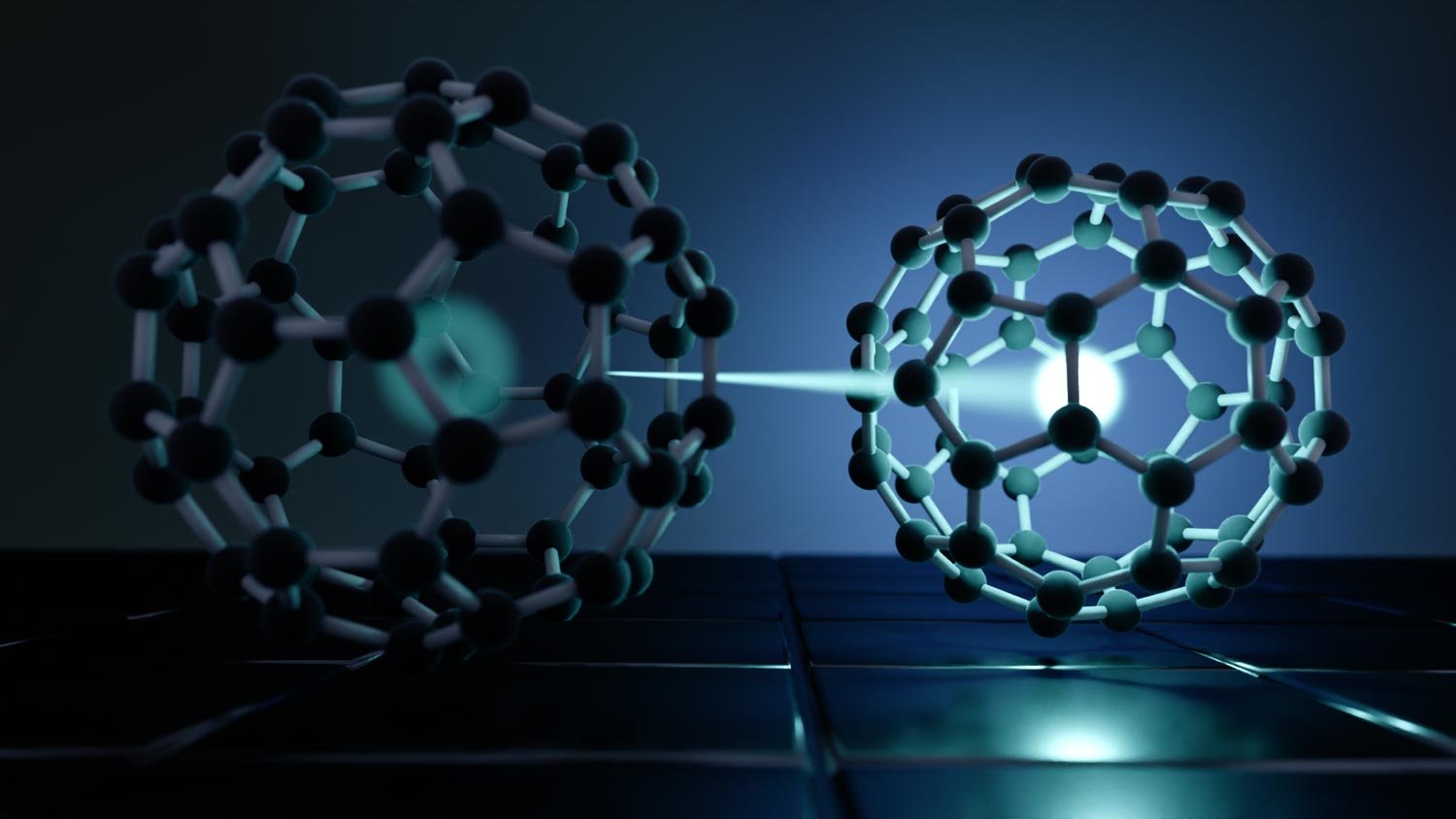
New imaging technique reveals exciton dynamics in organic semiconductors, offering insights into their quantum properties and potential for improving energy conversion materials.
From solar panels on our roofs to the new OLED TV screens, many everyday electronic devices simply wouldn’t work without the interaction between light and the materials that make up semiconductors. A new category of semiconductors is based on organic molecules, which largely consist of carbon, such as buckminsterfullerene. The way organic semiconductors work is largely determined by their behavior in the first few moments after light excites electrons, forming “excitons” in the material.

Researchers from the Universities of Göttingen, Graz, Kaiserslautern-Landau and Grenoble-Alpes have now, for the first time, made very fast and very precise images of these excitons – in fact, accurate to one quadrillionth of a second (0.000,000,000,000,001s) and one billionth of a meter (0.000,000,001m). This understanding is essential for developing more efficient materials with organic semiconductors.
The results were published recently in the scientific journal Nature Communications.
Understanding Exciton Dynamics
When light hits a material, some electrons absorb the energy and this puts them into an excited state. In organic semiconductors, such as those used in OLEDs, the interaction between such excited electrons and left-over “holes” is very strong, and electrons and holes can no longer be described as individual particles. Instead, negatively charged electrons and positively charged holes combine to form pairs, known as excitons.
Understanding the quantum mechanical properties of these excitons in organic semiconductors has long been considered a major challenge – both from a theoretical and an experimental point of view.

The new method sheds light on this puzzle. Wiebke Bennecke, physicist at the University of Göttingen and first author of the study, explains: “Using our photoemission electron microscope, we can recognize that the attractive forces within the excitons significantly change their energy and velocity distribution. We measure the changes with extremely high resolution in both time and space, and compare them with the theoretical predictions of quantum mechanics.”
The researchers refer to this new technique as photoemission exciton tomography. The theory behind it was developed by a team led by Professor Peter Puschnig at the University of Graz.
Advancements in Semiconductor Research
This new technique enables scientists, for the first time, to both measure and visualize the quantum mechanical wave function of the excitons. Put simply, the wave function describes the state of an exciton and determines its probability of being present.
Dr. Matthijs Jansen, Göttingen University, explains the significance of the findings: “The organic semiconductor that we studied was buckminsterfullerene which consists of a spherical arrangement of 60 carbon atoms. The question was whether an exciton would always be located on a single molecule or whether it could be distributed across several molecules simultaneously. This property can have a major influence on the efficiency of semiconductors in solar cells.”

Photoemission exciton tomography provides the answer: immediately after the exciton is generated by light, it is distributed over two or more molecules. However, within a few femtoseconds, meaning in a tiny fraction of a second, the exciton shrinks back down to a single molecule.
In the future, the researchers want to record the behavior of the excitons using the new method. According to Professor Stefan Mathias, Göttingen University, this holds potential: “For example, we want to see how the relative motion of molecules influences the dynamics of excitons in a material. These investigations will help us understand energy conversion processes in organic semiconductors. And we hope that this knowledge will contribute to the development of more efficient materials for solar cells.”
Reference: “Disentangling the multiorbital contributions of excitons by photoemission exciton tomography” by Wiebke Bennecke, Andreas Windischbacher, David Schmitt, Jan Philipp Bange, Ralf Hemm, Christian S. Kern, Gabriele D’Avino, Xavier Blase, Daniel Steil, Sabine Steil, Martin Aeschlimann, Benjamin Stadtmüller, Marcel Reutzel, Peter Puschnig, G. S. Matthijs Jansen and Stefan Mathias, 28 February 2024, Nature Communications.
DOI: 10.1038/s41467-024-45973-x
This research benefited from the German Research Foundation (DFG) funding for the Collaborative Research Centres “Atomic scale control of energy conversion” and “Mathematics of Experiment” in Göttingen and “Spin+X” in Kaiserslautern-Landau. The team in Graz was supported by funding from the ERC Synergy Grant “Orbital Cinema” of the European Union.
Never miss a breakthrough: Join the SciTechDaily newsletter.
Follow us on Google and Google News.
1 Comment
That’s about 82nd revolutionary discovery in SciTechDaily only this week. Who’s gonna keep track of all that?