
Close Menu
    Facebook X (Twitter) Instagram
    SciTechDaily
    • Biology
    • Chemistry
    • Earth
    • Health
    • Physics
    • Science
    • Space
    • Technology
    Facebook X (Twitter) Pinterest YouTube RSS
    SciTechDaily
    Home»Physics»Quantum Theorists State That Wavefunctions Are Real, States Not Just Statistical Tools
    Physics

    Quantum Theorists State That Wavefunctions Are Real, States Not Just Statistical Tools

    By SciTechDailyMay 15, 20124 Comments2 Mins Read
    Facebook Twitter Pinterest Telegram LinkedIn WhatsApp Email Reddit
    Share
    Facebook Twitter LinkedIn Pinterest Telegram Email Reddit
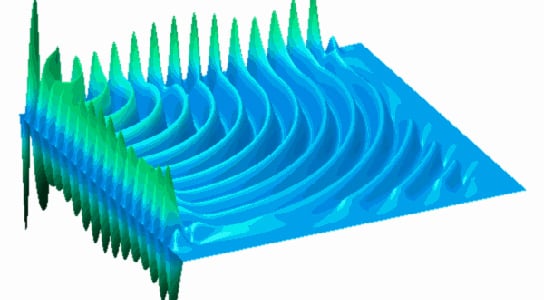
    wavefunction-graphic
    Wavefunction graphic

    The mathematics behind the claims of a group of quantum theorists state that the wavefunction, a probability amplitude used to in quantum mechanics to describe a particle’s state, isn’t just a statistical tool but rather a real, objective state of a quantum system. The researchers published their findings in the journal Nature Physics.

    This view was shared by Erwin Schrödinger, Austrian physicist, and quantum-mechanics pioneer. Others, like Albert Einstein, favored the opposing view that the wavefunction reflects the partial knowledge of that an experimenter has about a system.

    wavefunction-glass

    Jonathan Barrett and his colleagues follow John Bell’s counterintuitive implication that he developed in 1964: that measurements on one particle can influence the state of another, distant particle, faster than the speed of light should allow. The theorem proposed by Barrett shows that theories that treat the wavefunction in terms of lack of knowledge of a system’s physical state will also fail to reproduce those predictions.

    If wavefunctions simply reflect the experimenter’s uncertainty, then different wavefunctions could represent the same underlying reality. The authors show that the same reality cannot underpin different quantum states. The theorem depends on a controversial assumption, that quantum systems have an objective underlying physical state.

    This theorem could have applications in quantum information theory and cryptography. The theorem is incompatible with the standard model of quantum mechanics, possibly showcasing some faults in it.
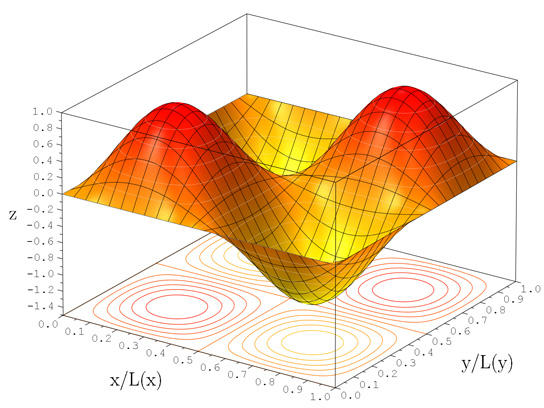
    wavefunction-plot

    Reference: “On the reality of the quantum state” by Matthew F. Pusey, Jonathan Barrett and Terry Rudolph, 6 May 2012, Nature Physics.
    DOI: 10.1038/nphys2309

    Never miss a breakthrough: Join the SciTechDaily newsletter.
    Follow us on Google and Google News.

    Quantum Physics Statistics Wave Function
    Share. Facebook Twitter Pinterest LinkedIn Email Reddit

    Related Articles

    Unlocking the Mysterious Quantum World With Wave Function

    Physicists in China Break Quantum Teleportation Record

    First Universal Quantum Network Prototype Operational

    Physicists Use Cheap Colliders to Probe for Heavy Photons

    Quantum Interference Shown Experimentally in Larger Molecules

    Simulating Quantum Walks in Two Dimensions

    Molecules as Antennas Transmit Signals of Single Photons

    Evidence of Elusive Majorana Fermions Raises Possibilities for Quantum Computing

    Higgs Boson Signals Gain Strength at Large Hadron Collider

    4 Comments

    1. Stephen on May 3, 2013 3:08 pm

      If the wave-function is a real, objective reality, then we ought to be able to measure it without it collapsing into one state or another by the process of measurement.
      That, to me, makes me question the use of the word “objective”, unless we violate Heisenberg’s Uncertainty Principle.
      But what do I know?

      Reply
    2. Jamahl Peavey on May 21, 2013 5:56 am

      Wave functions are real and the experimental proof was published before Natures article in the Indian Journal of science and Technology.

      Reply
      • tony on April 25, 2014 8:20 am

        http://link.springer.com/article/10.1007/s10910-014-0332-2

        Reply
    3. Conanth on June 1, 2015 6:52 pm

      If the wave function is not real then what ‘waves’ in a double slit experiment when you send a single electron/photon through a double slit and observe interference?

      Reply
    Leave A Reply Cancel Reply

    • Facebook
    • Twitter
    • Pinterest
    • YouTube

    Don't Miss a Discovery

    Subscribe for the Latest in Science & Tech!

    Trending News

    1.4-Million-Year-Old Footprints Reveal a Giant Human Relative

    Astronomers May Have Found the First Moon Beyond Our Solar System

    Underwater Cameras Expose the Secret Lives of Whale Sharks

    Why Dreaming Leaves the Brain Running Low on Energy

    CERN Experiments Detect Signs of the Universe’s Primordial Matter

    Study Finds a Surprising Link Between Gut Microbes and Aging

    Frequent Cannabis Users Wake Up With More “Stress Hormone”

    Scientists Reveal Hidden DNA Traces in the Shroud of Turin

    Follow SciTechDaily
    • Facebook
    • Twitter
    • YouTube
    • Pinterest
    • Newsletter
    • RSS
    SciTech News
    • Biology News
    • Chemistry News
    • Earth News
    • Health News
    • Physics News
    • Science News
    • Space News
    • Technology News
    Recent Posts
    • New Stroke Treatment Turns Brain Cavities Into Repair Hubs
    • World’s First Photonic Time Crystal Can Reshape Light in Trillionths of a Second
    • Meteorite That Smashed Through a New Jersey Roof Hid an Ancient Chemical Secret
    • Astronomers Find Ancient Black Holes Shining With the Power of a Trillion Suns
    • These “Good” Immune Cells Could Hold the Key to Spinal Cord Regeneration
    Copyright © 1998 - 2026 SciTechDaily. All Rights Reserved.
    • Science News
    • About
    • Contact
    • Editorial Board
    • Privacy Policy
    • Terms of Use

    Type above and press Enter to search. Press Esc to cancel.