

In a dramatic galactic showdown dubbed the “cosmic joust,” astronomers have captured an extraordinary cosmic event: a quasar-powered galaxy stabbing another with a blast of radiation during a collision 11 billion years ago.
For the first time, astronomers have captured a dramatic cosmic event where one galaxy appears to stab another with a beam of powerful radiation. Published in Nature, this breakthrough study shows how the intense energy from the attacking galaxy weakens its target’s ability to create new stars. Using two of the most advanced observatories on Earth—the European Southern Observatory’s Very Large Telescope (VLT) and the Atacama Large Millimeter/submillimeter Array (ALMA)—scientists were able to reveal the full extent of this galactic clash.
The “Cosmic Joust”: Galaxies Clash in Deep Space
Far across the Universe, two galaxies are caught in a high-speed, high-stakes struggle. They race toward each other at about 500 kilometers per second, collide briefly, and then swing apart before crashing together again. Astronomers have nicknamed this epic standoff the “cosmic joust,” inspired by medieval knights. But unlike a fair duel, one galaxy has a powerful weapon—a quasar. This brilliant core, powered by a supermassive black hole, sends out a beam of energy that slices straight through its opponent.
Quasars are among the brightest objects in the Universe, releasing enormous amounts of energy as matter falls into their central black holes. Events like these were more common billions of years ago, so astronomers look deep into space to see them. The light from this particular galactic encounter has traveled over 11 billion years to reach Earth. That means we are witnessing a moment from when the Universe was only 18% of its current age.
Astronomers have witnessed a violent galactic merger in deep space. Like a ‘cosmic joust’, one galaxy is piercing another with a cone of intense radiation. Credit: ESO
Quasar Radiation Sabotages Star Formation
“Here we see for the first time the effect of a quasar’s radiation directly on the internal structure of the gas in an otherwise regular galaxy,” explains study co-lead Sergei Balashev, who is a researcher at the Ioffe Institute in St Petersburg, Russia. The new observations indicate that radiation released by the quasar disrupts the clouds of gas and dust in the regular galaxy, leaving only the smallest, densest regions behind. These regions are likely too small to be capable of star formation, leaving the wounded galaxy with fewer stellar nurseries in a dramatic transformation.
But this galactic victim isn’t all that is being transformed. Balashev explains: “These mergers are thought to bring huge amounts of gas to supermassive black holes residing in galaxy centers.” In the cosmic joust, new reserves of fuel are brought within reach of the black hole powering the quasar. As the black hole feeds, the quasar can continue its damaging attack.
Chilean Telescopes Reveal the Brutal Details
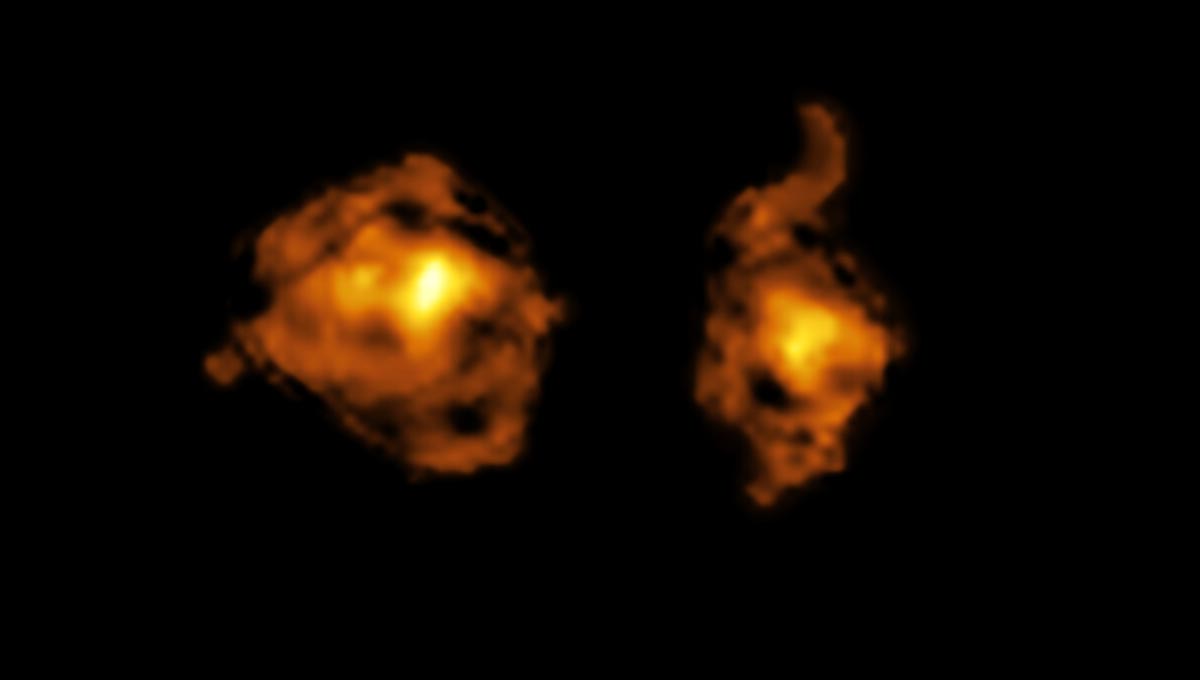
This study was conducted using ALMA and the X-shooter instrument on ESO’s VLT, both located in Chile’s Atacama Desert. ALMA’s high resolution helped the astronomers clearly distinguish the two merging galaxies, which are so close together they looked like a single object in previous observations. With X-shooter, researchers analyzed the quasar’s light as it passed through the regular galaxy. This allowed the team to study how this galaxy suffered from the quasar’s radiation in this cosmic fight.
This video shows a series of animations of two interacting galaxies, where one of them is piercing the other with intense radiation, like a cosmic joust. Credit: ESO/M. Kornmesser
Observations with larger, more powerful telescopes could reveal more about collisions like this. As Noterdaeme says, a telescope like ESO’s Extremely Large Telescope “will certainly allow us to push forward a deeper study of this, and other systems, to better understand the evolution of quasars and their effect on host and nearby galaxies.”
This video zooms into a galactic merging event in deep space, like a ‘cosmic joust’. One of these galaxies is piercing the other with intense radiation, emitted by a quasar at its core. This radiation is disrupting the gas and dust inside the other galaxy, dampening its ability to form stars. Credit: ESO
Reference: “Quasar radiation transforms the gas in a merging companion galaxy” by Sergei Balashev, Pasquier Noterdaeme, Neeraj Gupta, Jens-Kristian Krogager, Françoise Combes, Sebastián López, Patrick Petitjean, Alain Omont, Raghunathan Srianand and Rodrigo Cuellar, 21 May 2025, Nature.
DOI: 10.1038/s41586-025-08966-4
The team is composed of S. Balashev (Ioffe Institute, St Petersburg, Russia), P. Noterdaeme (Institut d’Astrophysique de Paris, Paris, France [IAP] & French-Chilean Laboratory for Astronomy [FCLA], Chile), N. Gupta (Inter-University Centre for Astronomy, Pune, India [IUCAA]), J.K. Krogager (Université Lyon I, Lyon, France & FCLA), F. Combes (Collège de France, Paris, France), S. López (Universidad de Chile [UChile]), P. Petitjean (IAP), A. Omont (IAP), R. Srianand (IUCAA), and R. Cuellar (UChile).
Never miss a breakthrough: Join the SciTechDaily newsletter.
Follow us on Google and Google News.
3 Comments
Note 2505280544_Source1. Analyzing【
_[3,3-1] The intergalactic battle is cosmic joust, with one galaxy penetrating the other with intense radiation like the creation of the universe.
In my cosmology, we see galaxies as msbase. The window could be nk2. nk2 is the end and the highest in mass, so when it is decomposed into qpeoms, a view 2. qms.qvix.qcell quasar(2) window appears. Uh-huh. In this window, a collection of black holes zz'(3d.vixer) strongly pokes the opponent’s torso (2d.smolas). Thus, it devours the scattered stars of the opponent. Huh.
View 2.
sample qoms (standard)
0000000011=2,0
0000001100
0000001100
0000010010
0001100000
0101000000
0010010000
0100100000
2000000000
0010000001
When the opponent loses the qpeoms of gas and dust to make the stars, when lost by qcell, it is hard to maintain the galactic msbase anymore and is integrated and absorbed. Hmmm.
It’s like a survival game in which the integration between msbase is triggered in a battle scene. So the strongest nk2 has turned into a dark matter demon through the oss? Huh. Ironically, the devil’s energy appears in the qms. The tip of the window is the qcell quasar. But nk ̧ 2.star is not the only quasar, and regular nk.stars can also be quasar.
For reference, in the galactic msbase, stars are arranged in 1k-nk-nk2(*) mass size domain (*) to form a magicsum.state. Here, the mass is in principle that general local sparsity overlaps and collapses for a long time by qpeoms, but special local sparsity is immediately obtained or destroyed by qms.qvix.qcell.
Of course, the stars of the opponent msbase become prey to the winner.
[-]But in the cosmic joust, one galaxy is stabbed with nk, nk2.qcell, which is represented by a spear to another galaxy. This suggests that the weapons of war between dark energy are quasars, as the battle between the two galaxies takes place with qcell’s tools. Uh-huh.
≈≈≈=========
Source 1.
https://scitechdaily.com/quasar-powered-galaxy-attack-revealed-in-stunning-detail/
1.
Quasar-based Galactic Attack Revealed With Incredible Detail
The artist’s imagination shows a ‘cosmic collision’, that is, galaxy merger with a quasar in the center of the right galaxy. The quasar receives the energy of a supermassive black hole that swallows the surrounding material and emits powerful conical radiation, penetrating another galaxy like a window. The radiation interacts with the left galaxy, destroying the clouds of gas and dust inside, leaving only the smallest and densest regions. These regions are likely to become impossible to form stars after this process.
1-1
In a dramatic galactic showdown called the “Fight of the Universe,” astronomers have captured an astonishing cosmic event. It was an incident when a quasar-powered galaxy stabbed another galaxy with a radiation explosion during a collision 11 billion years ago.
Astronomers first detected a dramatic cosmic phenomenon in which one galaxy poked another with a powerful beam of radiation. The groundbreaking study, published in Nature, shows how the intense energy of an attacking galaxy weakens the target galaxy’s ability to generate new stars. Using the two most advanced observatories on Earth, the European Southern Observatory’s Very Large Telescope (VLT) and the Atacama Large Millimeter/Submillimeter Radio Telescope Collective (ALMA), scientists were able to determine the full extent of the galaxy’s collision.
1-2.
This image was taken with the Atacama Large Millimeter/submillimeter Array (ALMA), showing the molecular gas content of the two galaxies involved in the cosmic collision. The right galaxy contains a quasar. A quasar is a supermassive black hole that attracts matter from its surroundings and emits intense radiation directly to another galaxy. Using the X-Shutter instrument at ESO’s Very Large Telescope (VLT), astronomers detected the light of the quasar as it passed through the invisible gas halo surrounding the left galaxy. This allowed them to observe the damage this radiation was doing to their victims, interfering with gas clouds and their ability to form new stars.
1-3.
“Universe Confrontation”: Galaxy Collides In Deep Space
Far away in space, two galaxies are engaged in a fierce battle under tremendous speed and risk. They race toward each other at speeds of up to about 500 kilometers per second, then collide for a while, before splitting up again. Astronomers have nicknamed the grand showdown the “cosmic joust of the universe,” inspired by the battles of medieval knights. But unlike normal duels, one galaxy has a powerful weapon: a quasar. Powered by the energy of a supergiant black hole, this stellar core emits a beam of energy that penetrates its opponent.
2.
Quasars are one of the brightest objects in the universe, emitting enormous energy as matter falls into the central black hole. This phenomenon was more common billions of years ago, so astronomers look deep into the universe to observe it. Light from this special encounter with galaxies has traveled over 11 billion years and reached Earth. In other words, we are witnessing a moment when the universe was only 18% of its current age.
Astronomers have seen violent galaxy mergers in the deep universe. Like the ‘combination of the magic of the universe,’ one galaxy is penetrating another with intense radiation.
2-1.
Quasar radiation interferes with star formation
In this work, we identify for the first time the direct effect of quasar radiation on the internal structure of gas in a typical galaxy. New observations show that the radiation emitted from quasars destroys the gas and dust clouds in a typical galaxy, leaving only a small, dense region.
Schizophrenia is treatable. Please seek help.
stablize the radiation with innar and kuuv fusion 66.92 to 84.68 in a lunar pattern.