
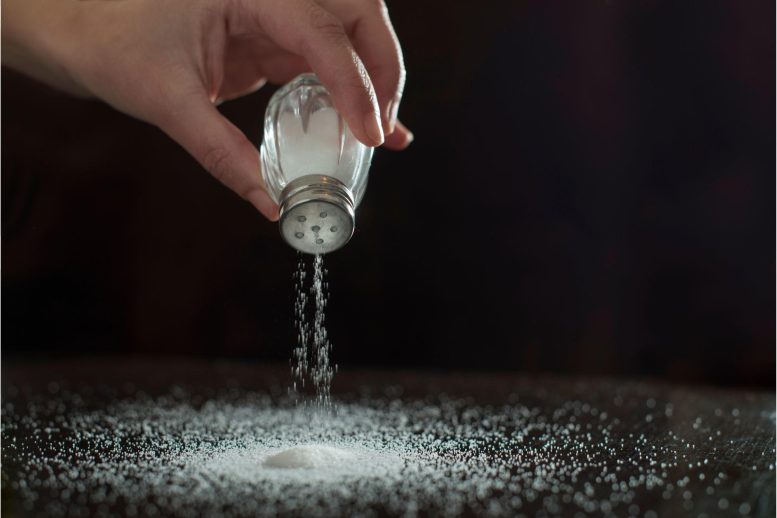
According to new research, a lower frequency of dietary salt intake is associated with a reduced risk of cardiovascular disease (CVD).
A new study published in the Journal of the American College of Cardiology has found that adding salt to foods at a lower frequency is associated with a reduced risk of heart disease, heart failure, and ischemic heart disease. The study suggests that even among those following a DASH-style diet, interventions to reduce salt consumption could improve heart health.
Previous research has shown that high levels of sodium in the diet can contribute to the development of high blood pressure, which is a major risk factor for cardiovascular disease. However, previous studies investigating this link have produced conflicting results due to a lack of practical methods for assessing long-term dietary sodium intake. Recent studies suggest that the frequency at which an individual adds salt to their foods can be used to predict their individual sodium intake over time.
“Overall, we found that people who don’t shake on a little additional salt to their foods very often had a much lower risk of heart disease events, regardless of lifestyle factors and pre-existing disease,” said Lu Qi, MD, Ph.D., HCA Regents Distinguished Chair and professor at the School of Public Health and Tropical Medicine at Tulane University in New Orleans.
“We also found that when patients combine a DASH diet with a low frequency of adding salt, they had the lowest heart disease risk. This is meaningful as reducing additional salt to food, not removing salt entirely, is an incredibly modifiable risk factor that we can hopefully encourage our patients to make without much sacrifice.”
In the current study, the authors evaluated whether the frequency of adding salt to foods was linked with incident heart disease risk in 176,570 participants from the UK Biobank. The study also examined the association between the frequency of adding salt to foods and the DASH diet as it relates to heart disease risk.
The study used a questionnaire at baseline to collect data on the frequency of adding salt to foods, not including salt used in cooking. Participants were also asked if they had made any major changes to their diet in the last 5 years, as well as complete 1-5 rounds of 24-hour dietary recalls over a three-year period.
DASH Diet and Sodium Reduction
The DASH-style diet was developed to prevent hypertension by limiting the consumption of red and processed meats and focusing on vegetables, fruit, whole grains, low-fat dairy, nuts, and legumes.
While the DASH diet has yielded benefits in relation to reducing cardiovascular disease risk, a recent clinical trial found that combining the DASH diet with sodium reduction was more beneficial for certain cardiac biomarkers, including cardiac injury, strain, and inflammation. The researchers calculated a modified DASH score that did not consider sodium intake based on seven foods and nutrients that were emphasized or deemphasized in the DASH-style diet.
Data on heart disease events was collected through medical history and data on hospital admissions, questionnaires and death register data.
Overall, study participants with a lower frequency of adding salt to foods were more likely to be women; white; have a lower body mass index; more likely to have moderate alcohol consumption; less likely to be current smokers; and more physically active. They also had a higher prevalence of high blood pressure and chronic kidney disease, but a lower prevalence of cancer.
These participants were also more likely to adhere to a DASH-style diet and consumed more fruits, vegetables, nuts and legumes, whole grains, low-fat dietary but less sugar-sweetened drinks, or red/processed meats than those with a higher frequency of adding salt to foods.
Socioeconomic and Lifestyle Variations
The researchers found the association of adding salt to foods with heart disease risk was stronger in participants of lower socioeconomic status, as well as in current smokers. A higher modified DASH diet score was associated with a lower risk of heart disease events.
In a related editorial comment, Sara Ghoneim, MD, a gastroenterology fellow at the University of Nebraska Medical Center, wrote that the study is promising, builds on previous reports, and alludes to the potential impact of long-term salt preferences on total cardiovascular risk.
“A major limitation of the study is the self-reported frequency of adding salt to foods and the enrollment of participants only from the UK, limiting generalizability to other populations with different eating behaviors,” Ghoneim said.
“The findings of the present study are encouraging and are poised to expand our understanding of salt-related behavioral interventions on cardiovascular health.”
References: “Adding Salt to Foods and Risk of Cardiovascular Disease” by Hao Ma, MD, Ph.D., Xuan Wang, MD, Ph.D., Xiang Li, MD, Ph.D., Yoriko Heianza, RD, Ph.D. and Lu Qi, MD, Ph.D., 28 November 2022, Journal of the American College of Cardiology.
DOI: 10.1016/j.jacc.2022.09.039
“Dietary Salt Intake Preferences and the Risk of Cardiovascular Disease” by Sara Ghoneim, MD, 28 November 2022, Journal of the American College of Cardiology.
DOI: 10.1016/j.jacc.2022.10.005
Never miss a breakthrough: Join the SciTechDaily newsletter.
Follow us on Google and Google News.
6 Comments
I am 56 years old and have stopped taking additional or table sugar and salt in my diet. I also do my weekend 10 to 12 km run exercise in my neighborhood. Benefits so far are no high blood pressure and type II sugar disease when I do my regular check up.
I had to separately google what a DASH diet was, because the article never bothers to define it. What’s with these quasi-clickbait articles with “one simple trick” here, too?
But, anyway, this particle sentence astounded me:
The researchers found the association of adding salt to foods with heart disease risk was stronger in participants of lower socioeconomic status, as well as in current smokers. A higher modified DASH diet score was associated with a lower risk of heart disease events.
So… people who are poor, who can’t afford decent food (I’m in this class) and/or people who also smoke, … also hate heart disease and add salt to their food. But the correlation to heart disease is the salt, and not the lack of nutritious food and smoking? Huh?!
This article blames people but fails to tell that most of the salt people consume is from cold cuts, processed and canned foods and fast food. This is bogus science.
This study is flaw. I can be right or wrong, like a coin flip. There is no control of whether people who add more salt having reasons for doing so, and whether the reason maybe due or related to heart issue in the first place.
So, is adding salt a symptom or the cause?
Did the also try adding more water for those added salt to see if there is a difference?
Ei bine , marile companii farmaceutice producătoare de medicamente știu că sodiul ajută corpul uman să-și mențină sănătatea , datorită acestui fapt oamenii care consumă mai multă sare sunt mai sănătoși , și nu au nevoie de medicamente . De aceea , ele companiile producătoare , plătesc anumiți medici să mintă populația în privința consumului de sare ca să-și vândă medicamentele. Eu personal , am consumat toată viața mâncarea mai sărată ca de obicei și la 72 de ani sunt mai sănătos decât majoritatea celor de vârsta mea . E adevărat că odată cu trecerea anilor și cu înaintarea în vârstă nu mai poți fi ca în tinerețe , dar eu mă consider un om sănătos și consum în continuare mâncarea destul de sărată și cred cu tărie că toate studiile privind consumul de sare sunt plătite de BIG PHARMA în scopul de a-și vinde medicamentele . Când eram tânăr , diabetul era stabilit de medicii vremii la 250 și foarte puțini oameni ajungeau la acel coeficient , atunci producătorii de medicamente au plătit medicii ca să micșoreze acel coeficient la 200 , apoi la 150 , iar acum este scăzut la 120 , asta s-a făcut ca medicii să dea rețete pentru medicamentele de diabet crescând vânzările la dublu sau chiar la triplu .
Persian Proverb “Whatever he says is salted, woe betide the day he says salt”
They have spoiled the salt. Of course, too much of anything is not good.