
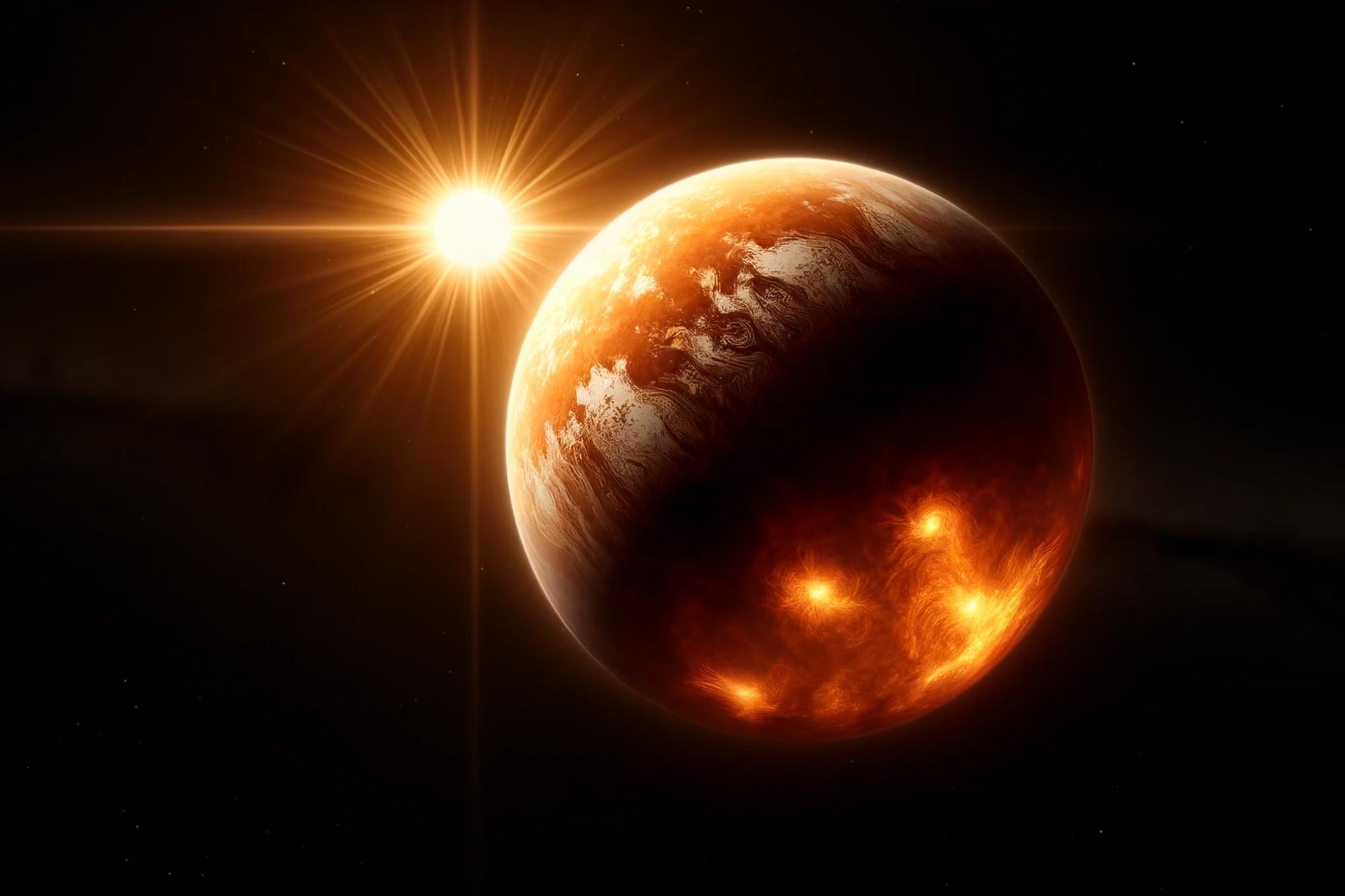
A new proposal seeks to change the scientific definition of a planet, which currently requires orbiting our sun.
- The International Astronomical Union defines a planet as a celestial body that orbits the sun, is massive enough that gravity has forced it into a spherical shape, and has cleared away other objects near its orbit around the sun.
- Scientists now recognize the existence of thousands of planets, but the IAU definition applies only to those within our solar system.
- The new proposed definition specifies that the body may orbit one or more stars, brown dwarfs, or stellar remnants and sets mass limits that should apply to planets everywhere.
Planetary scientists are proposing a new definition of a planet to replace one that many researchers view as sun-centric and outdated. The current definition — established in 2006 by the International Astronomical Union, or IAU, the organization that officially names objects in space — specifies that to qualify as a planet, a celestial body must orbit the sun within our solar system.
Extending the Definition Beyond Our Solar System
Because scientists know that celestial bodies orbiting stars outside our solar system are fairly common, a forthcoming article in the Planetary Science Journal argues for a new definition of a planet that includes being unrestrained by the bounds of our solar system. The proposal also provides quantitative criteria to further clarify the definition of a planet.
Jean-Luc Margot, lead author of the article and UCLA professor of earth, planetary, and space sciences and of physics and astronomy, will present the proposed new definition at the IAU General Assembly in August 2024.
The International Astronomical Union (IAU) is a global organization founded in 1919 that promotes and safeguards the science of astronomy through international cooperation. Headquartered in Paris, France, the IAU’s mission includes the coordination of astronomical research, the establishment of standardized astronomical nomenclature, and the dissemination of scientific information. It is best known for its role in defining planetary classifications and for naming celestial bodies and features. The IAU consists of over 12,000 members from more than 90 countries and hosts General Assemblies every three years, where major astronomical discoveries and developments are discussed. The union also actively engages in outreach and educational activities to foster public interest in astronomy.
Current Definition and Its Limitations
Under the current definition, a planet is a celestial body that orbits the sun, is massive enough that gravity has forced it into a spherical shape, and has cleared away other objects near its orbit around the sun.
“The current definition specifically mentions orbiting our sun. We now know about the existence of thousands of planets, but the IAU definition applies only to the ones in our solar system,” Margot said. We propose a new definition that can be applied to celestial bodies that orbit any star, stellar remnant, or brown dwarf.”
A New Universal Definition
The authors argue that while the requirement to orbit our sun is too specific, other criteria in the IAU definition are too vague. For example, it says a planet has “cleared its orbit” without stating what that means. The proposed new definition contains quantifiable criteria that can be applied to defining planets inside and outside our solar system.
In the new definition, a planet is a celestial body that:
- orbits one or more stars, brown dwarfs, or stellar remnants and
- is more massive than 1023 kg and
- is less massive than 13 Jupiter masses (2.5 X 1028 kg).
Establishing a Taxonomy Based on Dynamic Dominance
Margot and co-authors Brett Gladman of the University of British Columbia and Tony Yang, a student at Chaparral High School in Temecula, California, ran a mathematical algorithm on the properties of objects in our solar system to see which objects clustered together. The analysis revealed groups of distinct qualities shared by planets in our solar system that can be used as a starting point for creating a taxonomy for planets in general.
For example, if an object has enough gravity to clear a path by accumulating or ejecting smaller objects nearby, it is said to be dynamically dominant.
“All the planets in our solar system are dynamically dominant, but other objects — including dwarf planets like Pluto, and asteroids — are not,” Margot said. “So this property can be included in the definition of planet.”
Revising the Criteria for Planetary Status
The requirement for dynamical dominance provides a lower limit on mass. But potential planets can also be too big to fit the new definition. Some gas giants, for example, are so large that thermonuclear fusion of deuterium occurs, and the object becomes a substar called a brown dwarf and therefore not a planet. This limit has been determined to be the mass of 13 or more Jupiters.
The current requirement to be spherical, on the other hand, is more problematic. Distant planets can rarely be observed in enough detail to ascertain their shape with certainty. The authors argue that the shape requirement is so difficult to implement that it is effectively useless for definitional purposes, even though planets are generally round.
Future Prospects for the Definition of a Planet
“Having definitions anchored to the most easily measurable quantity — mass — removes arguments about whether or not a specific object meets the criterion,” Gladman said. “This is a weakness of the current definition.”
The good news is that, in the solar system, celestial bodies larger than 1021 kg appear to be round. So all bodies that satisfy the proposed lower limit on mass of 1023 kg are expected to be spherical.
While any official change to the IAU definition of planet is likely a few years away, Margot and his colleagues hope their work starts a conversation that results in an improved definition.
Reference: “Quantitative Criteria for Defining Planets” by Jean-Luc Margot, Brett Gladman and Tony Yang, 17 July 2024, The Planetary Science Journal.
DOI: 10.3847/PSJ/ad55f3
Never miss a breakthrough: Join the SciTechDaily newsletter.
Follow us on Google and Google News.
3 Comments
As if day to day life on Earth depends on a proper classification of places we’ll never visit in a million years.
There are members of the IAU who have nothing better to do than coming up with new and arbitrary definitions of what a planet is.
This nonsense started in 2006 when the IAU came up with a new B.S. “definition” for planets so they could exclude anything in the Kuiper Belt, starting with Pluto. The so-called “orbit clearing” requirement did not hold up under scrutiny. So now the latest definition includes simply a maximum and minimum mass requirement. The minimum mass requirement is conveniently just above that of Pluto. All of this was an unnecessary waste of time.