
Close Menu
    Facebook X (Twitter) Instagram
    SciTechDaily
    • Biology
    • Chemistry
    • Earth
    • Health
    • Physics
    • Science
    • Space
    • Technology
    Facebook X (Twitter) Pinterest YouTube RSS
    SciTechDaily
    Home»Health»Repeated Infections Linked With Increased Risk of Neurodegenerative Diseases
    Health

    Repeated Infections Linked With Increased Risk of Neurodegenerative Diseases

    By PLOSOctober 16, 20221 Comment3 Mins Read
    Facebook Twitter Pinterest Telegram LinkedIn WhatsApp Email Reddit
    Share
    Facebook Twitter LinkedIn Pinterest Telegram Email Reddit
    Brain Glitch Stress Disorder Concept
    Infections treated in hospitals, particularly during early and middle adulthood, were linked to a higher risk of developing Alzheimer’s disease (AD) and Parkinson’s disease (PD), mainly in cases where AD and PD were diagnosed before the age of 60.

    People with hospital-treated infections in early- and mid-life had the greatest risk of Alzheimer’s and Parkinson’s diseases later in life.

    Infections treated with specialty hospital care in early- and mid-life are associated with an increased subsequent risk of Alzheimer’s (AD) and Parkinson’s diseases (PD), but not amyotrophic lateral sclerosis (ALS). This is according to a new study published recently in the open-access journal PLOS Medicine by Jiangwei Sun of Karolinska Institute, Sweden, and colleagues.

    According to the CDC, an estimated 6.5 million Americans are living with Alzheimer’s disease. Nearly one million people in the U.S. are living with Parkinson’s disease, according to the Parkinson’s Foundation.

    Experimental studies in animals have indicated that infection plays a role in the development of some neurodegenerative diseases. However, supporting evidence in humans is limited. In the new study, scientists used data on people diagnosed with AD, PD, or ALS from 1970-2016 in Sweden, as well as five matched controls per case, all identified from the Swedish National Patient Register. The analysis included 291,941 AD cases, 103,919 PD cases, and 10,161 ALS cases.

    Stronger Associations for Early-Life Infections

    A hospital-treated infection 5 or more years before diagnosis was associated with a 16% higher risk of AD (95%CI: 1.15-1.18, P < 0.001) and a 4% higher risk of PD (95%CI: 1.02-1.06, P < 0.001), with similar risks seen for bacterial, viral and other infections and for different sites of infection. The highest risk of disease was seen in people with multiple hospital-treated infections before the age of 40, with more than double the risk of AD (OR=2.62, 95%CI: 2.52-2.72, P < 0.001) and more than 40% increase in the risk of PD (OR=1.41, 95%CI: 1.29-1.53, 3 44 P < 0.001). No association was observed for ALS, regardless of age at diagnosis.
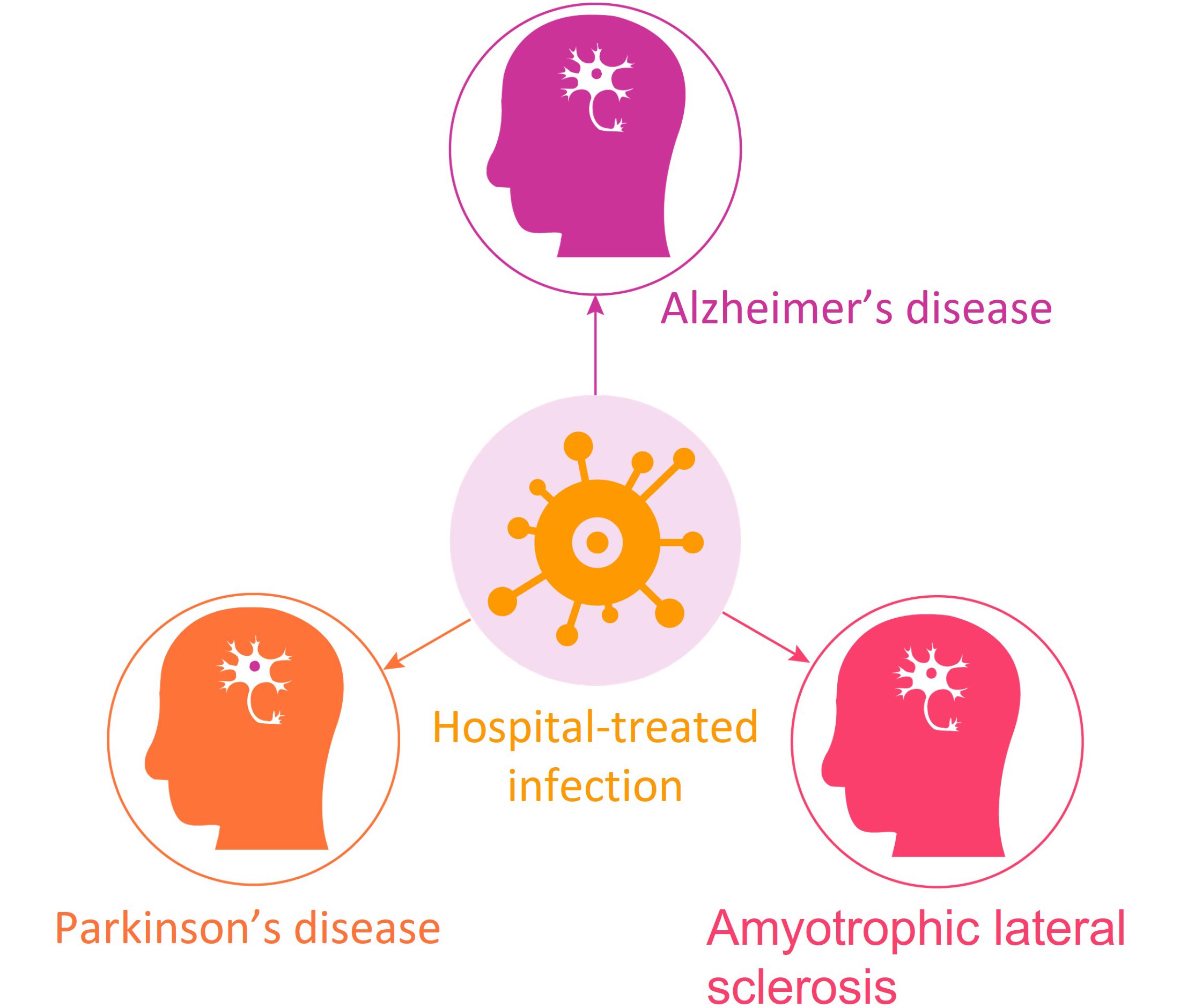
    Repeated Infections Increased Risk of Neurodegenerative Diseases
    Researchers assess hospital-treated infection and risk of neurodegenerative diseases. Credit: Jiangwei Sun (CC-BY 4.0)

    “These findings suggest that infectious events may be a trigger or amplifier of a pre-existing disease process, leading to clinical onset of neurodegenerative disease at a relatively early age,” the authors say, while also pointing out that “due to the observational nature of the study, these results do not formally prove a causal link.”

    Sun adds, “Hospital-treated infections, especially in early- and mid-life, were associated with an increased risk of Alzheimer’s disease (AD) and Parkinson’s disease (PD), primarily among AD and PD cases diagnosed before 60 years.”

    Reference: “Hospital-treated infections in early- and mid-life and risk of Alzheimer’s disease, Parkinson’s disease, and amyotrophic lateral sclerosis: A nationwide nested case-control study in Sweden” by Jiangwei Sun, Jonas F. Ludvigsson, Caroline Ingre, Fredrik Piehl, Karin Wirdefeldt, Ulrika Zagai, Weimin Ye and Fang Fang, 15 September 2022, PLoS Medicine.
    DOI: 10.1371/journal.pmed.1004092

    Funding: This study was supported by the Swedish Research Council (grants No: 2019-01088 (FF), 340-2013-5867 (FF), and 2017-02175 (KW)), the Joint Program on Neurodegenerative Diseases (JPND, grant number: 2021-00696 (FF)), and the Chinese Scholarship Council (JS). The funders had no role in study design, data collection and analysis, decision to publish, or preparation of the manuscript.

    Never miss a breakthrough: Join the SciTechDaily newsletter.
    Follow us on Google and Google News.

    Alzheimer's Disease Brain Dementia Infectious Diseases Parkinson's Disease PLOS
    Share. Facebook Twitter Pinterest LinkedIn Email Reddit

    Related Articles

    Fixing Rogue Brain Cells To Treat Neurodegenerative Diseases Like Alzheimer’s and Parkinson’s

    COVID-19 Positive Patients at Far Higher Risk of Developing Serious Neurodegenerative Disorders

    AI Links COVID-19 Brain Changes to Alzheimer’s Disease-Like Cognitive Impairment

    COVID-19 Associated With Long-Term Cognitive Dysfunction, Acceleration of Alzheimer’s Symptoms

    “Cognitive Clock” – Researchers Develop New Measure of Brain Health

    Eating Just One Serving of Processed Meat a Day Could Increase Dementia Risk by 44%

    Identifying “The Terrorist Inside My Husband’s Brain” – Living Brain Imaging Can Clearly Differentiate Between Types of Dementia

    Century of Data Shows COVID-19 Likely to Impact the Brain Long-Term

    Promising Dementia Vaccine Draws Closer

    1 Comment

    1. Joan VT on October 17, 2022 11:41 am

      What constitutes a “hospital-treated infection?” Tonsils, appendicitis, measles, mumps, any or all? I guess “hospital-treated” is key…does that include surgery?
      Thanks, Joan VT

      Reply
    Leave A Reply Cancel Reply

    • Facebook
    • Twitter
    • Pinterest
    • YouTube

    Don't Miss a Discovery

    Subscribe for the Latest in Science & Tech!

    Trending News

    Artificial Sweeteners May Harm Future Generations, Study Suggests

    Splashdown! NASA Artemis II Returns From Record-Breaking Moon Mission

    What If Consciousness Exists Beyond Your Brain

    Scientists Finally Crack the 100-Million-Year Evolutionary Mystery of Squid and Cuttlefish

    Beyond “Safe Levels”: Study Challenges What We Know About Pesticides and Cancer

    Researchers Have Found a Dietary Compound That Increases Longevity

    Scientists Baffled by Bizarre “Living Fossil” From 275 Million Years Ago

    Your IQ at 23 Could Predict Your Wealth at 27, Study Finds

    Follow SciTechDaily
    • Facebook
    • Twitter
    • YouTube
    • Pinterest
    • Newsletter
    • RSS
    SciTech News
    • Biology News
    • Chemistry News
    • Earth News
    • Health News
    • Physics News
    • Science News
    • Space News
    • Technology News
    Recent Posts
    • Scientists Break Optical Limits With Quantum Dot-Powered Nanoscopy
    • Scientists Shrink a Lab Spectrometer to the Size of a Grain of Sand
    • Quantum Reality Gets Stranger: Physicists Put a Lump of Metal in Two Places at Once
    • 34-Million-Year-Old Snake Found in Wyoming Rewrites Our Understanding of Evolution
    • Prehistoric “Vomit Fossil” Reveals Never-Before-Seen Flying Reptile
    Copyright © 1998 - 2026 SciTechDaily. All Rights Reserved.
    • Science News
    • About
    • Contact
    • Editorial Board
    • Privacy Policy
    • Terms of Use

    Type above and press Enter to search. Press Esc to cancel.