
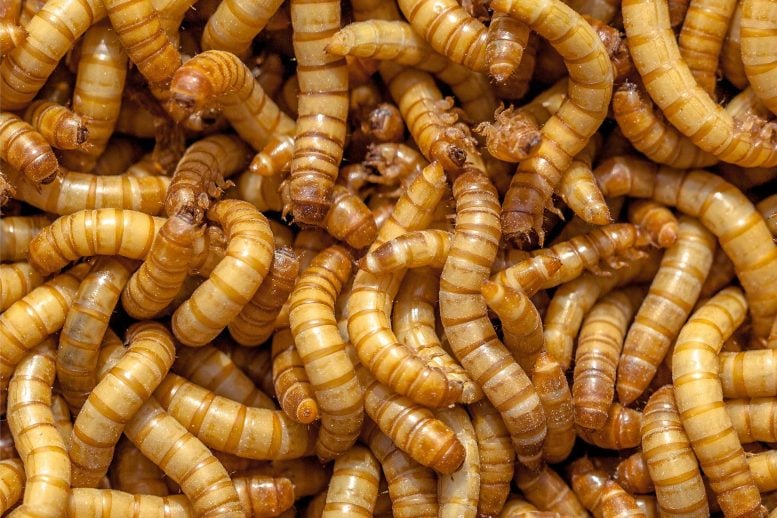
Scientists created “meat-like” flavors from mealworms, aiming to use them in convenience foods as a sustainable protein alternative to meat.
Most people consider Beetle larvae, such as mealworms, to be creepy, crawly nuisances. However, these insects are edible and could be a healthful alternative to traditional meat protein sources. Today, scientists report that they’ve cooked up mealworms with sugar, creating a “meat-like” flavoring. Someday, it could be used in convenience foods as a tasty source of extra protein.
The researchers presented their results last week at the fall meeting of the American Chemical Society (ACS). The meeting features nearly 11,000 presentations on a wide range of science topics.
Insects as a Nutritious and Environmentally Friendly Food Source
“Recently, eating insects has become of interest because of the increasing cost of animal protein, as well as the associated environmental issues,” says In Hee Cho, Ph.D., the project’s principal investigator.
According to the United Nations, the global human population is expected to reach 9.7 billion people by 2050 and nearly 11 billion by 2100. Feeding them all with animal meat — especially cows, pigs, and sheep — will require larger amounts of food, water, and land resources. Additionally, cows are a substantial contributor to climate change, releasing copious amounts of methane in their burps. Therefore, more sustainable sources of protein are needed.
“Insects are a nutritious and healthy food source with high amounts of fatty acids, vitamins, minerals, fiber, and high-quality protein, which is like that of meat,” says Cho, whose team is at Wonkwang University (South Korea).
A big issue is that mealworms suffer from an image problem, she says.
Eating insects isn’t common in many parts of the world, and people can be repulsed by just the idea of munching on them. Some companies are trying to change people’s minds by selling cooked whole mealworms as crunchy, salty snacks, but consumer acceptance is not widespread. Cho says that to get more people to regularly eat mealworms, a sneakier approach might be in order — hiding insects in the form of seasonings inside easy-to-cook and other convenience products.
The first step for the research team was to understand this insect’s flavor profile. They compared the aromas of mealworms throughout their lifecycle, from egg to larva to pupa to adult. Although there were some differences in the individual compounds, all of the stages primarily contained volatile hydrocarbons, which evaporate and give off scents. For example, raw larvae had wet soil-like, shrimp-like, and sweet corn-like aromas.
Hojun Seo, a graduate student on Cho’s team, then compared the flavors that developed as larvae were cooked with different methods. Mealworms that were steamed developed even stronger sweet corn-like aromas, whereas roasted and deep-fried versions had shrimp-like and fried oil-like attributes. According to Seo, the flavor compounds from roasting and frying included pyrazines, alcohols, and aldehydes, and were similar to the compounds formed when meat and seafood are cooked.
Creating “Meat-like” Flavors Using Mealworms and Sugar
Based on these results, the researchers expected that additional reaction flavors could be produced from the protein-rich mealworms if they were heated with sugar. Reaction flavors, sometimes called process flavors, are produced when proteins and sugars are heated together and interact. Examples include Maillard, Strecker, and caramelization reactions and fatty acid oxidation, says Cho. The result is usually a suite of “meat-like” and savory flavors.
Hyeyoung Park, a graduate student in Cho’s lab and the presenter at the meeting, tested different manufacturing conditions and ratios of powdered mealworm and sugars. This resulted in multiple versions of reaction flavors. She identified a total of 98 volatile compounds in the samples. The researchers then supplied the samples to a panel of volunteers to gather feedback about which had the most favorable “meat-like” odor. “As a result of this study, 10 of the reaction flavors were optimized based on consumer preferences,” says Park.
To the best of the researchers’ knowledge, this is the first time that mealworms have been used to produce desirable reaction flavors. They hope that these results will contribute to the commercial development of meat-like and savory flavorings and seasonings, and will encourage the convenience food industry to include edible insects in their products. The next step for the team is to further optimize cooking processes to reduce any potentially undesirable or off-flavors in the final flavoring material made from mealworms.
The researchers acknowledge support from the Rural Development Administration (South Korea) and Wonkwang University (South Korea).
Title
Comparison of aroma profiles from mealworm (Tenebrio molitor)-based reaction flavors optimized by consumer preferences
Abstract
Mealworm (Tenebrio molitor), which contains beneficial essential amino acids and is high in unsaturated fatty acids, is one of the most widely used edible insects in the world. However, edible insects are not universally accepted in our food cultures due to their repellant appearance and unique flavor characteristics. Therefore, many studies have been conducted on various processed food applications with mealworm. Our previous study had demonstrated the possibility of manufacturing mealworm-based reaction flavor (M-RF); the present investigated aroma profiles and the differences between M-RFs optimized by consumer preferences. A total of 98 volatile compounds were identified in M-RFs, including 17 nitrogen-containing heterocyclic compounds, 9 oxygen-containing heterocyclic compounds, 8 sulfur-containing heterocyclic compounds, 11 sulfides, 15 aldehydes, 6 ketones, 11 alcohols, 13 esters & acids, and 8 aliphatic hydrocarbons. The differences in M-RF aroma profiles were modeled using partial least squares-discriminant analysis. This indicated that M-RFs exhibiting larger amounts of methionine and garlic powder were located on the positive t[1] axis, while those with higher proportion of cysteine were on the negative t[1] axis. The main compounds contributing to this separation were linoleic acid ethyl ester, 2-pentylfuran, benzeneacetaldehyde, ethyl palmitate, benzaldehyde, ethyl oleate, 2-ethyl-3,5-dimethylpyrazine, and tricosane. Our model also revealed that M-RFs exhibiting higher proportion of garlic powder were located on the positive t[2] axis, while those with more methionine were on the negative t[2] axis. Ferruginol, diallyl sulfide, eugenol, 2-methyl-3-furanthiol, 2-furfurylthiol, 3-methyl-2-thiophenecarboxaldehyde, 1-hexanol, 2-nonen-4-one, allyl propyl sulfide, diallyl trisulfide, allyl prop-1-enyl disulfide, and 4-heptenal were associated with this discrimination.
Never miss a breakthrough: Join the SciTechDaily newsletter.
Follow us on Google and Google News.
2 Comments
Keep the bugs, not telling us about the bad things in them, hmmm
EWWWWWWW ! Gross I’d never eat them