
Physics Techniques Provide a Rare Glimpse Into the Early American Monetary History
Benjamin Franklin is often celebrated for inventing bifocals and the lightning rod. However, researchers from the University of Notre Dame suggest he should also be known for his innovative ways of making (literal) money.
During his career, Franklin printed nearly 2,500,000 money notes for the American Colonies using what the researchers have identified as highly original techniques, according to a recent study published in the Proceedings of the National Academy of Sciences.
Colonial Money and Counterfeiting Concerns
The research team, led by Khachatur Manukyan, an associate research professor in the Department of Physics and Astronomy, has spent the past seven years analyzing a trove of nearly 600 notes from the Colonial period, which is part of an extensive collection developed by the Hesburgh Libraries’ Rare Books and Special Collections. The Colonial notes span an 80-year period and include notes printed by Franklin’s network of printing shops and other printers, as well as a series of counterfeit notes.
Manukyan explained that the effort to print money for the fledgling Colonial monetary system was important to Franklin not just as a printer but as a statesman as well.
“Benjamin Franklin saw that the Colonies’ financial independence was necessary for their political independence. Most of the silver and gold coins brought to the British American colonies were rapidly drained away to pay for manufactured goods imported from abroad, leaving the Colonies without sufficient monetary supply to expand their economy,” Manukyan said.
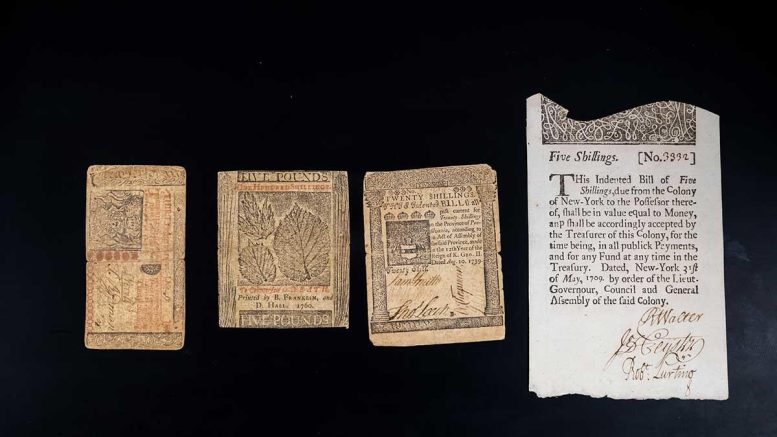
However, one major problem stood in the way of efforts to print paper money: counterfeiting. When Franklin opened his printing house in 1728, paper money was a relatively new concept. Unlike gold and silver, paper money’s lack of intrinsic value meant it was constantly at risk of depreciating. There were no standardized bills in the Colonial period, leaving an opportunity for counterfeiters to pass off fake bills as real ones. In response, Franklin worked to embed a suite of security features that made his bills distinctive.
“To maintain the notes’ dependability, Franklin had to stay a step ahead of counterfeiters,” said Manukyan. “But the ledger where we know he recorded these printing decisions and methods has been lost to history. Using the techniques of physics, we have been able to restore, in part, some of what that record would have shown.”
Scientific Analysis of Franklin’s Techniques
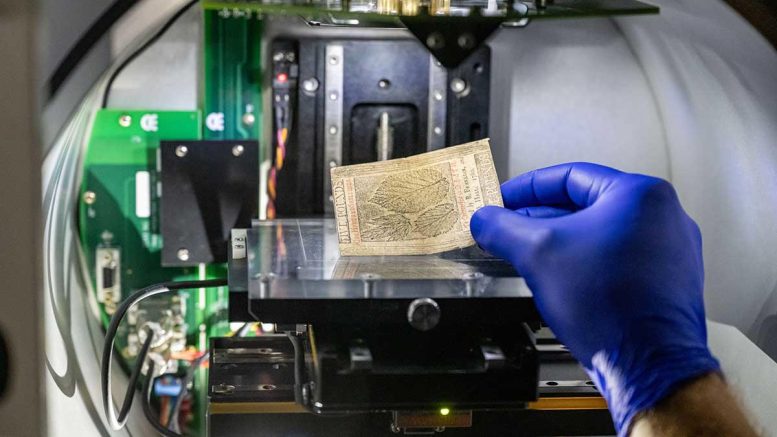
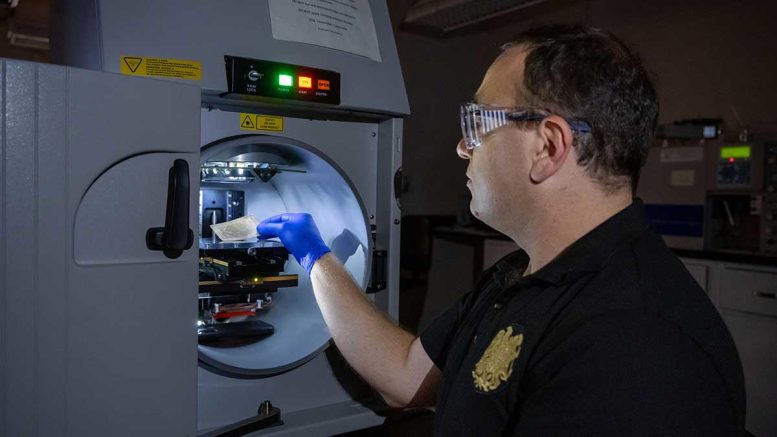
Manukyan and his team employed cutting-edge spectroscopic and imaging instruments housed in the Nuclear Science Laboratory and four Notre Dame research core facilities: the Center for Environmental Science and Technology, the Integrated Imaging Facility, the Materials Characterization Facility, and the Molecular Structure Facility. The tools enabled them to get a closer look than ever at the inks, paper, and fibers that made Franklin’s bills distinctive and hard to replicate.
One of the most distinctive features they found was in Franklin’s pigments. Manukyan and his team determined the chemical elements used for each item in Notre Dame’s collection of Colonial notes. The counterfeits, they found, have distinctive high quantities of calcium and phosphorus, but these elements are found only in traces in the genuine bills.
Their analyses revealed that although Franklin used (and sold) “lamp black,” a pigment created by burning vegetable oils, for most printing, Franklin’s printed currency used a special black dye made from graphite found in rock. This pigment is also different from the “bone black” made from burned bone, which was favored both by counterfeiters and by those outside Franklin’s network of printing houses.
Another of Franklin’s innovations was in the paper itself. The invention of including tiny fibers in paper pulp — visible as pigmented squiggles within paper money — has often been credited to paper manufacturer Zenas Marshall Crane, who introduced this practice in 1844. But Manukyan and his team found evidence that Franklin had included colored silks in his paper much earlier.
The team also discovered that notes printed by Franklin’s network have a distinctive look due to the addition of a translucent material they identified as muscovite. The team determined that Franklin began adding muscovite to his papers and the size of this muscovite crystals in his paper increased over time. The team speculates that Franklin initially began adding muscovite to make the printed notes more durable but continued to add it when it proved to be a helpful deterrent to counterfeiters.
Challenges and Collaborative Discoveries
Manukyan said that it is unusual for a physics lab to work with rare and archival materials, and this posed special challenges.
“Few scientists are interested in working with materials like these. In some cases, these bills are one-of-a-kind. They must be handled with extreme care, and they cannot be damaged. Those are constraints that would turn many physicists off to a project like this,” he said.
But for him, the project is a testament to the value of interdisciplinary work.
“We were fortunate to have student researchers on this project with interests both in physics as well as in history and art conservation. And the core research facilities as well as the Rare Books and Special Collections team were incredible research partners. Without an uncommon level of collaboration across disciplines, our discoveries would not have been possible.”
Reference: “Multiscale analysis of Benjamin Franklin’s innovations in American paper money” by Khachatur Manukyan, Armenuhi Yeghishyan, Ani Aprahamian, Louis Jordan, Michael Kurkowski, Mark Raddell, Laura Richter Le, Zachary D. Schultz, Liam Spillane and Michael Wiescher, 17 July 2023, Proceedings of the National Academy of Sciences.
DOI: 10.1073/pnas.2301856120
In addition to lead investigator Manukyan, the research team for this project included Armenuhi Yeghishyan, a laboratory technician in the Department of Physics and Astronomy; Ani Aprahamian, the Frank M. Freimann Professor of Physics and concurrent professor in the Department of Chemistry and Biochemistry; Louis Jordan, an associate University librarian emeritus for academic services and collections; Michael Kurkowski, a former undergraduate researcher studying physics and mathematics; Mark Raddell, a former undergraduate researcher studying finance and physics who is now a consultant at Deloitte; Laura Richter Le, a former undergraduate researcher who is now a graduate student at the Conservation Center at New York University’s Institute of Fine Arts; Zachary D. Schultz, a former associate professor at Notre Dame who is now a faculty member at the Ohio State University; Liam Spillane, who works at Gatan Inc.; and Michael Wiescher, the Frank M. Freimann Professor of Physics.
This research project was funded by an internal grant from Notre Dame Research.
Never miss a breakthrough: Join the SciTechDaily newsletter.
Follow us on Google and Google News.