
Close Menu
    Facebook X (Twitter) Instagram
    SciTechDaily
    • Biology
    • Chemistry
    • Earth
    • Health
    • Physics
    • Science
    • Space
    • Technology
    Facebook X (Twitter) Pinterest YouTube RSS
    SciTechDaily
    Home»Biology»Researchers Discover the Cell’s Secret Anti-Aging Mechanism
    Biology

    Researchers Discover the Cell’s Secret Anti-Aging Mechanism

    By Science China PressOctober 15, 2025No Comments4 Mins Read
    Facebook Twitter Pinterest Telegram LinkedIn WhatsApp Email Reddit
    Share
    Facebook Twitter LinkedIn Pinterest Telegram Email Reddit
    Golden Cell Anti Aging
    Scientists have discovered that boosting lysosome activity helps cells clear progerin, the toxic protein behind premature aging in progeria, offering a potential new way to fight aging-related diseases. Credit: Shutterstock

    Activating lysosome biogenesis helps alleviate cellular senescence in progeria.

    Hutchinson-Gilford progeria syndrome (HGPS) is a rare genetic condition that causes rapid aging and a range of visible and internal symptoms. Individuals with HGPS often experience early skin wrinkling, reduced skin elasticity, loss of body fat beneath the skin, hair loss, hardening of the arteries (atherosclerosis), and insulin resistance.

    Research has shown that about 90% of HGPS cases are linked to a defective protein called progerin, which disrupts normal cell function. Progerin exerts a dominant-negative effect, leading to several cellular problems such as nuclear envelope (NE) deformation, increased DNA damage, telomere shortening, cell cycle arrest, and poor cell proliferation.

    Recent studies have revealed that progerin is not limited to HGPS. It also appears in normal aging and chronic kidney disease (CKD), suggesting that it plays a broader role in age-related cellular decline. Because of this, improving the body’s ability to remove progerin has become an important focus for developing treatments targeting HGPS, CKD, and other diseases related to aging.

    A research team led by Professor Chuanmao Zhang from Peking University and Kunming University of Science and Technology has been studying the biological mechanisms behind both progeria and aging. In a new paper published in Science China Life Sciences, the group describes how progerin is cleared from cells through a lysosome-dependent pathway. Their work also identifies defects in lysosome function in HGPS and shows that enhancing lysosome biogenesis can repair these problems, promote progerin removal, and reduce cellular aging.

    These discoveries highlight the crucial role of lysosomes in maintaining cellular health and eliminating harmful proteins. The study offers fresh perspectives on how stimulating lysosome activity could lead to new treatments for HGPS, CKD, and other age-related disorders.
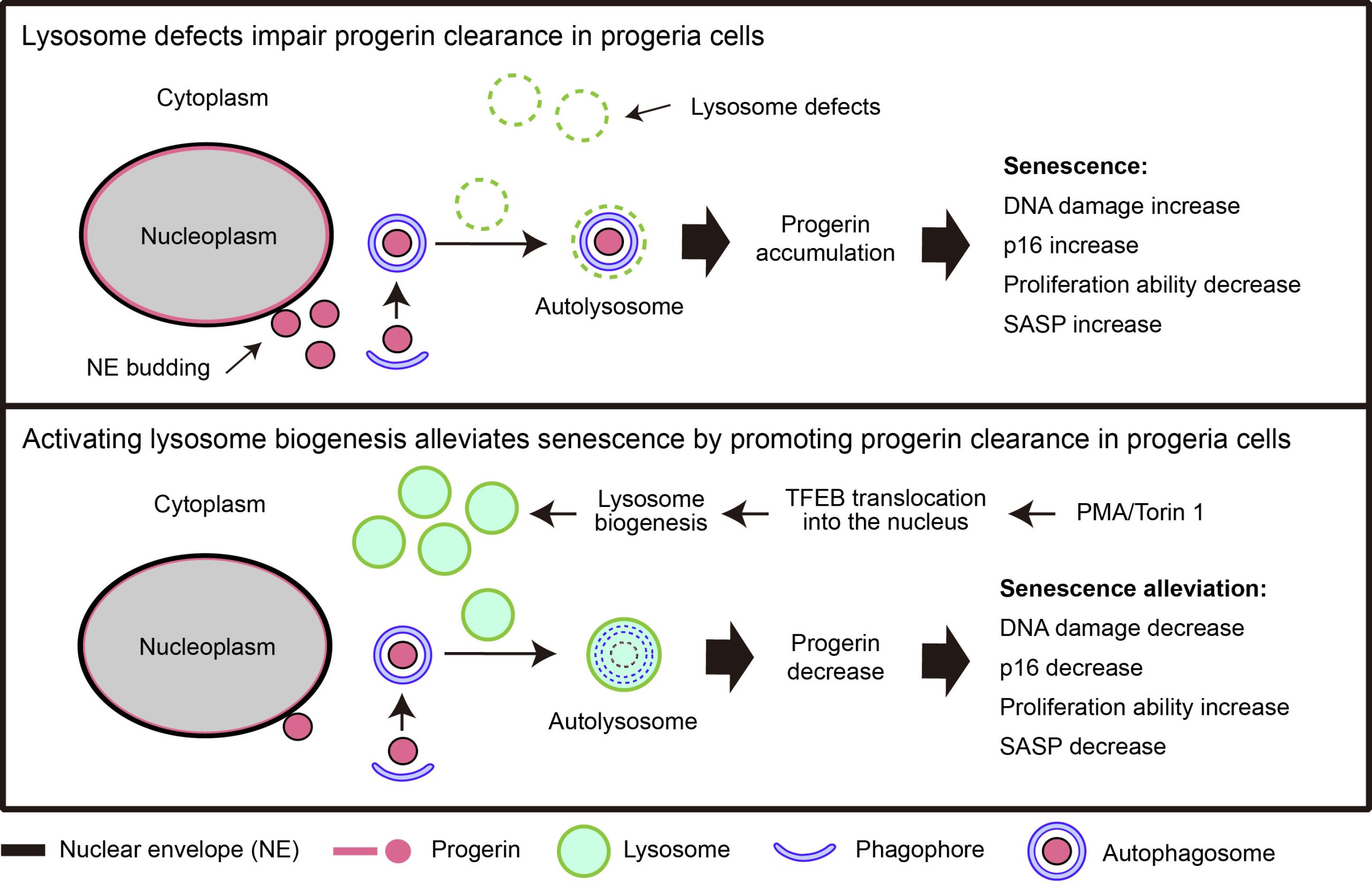
    Working Model of the Mechanism by Which Counteracting Lysosome Defects Alleviates Cellular Senescence in HGPS
    In HGPS cells, progerin can be expelled from the nucleus into the cytoplasm via nuclear envelope budding and degraded through lysosomes. However, lysosome defects, which impair progerin clearance, occur in progeria cells. PMA or Torin 1 treatment promotes the nuclear translocation of TFEB, activates lysosome biogenesis and progerin clearance in HGPS cells, and accordingly alleviates senescence phenotypes, including DNA damage, cell cycle arrest, low proliferation ability and SASP. (PMA, phorbol 12-myristate 13-acetate; SASP, senescence-associated secretory phenotype.) Credit: Science China Press

    Tracking Progerin Through the Cell

    Through immunofluorescence, live-cell imaging, and biochemical analyses, they discovered that the NE-localized progerin could be transported to the cytoplasm via NE budding and subsequently degraded through the autophagy-lysosome pathway. Further investigation revealed that progerin translocated to the cytoplasm was not efficiently cleared and accumulated in the cytoplasm.

    To elucidate the underlying molecular mechanisms, RNA sequencing was performed on primary cells from two HGPS patients, which demonstrated significant downregulation of genes associated with lysosomal function in both patients. Lysosome defects in HGPS were further validated by reverse transcription quantitative PCR (RT-qPCR), immunofluorescence, and biochemical assays.

    Subsequently, they explored whether counteracting lysosome defects could enhance progerin clearance and mitigate cellular senescence. Lysosome biogenesis was activated through two distinct approaches: stimulation of protein kinase C (PKC) or inhibition of mammalian target of rapamycin complex 1 (mTORC1). The results indicated that activation of lysosome biogenesis markedly counteracted lysosome defects, accelerated progerin clearance, and alleviated key senescence-associated phenotypes, including DNA damage, cell cycle arrest, and diminished proliferative capacity.

    In conclusion, this study not only delineates the critical role of lysosomes in progerin clearance but also highlights the anti-aging potential of targeting lysosome biogenesis, offering innovative therapeutic avenues for HGPS and other age-related disorders.

    Reference: “Counteracting lysosome defects alleviates the cellular senescence of Hutchinson-Gilford progeria syndrome” by Xiangyang Wang, Yihong Song, Mingkang Jia, Gan Zhao, Yumin Liu, Guangwei Xin, Bo Zhang, Qing Jiang and Chuanmao Zhang, 5 September 2025, Science China Life Sciences.
    DOI: 10.1007/s11427-025-2983-2

    Never miss a breakthrough: Join the SciTechDaily newsletter.
    Follow us on Google and Google News.

    Aging Cell Biology Genetics Longevity Science China Press
    Share. Facebook Twitter Pinterest LinkedIn Email Reddit

    Related Articles

    How Cells Use “Trash Bags” To Transport Their Waste for Recycling

    New Research Shows How to Boost Muscle Regeneration and Rebuild Tissue

    “Hot Spots” of Aging and Disease Revealed by How Brain Cells Repair Their DNA

    Accurate Aging of Wild Animals Thanks to Discovery of First Epigenetic Clock for Bats

    Researchers Solve Anti-aging Mystery – Identify Gene Responsible for Cellular Aging

    Scientists May Have Discovered a Way to to Slow Aging by Direct Reprogramming of Human Cells

    Bats Offer Clues to Treating COVID-19 – Secrets to Longevity and Disease Tolerance

    Genetic Self-Destruct – Some Worms Programmed to Die Early for Sake of Colony

    Synergistic Cellular Pathways Identified That Extend Lifespan by 500%

    Leave A Reply Cancel Reply

    • Facebook
    • Twitter
    • Pinterest
    • YouTube

    Don't Miss a Discovery

    Subscribe for the Latest in Science & Tech!

    Trending News

    New Pill Lowers Stubborn Blood Pressure and Protects the Kidneys

    Humans May Have Hidden Regenerative Powers, New Study Suggests

    Scientists Just Solved the Mystery of Why Crabs Walk Sideways

    Doctors Are Surprised by What This Vaccine Is Doing to the Heart

    This Popular Supplement May Boost Your Brain, Not Just Your Muscles

    Scientists Say This Simple Supplement May Actually Reverse Heart Disease

    Warming Oceans Could Trigger a Dangerous Methane Surge

    This Simple Movement Could Be Secretly Cleaning Your Brain

    Follow SciTechDaily
    • Facebook
    • Twitter
    • YouTube
    • Pinterest
    • Newsletter
    • RSS
    SciTech News
    • Biology News
    • Chemistry News
    • Earth News
    • Health News
    • Physics News
    • Science News
    • Space News
    • Technology News
    Recent Posts
    • Interstellar Comet 3I/ATLAS Came From a Place Nothing Like Our Solar System
    • Webb Space Telescope Reveals Rare Planet Pair That Shouldn’t Exist
    • Scientists Just Discovered How the Universe Builds Monster Black Holes
    • Physicists Solve Major Challenge in Quantum Synchronization
    • Scientists Solve 100-Year-Old Schrödinger Mystery About Color Perception
    Copyright © 1998 - 2026 SciTechDaily. All Rights Reserved.
    • Science News
    • About
    • Contact
    • Editorial Board
    • Privacy Policy
    • Terms of Use

    Type above and press Enter to search. Press Esc to cancel.