
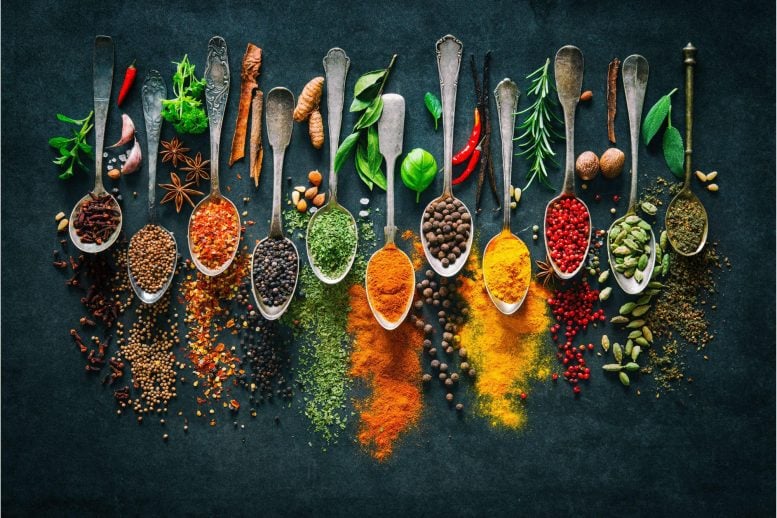
Healthier recipes using herbs and spices can reduce harmful nutrients while keeping meals flavorful.
In reaction to the 1990s’ obsession with low-fat diets, numerous food manufacturers eliminated saturated fats from their items, substituting them with sugars to keep the flavors intact. Regrettably, the modified products were not any healthier than the original versions, and today, the average individual ingests an excessive amount of saturated fat.
Now, a team of researchers from Penn State has discovered a method to reduce the amounts of saturated fat, sugar, and salt in popular American dishes without compromising on taste. The trick? Substituting the excessively consumed ingredients with a dose of healthy herbs and spices.
“Cardiovascular disease is the leading cause of death globally, and limiting saturated fat and sodium intake are key recommendations for reducing the risk of developing this disease,” said Kristina Petersen, associate professor of nutritional sciences, at Penn State. “Yet, we know that one of the key barriers to reducing intake of these ingredients is the flavor of the food. If you want people to eat healthy food, it has to taste good. That’s why our finding that participants actually preferred some of the recipes in which much of the saturated fat and salt was replaced with herbs and spices is so important.”
The team used a nationally representative database from the Centers for Disease Control and Prevention, called the National Health and Nutrition Examination Survey, to identify 10 of the most popular foods that are typically high in sodium, added sugars, and saturated fat. These included meatloaf, chicken pot pie, macaroni and cheese, and brownies.
Reinventing Recipes with Healthier Ingredients
Next, they worked with culinary experts to develop three versions of these recipes. The first contained typical amounts of saturated fat, sugar, and salt used in these recipes. The second version was nutritionally improved by removing the excess saturated fat, sugar, and salt. The third version had the same nutrient profile as the second version but also contained added herbs and spices, such as garlic powder, ground mustard seed, cayenne, cumin, rosemary, thyme, cinnamon, and vanilla extract.
For example, the typical macaroni and cheese recipe included salted butter, 2% milk, American cheese, and salt. For the nutritionally improved version, the researchers swapped the salted butter for unsalted butter and reduced the amount in the recipe by 75%. They swapped the 2% milk for skim milk, replaced some of the American cheese with reduced-fat cheese, and eliminated the extra salt. For the nutritionally improved, plus herbs and spices, version, the researchers added onion powder, garlic powder, ground mustard seed, paprika, and cayenne.
“Our goal was to see how much we could lower these overconsumed ingredients without affecting the overall properties of the food in terms of mouthfeel and structure, and then add in herbs and spices to improve the flavor,” said Petersen.
Next, the researchers conducted blind taste tests featuring each of the 10 recipes. Participants evaluated all three versions of a dish, one at a time, in a single session. Between 85 and 107 consumers completed each test. Participants rated several aspects of acceptability for each recipe, including overall liking and attribute liking, such as the food’s appearance, flavor, and texture. Participants then ranked the dishes in order of preference.
Some Healthier Versions Preferred Over Originals
“We found that adding herbs and spices restored the overall liking to the level of the original food in seven of the ten recipes,” said Petersen. “In fact, participants actually liked some of the recipes better than the originals.”
Specifically, participants liked the healthier, flavor-enhanced versions of the brownies and chicken in cream sauce significantly more than the original recipes. For five of the dishes –meatloaf, chili, apple pie, pasta with meat sauce, and taco meat – participants liked the healthier, flavor-enhanced versions about the same as the original versions. They liked the healthier, flavor-enhanced cheese pizza, mac and cheese, and chicken pot pie recipes less than the original versions.
Potential Impact on Public Health
Finally, the team modeled the potential impact of 25 to 100% of U.S. adult consumers eating these recipes instead of the original recipes. For both saturated fat and salt, they found that the estimated daily reduction would be about 3% if 25% of consumers adopted the healthier recipes versus about 11.5% if 100% of consumers adopted the healthier recipes. Smaller estimated reductions in added sugars were observed across the modeled range of consumer adoption.
The results were recently published in the Journal of the Academy of Nutrition and Dietetics.
“We demonstrated a meaningful reduction in overconsumed nutrients is possible with modification of these 10 recipes, and these changes are acceptable to consumers,” said Petersen. “This suggests that more research should be done to look at how to implement this more broadly, and how to educate people to make these kinds of changes. Importantly, these findings could be applied to the food supply because most foods that people consume are purchased in a prepared form. I think that would have a profound impact on people’s health.”
Reference: “Using herbs/spices to enhance the flavor of commonly consumed foods reformulated to be lower in overconsumed dietary components is an acceptable strategy and has the potential to lower intake of saturated fat and sodium: A National Health and Nutrition Examination Survey analysis & blind tasting” by Kristina S. Petersen, Victor L. Fulgoni, Helene Hopfer, John E. Hayes, Rachel Gooding and Penny Kris-Etherton, 31 July 2023, Journal of the Academy of Nutrition and Dietetics.
DOI: 10.1016/j.jand.2023.07.025
Other authors on the paper include Victor Fulgoni, senior vice president, Nutrition Impact LLC; Helene Hopfer, associate professor of food science, Penn State; John Hayes, professor of food science, Penn State; Rachel Gooding, senior research chef, McCormick & Co.; and Penny Kris-Etherton, Emeritus Evan Pugh University professor of nutritional sciences, Penn State.
The McCormick Science Institute supported this research.
Never miss a breakthrough: Join the SciTechDaily newsletter.
Follow us on Google and Google News.