
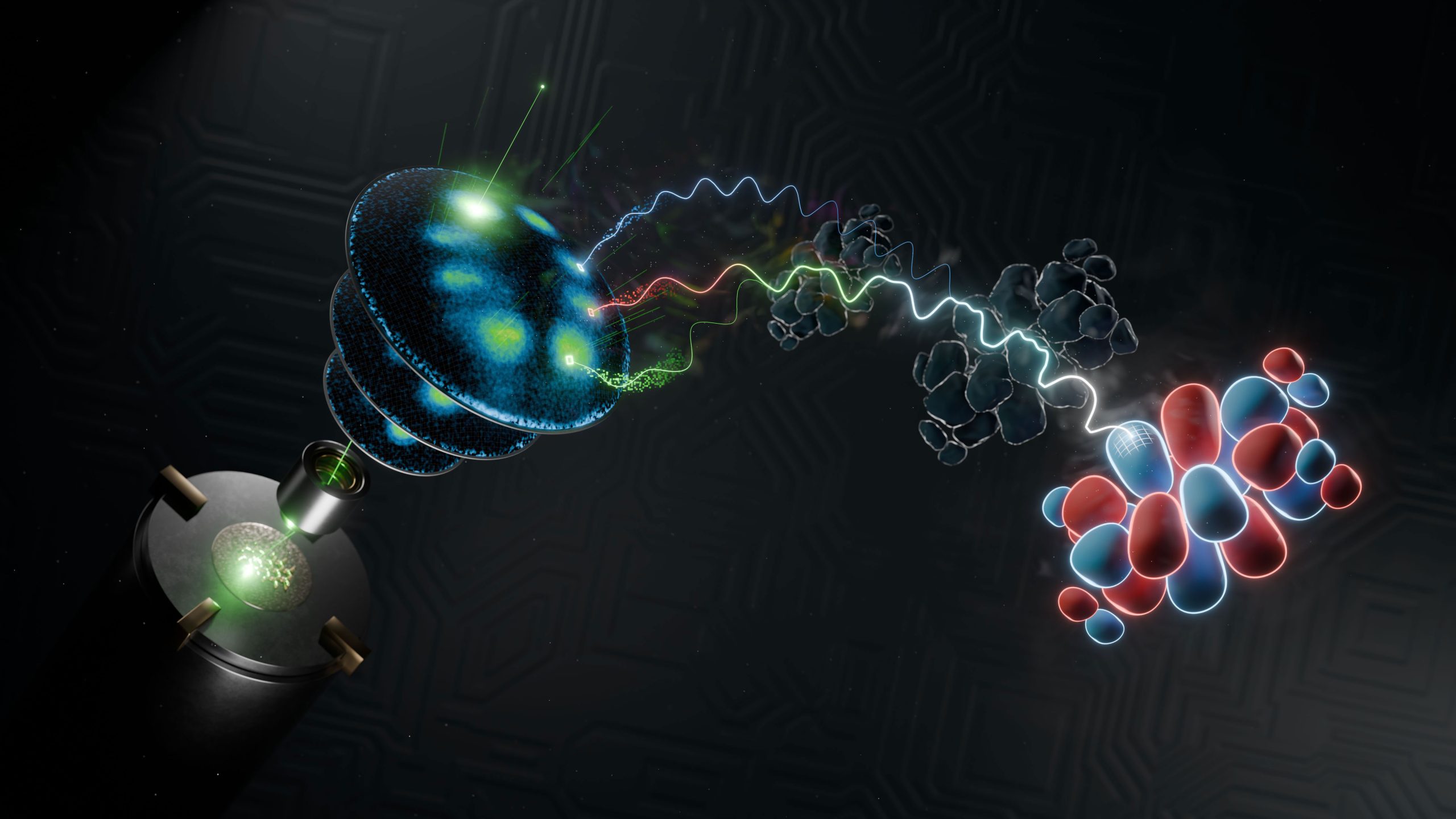
Physicists at Göttingen University imaged three-dimensional wave functions using a tabletop soft X-ray laser.
An electron inside a molecule does not occupy one fixed point. Quantum mechanics instead describes it through a “wavefunction,” a mathematical map that gives the probabilities of properties such as position and momentum.
Within molecules, these electron wavefunctions are known as “molecular orbitals.” Their shapes contain information about how a molecule may absorb light, interact with its surroundings, or undergo a chemical reaction.
Capturing the complete three-dimensional wavefunction would therefore give researchers a powerful view of molecular behavior. Yet producing such an image has remained a major experimental challenge.
An interdisciplinary group at the University of Göttingen has now imaged the three-dimensional wavefunction of a nanometer-sized organic molecule. By combining advanced photoelectron spectroscopy with mathematical algorithms, the researchers reconstructed details at scales smaller than the distance between neighboring carbon atoms. The results were published in Nature Communications.
An indirect method reconstructs the orbital
“The wavefunction is a fundamental quantity in quantum mechanics, yet it cannot be directly observed or measured,” explains Professor Stefan Mathias at the University of Göttingen.
The researchers instead used photoelectron spectroscopy, an indirect technique that measures the momentum of electrons emitted from a molecule. Those measurements revealed one half of the wavefunction without physically changing its state.
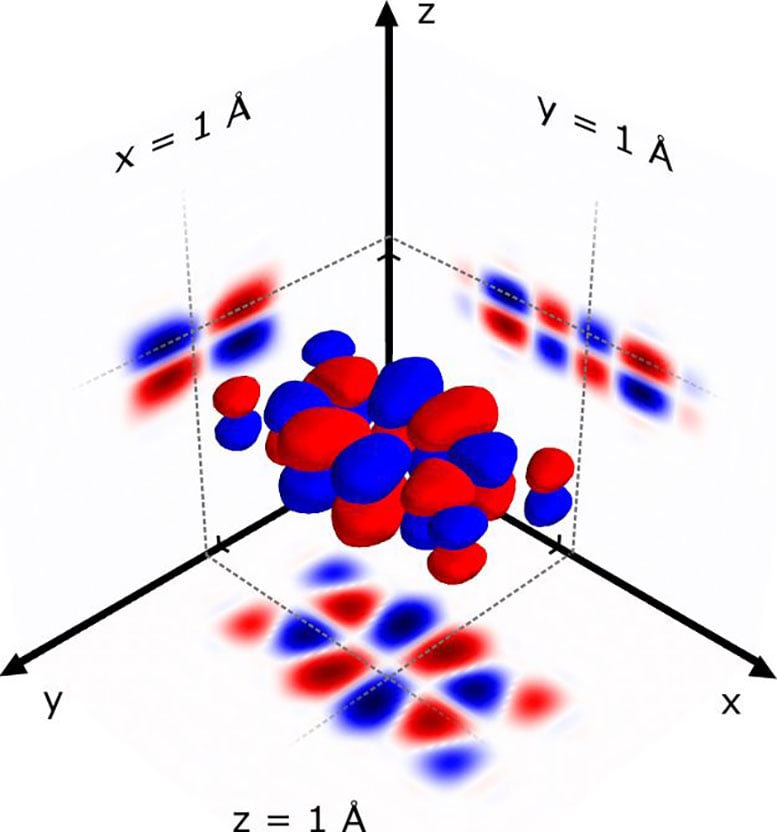
Advanced computer algorithms then calculated the missing half, producing an image of the complete molecular orbital. The reconstruction resolved features smaller than the spacing between the carbon atoms within the molecule.
Previously, extending this technique into three dimensions required lengthy measurements at large-scale synchrotron facilities. That limited its wider use and made it particularly difficult to capture “dynamical” wavefunctions as three-dimensional videos at the scale of individual atoms.
Less data could enable molecular movies
Dr Matthijs Jansen of the University of Göttingen, co-leader of the study, describes the two advances that made the new approach possible.
“We introduce two powerful new concepts. First, by redesigning the computer algorithm from the ground up, reliable 3D images can now be obtained using much less experimental data. Second, the experiment is based upon a powerful, lab-based soft-X-ray light source that provides ultrashort light pulses. It is the combination of these two techniques that has this remarkable impact.”
The redesigned algorithm reduces the amount of experimental data needed, while the laboratory soft-X-ray source supplies the ultrashort pulses required for rapid measurements. Together, these tools could make three-dimensional wavefunction imaging more practical without relying exclusively on large synchrotron facilities.
Dr Wiebke Bennecke, first author of the study, adds: “This technique might mean that stroboscopic videography becomes a reality, allowing us to observe not just the shape of wavefunctions, but also to see how it changes with ultrafast, even femtosecond or one quadrillionth of a second, resolution. This will mean we can learn how a molecule adapts to optical, electronic, or chemical changes and find new ways to control these interactions at the level of a few atoms.”
Reference: “Table-top three-dimensional photoemission orbital tomography with a femtosecond extreme ultraviolet light source” by Wiebke Bennecke, Thi Lan Dinh, Jan Philipp Bange, David Schmitt, Marco Merboldt, Lennart Weinhagen, Bent van Wingerden, Fabio Frassetto, Luca Poletto, Marcel Reutzel, Daniel Steil, D. Russell Luke, Stefan Mathias and G. S. Matthijs Jansen, 19 June 2026, Nature Communications.
DOI: 10.1038/s41467-026-74308-1
This research was funded by the Deutsche Forschungsgemeinschaft (DFG, German Research Foundation) – Project numbers 432680300/SFB 1456 (project B01), 217133147/SFB 1073 (projects B07 and B10), 535247173/SPP2244, 510228793/SFB 1633 (project C01), and 566257456.
Never miss a breakthrough: Join the SciTechDaily newsletter.
Follow us on Google and Google News.
3 Comments
It has been measured and modeled. Pizzaconstantlive.online
One might ask when electrons are finally going to die? But hey, nice name. That’s what it takes.
Mainstream quantum mechanics treats the Göttingen 3D orbital mapping as a statistical probability cloud, but the underlying geometry tells a direct mechanical story. Under the Torsion Hill Framework (V24), reconstructing the 3D phase profile from flat 2D photoelectron slices reflects the dimensional ingestion algebra where $(2\text{D}+\text{T}) + (3\text{D}+\text{T})$ resolves into an active spatial matrix. Mapping sub-angstrom phase contours directly validates that electron orbitals operate as continuous, 3D vector helical field topologies governed by strict spatial clearance limits (REF-004).