
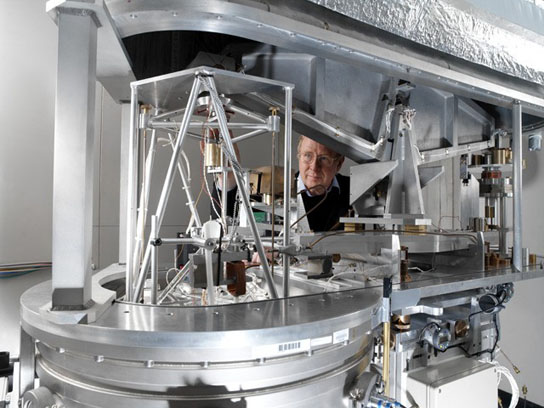
Researchers at the National Physical Laboratory are one step closer to changing the international definition of the kilogram. By using technology produced by the NPL, scientists will be able to redefine the kilogram in terms of Planck’s constant.
The international system of units (SI) is the most widely used system of measurement for commerce and science. Ideally, the seven base units within the SI (meter, kilogram, second, kelvin, ampere, mole, and candela) should be stable over time and universally reproducible, which requires definitions based on fundamental constants of nature. The kilogram is the only unit still defined by a physical artifact.
Planck’s constant is a fundamental constant of nature which relates the frequency (color) of a particle of light (a photon) to its energy. By using two quantum mechanical effects discovered in the last 60 years: the Josephson effect and the quantum Hall effect, electrical power can be measured in terms of Planck’s constant (and time).
The watt balance — first proposed by Brian Kibble at NPL in 1975 — relates electrical power to mechanical power. This allows for very accurate measurements of Planck’s constant in terms of the SI units of mass, length and time. The SI units of length and time are already fixed in terms of fundamental and atomic constants. If the value of Planck’s constant is fixed, the watt balance would provide a method of measuring mass.
The General Conference on Weights and Measures (CGPM) agrees that the kilogram should be redefined in terms of Planck’s constant. NPL’s research describes how this can be done with the required level of certainty and provides a measured value of Planck’s constant and extensive analysis of possible uncertainties that can arise during experimentation. Thanks to the improvements highlighted in this research, measurements at the National Research Council in Canada, which is now using the NPL equipment, look set to provide considerably greater accuracy.
Although these results alone are not enough to form a final agreement on the value of Planck’s constant, consistent results from other measurement institutes, using the same techniques and technology, will provide an even more accurate consensus value and a change to the way the world measures mass – possibly as soon as 2014.
A Planck-based kilogram would mean a universal standard that could be replicated anywhere in the world at any time. It will also bring much greater long-term certainty to scientists who rely on the SI for precise measurements, or the Planck constant itself.
Ian Robinson, who leads the project at NPL, said:
“This research will underpin the world’s measurement system and ensure the long term stability of the very top level of mass measurement. Although the man on the street won’t see much difference — you’ll still get the same 1kg bag of potatoes — these standards will ultimately be used to calibrate the world’s weighing systems, from accurate scientific instruments, right down the chain to domestic scales.”
Reference: “Towards the redefinition of the kilogram: a measurement of the Planck constant using the NPL Mark II watt balance” by I A Robinson, 20 December 2011, Metrologia.
DOI: 10.1088/0026-1394/49/1/016
Never miss a breakthrough: Join the SciTechDaily newsletter.
Follow us on Google and Google News.