
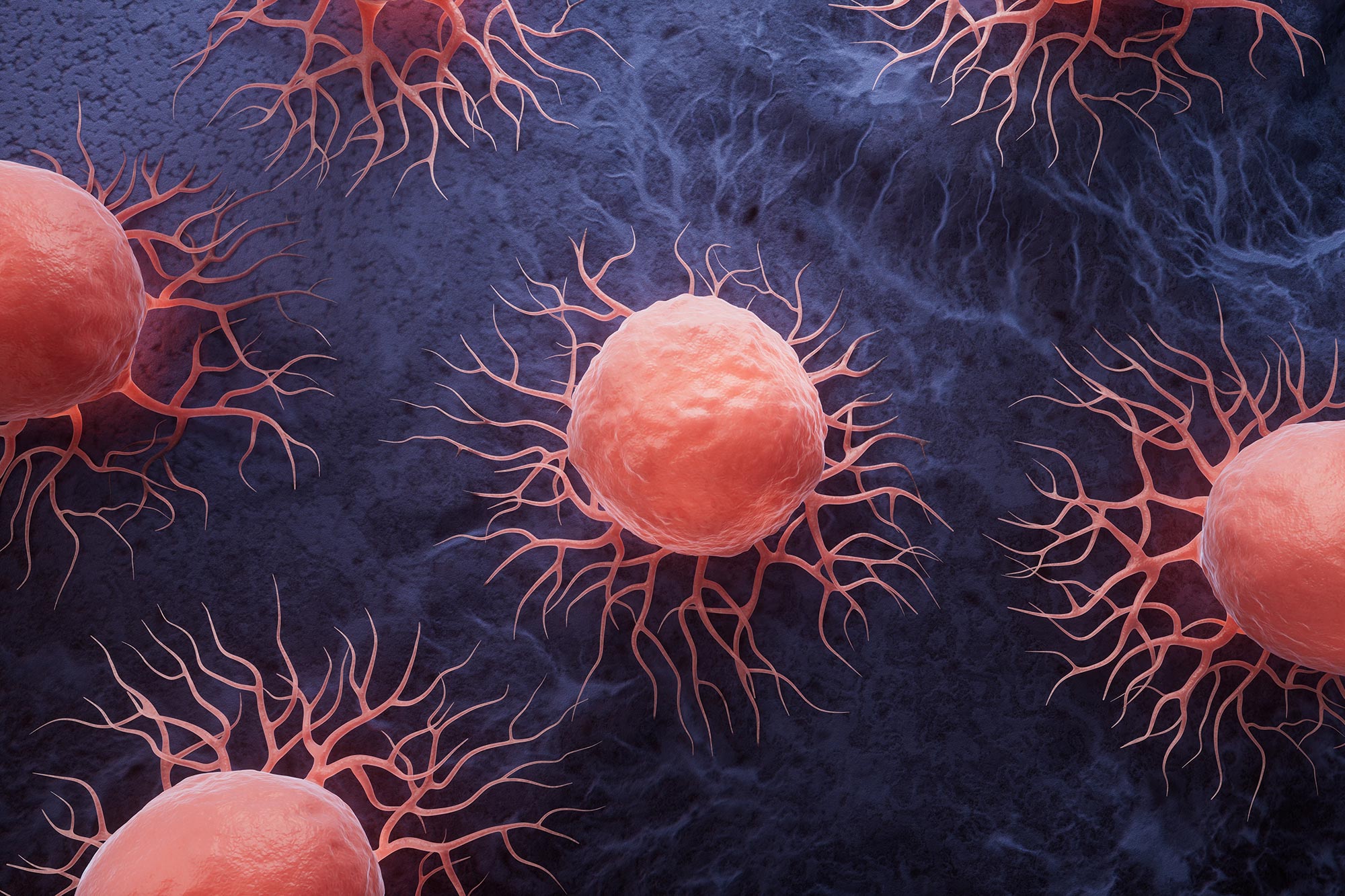
A hormone-receptor interaction weakens immunity. Targeting it could fight cancer.
Scientists at UT Southwestern Medical Center have identified how a hormone binds to a receptor on immune cells, allowing cancer cells to evade the body’s defenses. The study, published in Nature Immunology, points to potential new directions in cancer immunotherapy and may also open avenues for treating inflammatory and neurological conditions.
“Myeloid cells are among the first group of immune cells recruited to tumors, but very quickly these tumor-fighting cells turn into tumor-supporting cells. Our study suggests that receptors on these myeloid cells get stimulated by this hormone and end up suppressing the immune system,” said Cheng Cheng “Alec” Zhang, Ph.D., Professor of Physiology and a member of the Harold C. Simmons Comprehensive Cancer Center at UT Southwestern. Dr. Zhang co-led the study with first author Xing Yang, Ph.D., a postdoctoral researcher in the Zhang Lab.

Dr. Zhang noted that current immunotherapies, such as immune checkpoint inhibitors, only benefit about 20%-30% of patients. This limited success suggests that cancer uses multiple strategies to escape detection and destruction by the immune system.
Discovery of LILRB4 receptor
Several years ago, researchers in the Zhang Lab examined how myeloid cells, a type of immune cell that normally attacks cancer, could be suppressed. They identified an inhibitory receptor called LILRB4, and when this receptor was activated, the myeloid cells lost their ability to target tumors.
Building on that discovery, Dr. Zhang, Dr. Yang, and their team conducted a genome-wide search for proteins that interact with LILRB4. One strong candidate was a hormone known as SCG2. While earlier studies hinted that SCG2 might influence immune activity, its precise role and receptor were not established. Laboratory tests confirmed that SCG2 binds directly to LILRB4, triggering a signaling cascade that shut down the tumor-fighting function of myeloid cells and prevented them from recruiting T cells to attack tumors.
In mice genetically altered to express the human form of LILRB4, injected cancer cells that produced SCG2 grew rapidly as tumors. Treating these mice with an antibody that blocks LILRB4 significantly slowed cancer growth, as did artificially ridding the animals’ bodies of SCG2.
Together, these experiments suggest that interactions between LILRB4 and SCG2 allow cancer to grow unchecked by myeloid cells, T cells, and potentially other immune cell types. Dr. Zhang suggested that disrupting this interaction could someday offer a new immunotherapy option to treat cancer. Conversely, because this interaction neutralizes myeloid cells’ immune activity, delivering extra SCG2 could be a promising treatment for autoimmune or inflammatory disorders spurred by myeloid cells. Dr. Zhang and his colleagues plan to investigate both ideas in future studies.
Reference: “Secretogranin 2 binds LILRB4 resulting in immunosuppression” by Xing Yang, Ryan Huang, Meng Fang, Yubo He, Jingjing Xie, Xiaoye Liu, Chengcheng Zhang, Qi Lou, Mi Deng, Wei Xiong, Cheryl Lewis, Zade Sadek, Ankit Gupta, Lianqi Chen, Xuewu Zhang, Lei Guo, Lin Xu, Ningyan Zhang, Zhiqiang An and Cheng Cheng Zhang, 24 July 2025, Nature Immunology.
DOI: 10.1038/s41590-025-02233-4
This study was funded by grants from the National Cancer Institute (NCI) (R01CA248736, R01CA263079, and Lung Cancer 779 SPORE Development Research Program), the Cancer Prevention and Research Institute of Texas (RP220032, RP15150551, RP190561), The Welch Foundation (AU-0042-20030616, I-1702), Immune-Onc Therapeutics Inc. (Sponsored Research Grant No. 111077), the National Institutes of Health (R35GM130289), and NCI Cancer Center Support Grant (P30CA142543).
The University of Texas has a financial interest in Immune-Onc in the form of equity and licensing. Dr. Alec Zhang holds equity in and had sponsored research agreements with Immune-Onc.
Never miss a breakthrough: Join the SciTechDaily newsletter.
Follow us on Google and Google News.
3 Comments
Wow! They are right on that cutting edge of curing cancer.
Yeah, just like they have been for 70 years!
So check for and locate any LILRB4 cells and dispose of them correctly and/or turn the LILRB4 receptors off from their activation methods to turn off the LILRB4 and eat and digest the dead, damaged, abnormal and foreign cells and exchange the dead, damaged, abnormal cells and foreign cells, possibly turn on and activate The T-Cells scouting for tumors and bypass the LILRB4 and turn the receptors that produce LILRB4 off, by switching to 1 of the normal receptors for normal receptors signals… We could also just turn the altered to be LILRB4 signal to 1 of the receptors original receptors producing the signals and change those signals to normal receptors’ signals and not produce LILRB4… We could also train T-Cells to ignore the LILRB4 signals of the receptors… Though changing it would be better…