
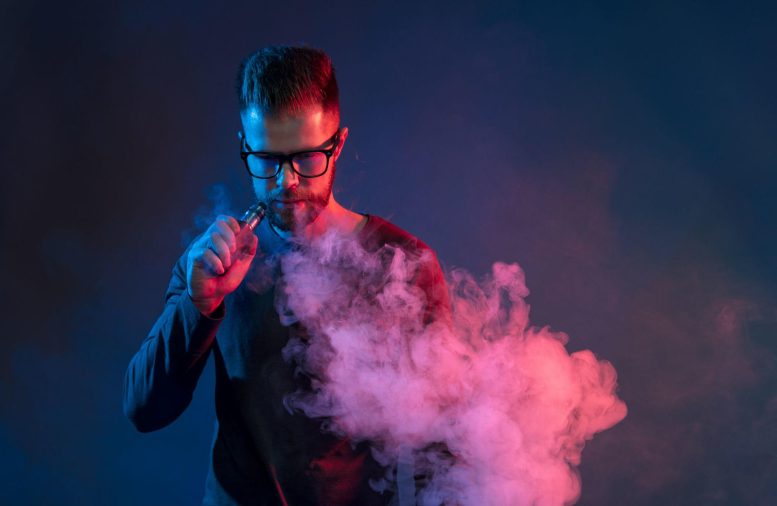
Vaping negatively impacts lung surfactant, reducing its function and potentially increasing susceptibility to lung injuries.
A preclinical study recently published by researchers at Lawson Health Research Institute and Western University’s Schulich School of Medicine & Dentistry suggests that vaping may have negative effects on the pulmonary surfactant in the lungs.
Surfactant, a critical layer made of lipids and proteins, is essential for easy breathing by reducing surface tension in the lungs. Without surfactant, it would take more effort to breathe and a person would need mechanical help to do so.
“Vaping continues to be popular but not much is known about what happens with the aerosol when it enters the lungs,” says Dr. Ruud Veldhuizen, Lawson Scientist and Professor at Schulich Medicine & Dentistry. “We realized that the first thing the vapor aerosol comes in contact with in the lungs is pulmonary surfactant, which is an area our team specializes in.”
Flavors and Additives Influence Lung Effects
The research team was able to study the effects by placing a film of surfactant inside a syringe and, then using a vaping device to push aerosol into the syringe. This allowed the vapor to directly interact with the surfactant. The researchers then mimicked inhaling and exhaling vapor into the syringe 30 times to resemble a standard vaping session.
“In particular we were looking at the surface tension in the surfactant,” explains Emma Graham, Master’s student at Schulich Medicine & Dentistry. “After vaping, we saw high surface tension which suggests the surfactant would not be as effective at supporting proper lung functioning.”
The team also examined different vaping devices, flavors, additives, and nicotine to see if there were any differences in effects.
“Nicotine didn’t have any worse effects on the surface tension of surfactant compared to other e-liquids, but some flavorings like menthol e-liquid did,” says Graham.
While his team intends to study this further, Veldhuizen says these findings could provide an indication as to why people who vape have a susceptibility to develop lung injury, including those with respiratory viruses such as COVID-19.
“We would like to get this information out there so that people know vaping may be damaging to the lungs,” says Veldhuizen. “As a next step, we hope to further investigate the effects of vaping on the lungs and how we can treat resulting injury.”
Reference: “E-cigarette aerosol exposure of pulmonary surfactant impairs its surface tension reducing function” by Emma Graham, Lynda McCaig, Gloria Shui-Kei Lau, Akash Tejura, Anne Cao, Yi Y. Zuo and Ruud Veldhuizen, 9 November 2022, PLOS One.
DOI: 10.1371/journal.pone.0272475
These findings build on a body of research about the impacts of vaping through Lawson and Schulich Medicine & Dentistry. The researchers were the first in the world to report on a potential new type of vaping-related injury in 2019.
Never miss a breakthrough: Join the SciTechDaily newsletter.
Follow us on Google and Google News.
6 Comments
That’s good news. Medicine may be able to mitigate potential mild negative effects of vaping. Experimentation could also lead to even safer formulations. It seems to be one of the safest things a person could do in a day, far from the terror of breathing near a home with a stove, but science can inform people’s choices and improve the options they enjoy.
Nobody inhales 30 lungfuls of vapor in a “standard vaping session.” Most people hit it once or twice and put it down for a while. That would be insane.
I periodically bring up phlegm with maroon coloured bits, _ have vaped for 8 years….. quit now 22 months ,tg. No results yet from my cat scan ….:(
no one is vaping that much
Ya gotta love these tests. 30? Really? I bet if you follow the money it leads back to Big Tobacco and the master settlement agreement. Just like the American lung association etc. There’s so much money in tobacco whether it’s the smoking or the healthcare or the cessation.
This reminds me of the tests that got sassafras labeled as “carcinogenic” and therefore struck from the list purchasable substances in the name of the drug war. Whenever they do this they literally feed rats up to 100 to 1000 times the normal exposure rate of a substance and then claim, through some “academic” agency, that said substance is “harmful” or “carcinogenic.
But the hypocrisy is apparent when you can’t make root beer because “sassafras carcinogenic” but you can purchase numerous carcinogenic substances easily, like gasoline or benzene derivative aromatics and paint thinners, without even a blink from these same agencies.
I wonder what the government or industry subsidy for Western was to sell their soul? If you do this s*** you’re not a scientist, you’re a schill.
Remember when an undergraduate student fed monkeys mass amounts of methamphetamine so NIDA and the DEA could claim “MDMA puts holes in your brain”? Yeah…you probably don’t, but I do.
Pure garbage.