
Material Could Be Used in Future Quantum Computing Applications
An international team of physicists led by the University of Minnesota has discovered that a unique superconducting metal is more resilient when used as a very thin layer. The research is the first step toward a larger goal of understanding unconventional superconducting states in materials, which could possibly be used in quantum computing in the future.
The collaboration includes four faculty members in the University of Minnesota’s School of Physics and Astronomy—Associate Professor Vlad Pribiag, Professor Rafael Fernandes, and Assistant Professors Fiona Burnell and Ke Wang—along with physicists at Cornell University and several other institutions. The study is published in Nature Physics, a monthly, peer-reviewed scientific journal published by Nature Research.
Unique Properties of NbSe₂ in 2D
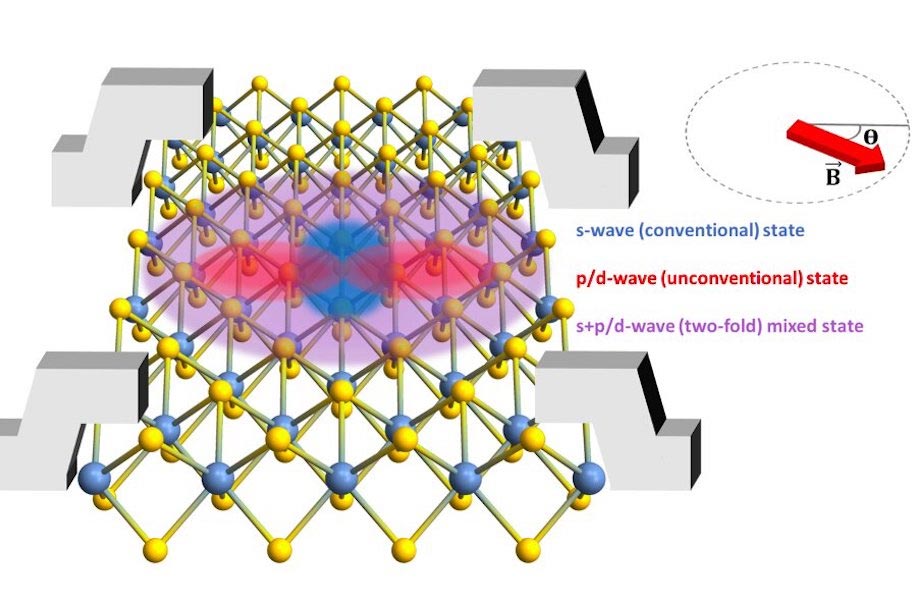
Niobium diselenide (NbSe2) is a superconducting metal, meaning that it can conduct electricity, or transport electrons from one atom to another, with no resistance. It is not uncommon for materials to behave differently when they are at a very small size, but NbSe2 has potentially beneficial properties. The researchers found that the material in 2D form (a very thin substrate only a few atomic layers thick) is a more resilient superconductor because it has a two-fold symmetry, which is very different from thicker samples of the same material.
Motivated by Fernandes and Burnell’s theoretical prediction of exotic superconductivity in this 2D material, Pribiag and Wang started to investigate atomically-thin 2D superconducting devices.
“We expected it to have a six-fold rotational pattern, like a snowflake,” Wang said. “Despite the six-fold structure, it only showed two-fold behavior in the experiment.”
“This was one of the first times [this phenomenon] was seen in a real material,” Pribiag said.
Mixing Conventional and Unconventional Superconductivity
The researchers attributed the newly-discovered two-fold rotational symmetry of the superconducting state in NbSe2 to the mixing between two closely competing types of superconductivity, namely the conventional s-wave type—typical of bulk NbSe2—and an unconventional d- or p-type mechanism that emerges in few-layer NbSe2. The two types of superconductivity have very similar energies in this system. Because of this, they interact and compete with each other.
Pribiag and Wang said they later became aware that physicists at Cornell University were reviewing the same physics using a different experimental technique, namely quantum tunneling measurements. They decided to combine their results with the Cornell research and publish a comprehensive study.
Burnell, Pribiag, and Wang plan to build on these initial results to further investigate the properties of atomically thin NbSe2 in combination with other exotic 2D materials, which could ultimately lead to the use of unconventional superconducting states, such as topological superconductivity, to build quantum computers.
“What we want is a completely flat interface on the atomic scale,” Pribiag said. “We believe this system will be able to give us a better platform to study materials to use them for quantum computing applications.”
Reference: “Two-fold symmetric superconductivity in few-layer NbSe2” by Alex Hamill, Brett Heischmidt, Egon Sohn, Daniel Shaffer, Kan-Ting Tsai, Xi Zhang, Xiaoxiang Xi, Alexey Suslov, Helmuth Berger, László Forró, Fiona J. Burnell, Jie Shan, Kin Fai Mak, Rafael M. Fernandes, Ke Wang and Vlad S. Pribiag, 15 April 2021, Nature Physics.
DOI: 10.1038/s41567-021-01219-x
In addition to Pribiag, Fernandes, Burnell, Wang, the collaboration included University of Minnesota physics graduate students Alex Hamill, Brett Heischmidt, Daniel Shaffer, Kan-Ting Tsai, and Xi Zhang; Cornell University faculty members Jie Shan and Kin Fai Mak and graduate student Egon Sohn; Helmuth Berger and László Forró, researchers at Ecole Polytechnique Fédérale de Lausanne in Switzerland; Alexey Suslov, a researcher at the National High Magnetic Field Laboratory in Tallahassee, Fla.; and Xiaoxiang Xi, a professor at Nanjing University in China.
The University of Minnesota research was supported primarily by the National Science Foundation (NSF) through the University of Minnesota Materials Research Science and Engineering Center (MRSEC). The research at Cornell was supported by the Office of Naval Research (ONR) and NSF. The work in Switzerland was supported by the Swiss National Science Foundation.
Never miss a breakthrough: Join the SciTechDaily newsletter.
Follow us on Google and Google News.
1 Comment
The team should read ROOM TEMPERATURE SUPERCONDUCTORS at aesopinstitute.org for a possible alternative. These polymer superconductors conduct through a thin layer.