

Used stone edges might help illuminate timber use by early humans.
Researchers from Tokyo Metropolitan University crafted replica Stone Age tools and used them for a range of tasks to see how different activities create traces on the edge. They found that a combination of macroscopic and microscopic traces can tell us how stone edges were used. Their criteria help separate tools used for wood-felling from other activities. Dated stone edges may be used to identify when timber use began for early humans.
Advancements in Woodworking Technology
For prehistoric humans, improvements in woodworking technology were revolutionary. While Paleolithic (early Stone Age) artifacts point to the use of wood for simple tools such as spears or throwing sticks, later Mesolithic and Neolithic artifacts reflect far more sophisticated uses, for building houses, canoes, bows, and wells. This is underscored by the availability of tools that let people craft more and more complex wooden instruments, particularly polished stone axes.
Investigating Early Use of Stone Tools
But while developed wood-processing technology is generally believed to be associated with a way of life seen in the Neolithic age of the Holocene, starting approximately 10,000 years ago, ground stone axes have been found from periods significantly before this. In sites around Australia and Japan, many ground edge artifacts from Marine Isotope Stage 3 (about 60,000 – 30,000 years ago) have been recovered. The important question becomes what they were used for at such an early stage.
To address this, a team led by Assistant Professor Akira Iwase from Tokyo Metropolitan University has tried to establish what kinds of traces might be left on ground stone edges when they are used for different activities. They took a hands-on approach, and crafted replicas of tools that might have been used in the Early Upper Paleolithic age (about 38,000 – 30,000 years ago). Edges were crafted and polished using knapping and grinding techniques which would have been available at the time. Though hafts have not been recovered from Japanese sites of the period, they adopted methods from Irian Jaya to attach a handle to the stone edges to create adzes, axes, and chisels.
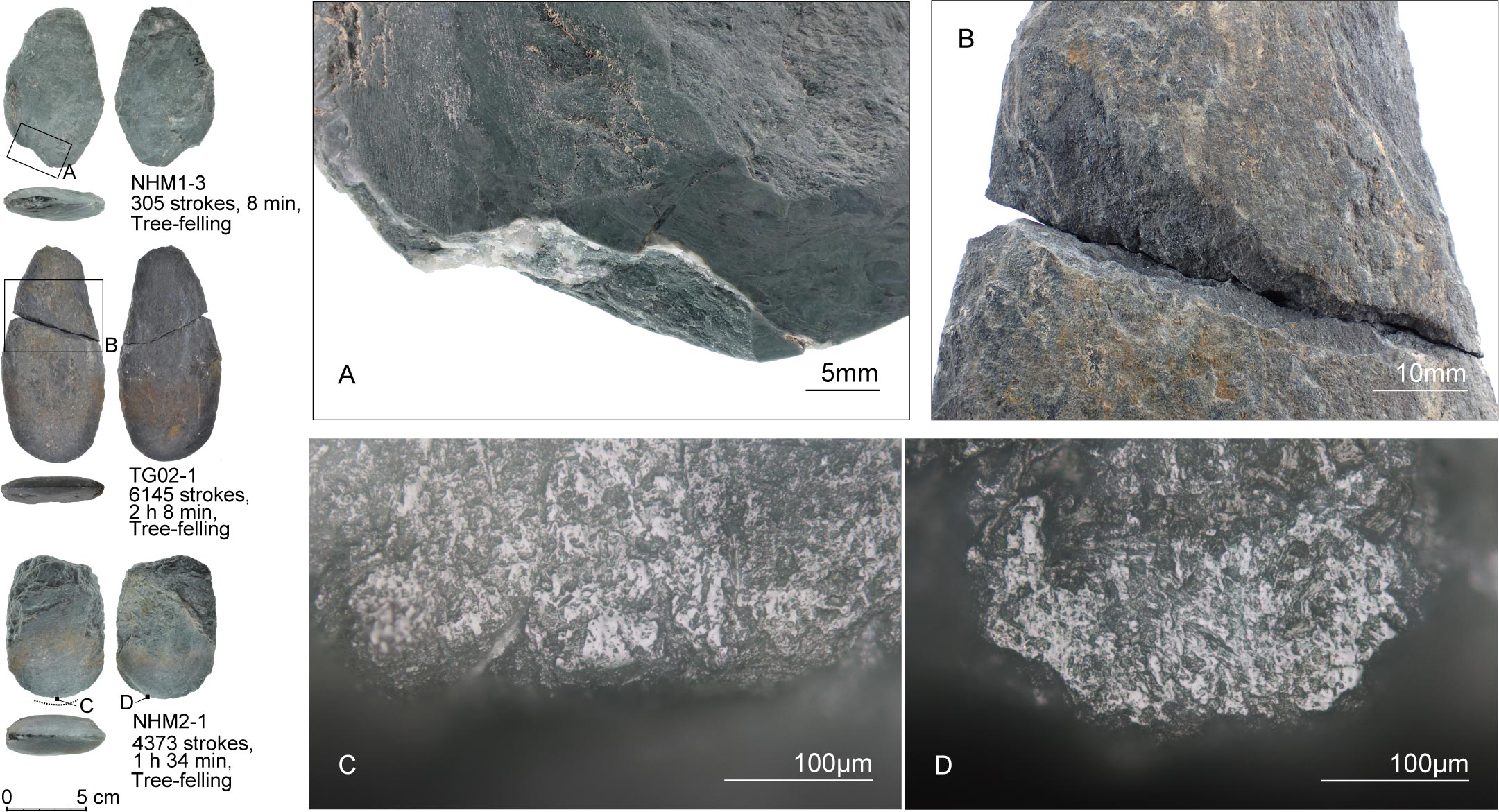
The team then got to work using the tools for 15 different activities, including tree-felling, hide-processing, and butchering, as well as “non-use” events like carrying them around and trampling them. Edges were then examined in depth for both macroscopic and microscopic traces of their history. They found that impacts like those required for cutting down trees leave distinctive, macroscopic fractures on the stone; friction at the micron-scale between the stone edge and wood also form microscopic traces that may be used for diagnosis. While fractures alone cannot tell us what they were used for, they found that combining both macroscopic and microscopic evidence can help us make reliable conclusions about whether the edges were used to fell trees.
The team believes that if similar traces are found on the edges of real artifacts from Marine Isotope Stage 3 sites, this would mean that humans had honed woodworking technology from significantly earlier times than is currently believed. This would change our understanding of stone tool use by Ice Age humans, and how such technology was spread into different environments.
Reference: “Experiments with replicas of Early Upper Paleolithic edge-ground stone axes and adzes provide criteria for identifying tool functions” by Akira Iwase, Katsuhiro Sano, Junichi Nagasaki, Noriaki Otake and Masahisa Yamada, 3 January 2024, Journal of Archaeological Science.
DOI: 10.1016/j.jas.2023.105891
This work was supported by JSPS KAKENHI Grant Numbers 15K16874, 18H03596, 20K13235, 23H04840, and 23H00009.
Never miss a breakthrough: Join the SciTechDaily newsletter.
Follow us on Google and Google News.