

Scientists have developed ‘entanglement microscopy,’ a technique that maps quantum entanglement at a microscopic level.
By studying the deep connections between particles, researchers can now visualize the hidden structures of quantum matter, offering new perspectives on particle interaction that could revolutionize technology and our understanding of the universe.
Quantum entanglement is a fascinating phenomenon where particles remain mysteriously linked, even when separated by vast distances. Understanding how this connection works, especially in complex quantum systems, has been a long-standing challenge in physics.
Researchers from the Department of Physics at The University of Hong Kong (HKU), along with their collaborators, have recently developed an innovative algorithm called entanglement microscopy. This breakthrough technique allows scientists to visualize and map entanglement at a microscopic level. By closely examining the intricate interactions between entangled particles, this method reveals hidden structures within quantum matter — offering new insights that could revolutionize technology and expand our understanding of the universe.

This study, led by Professor Zi Yang Meng and co-authored by his PhD students Ting-Tung Wang and Menghan Song of HKU Department of Physics, in collaboration with Professor William Witczak-Krempa and PhD student Liuke Lyu from the University of Montreal, unveils the hidden structures of quantum entanglement in many-body systems, offering a fresh perspective on the behavior of quantum matter. Their findings were recently published in the prestigious journal Nature Communications.
A Breakthrough in Mapping Quantum Entanglement
Quantum entanglement describes a deep connection between particles, where the state of one particle is instantly linked to another, even across vast distances. Imagine rolling two dice in different locations—quantum entanglement is like finding that the outcome of one die always determines the outcome of the other, no matter how far apart they are. This phenomenon, famously called ‘spooky action at a distance’ by Albert Einstein, is not just a theoretical curiosity but underpins technologies like quantum computing, cryptography, and the study of exotic materials and black holes. However, it is intrinsically difficult to obtain the entanglement information in quantum many-body systems both analytically and numerically due to the exponentially large degree of freedoms.
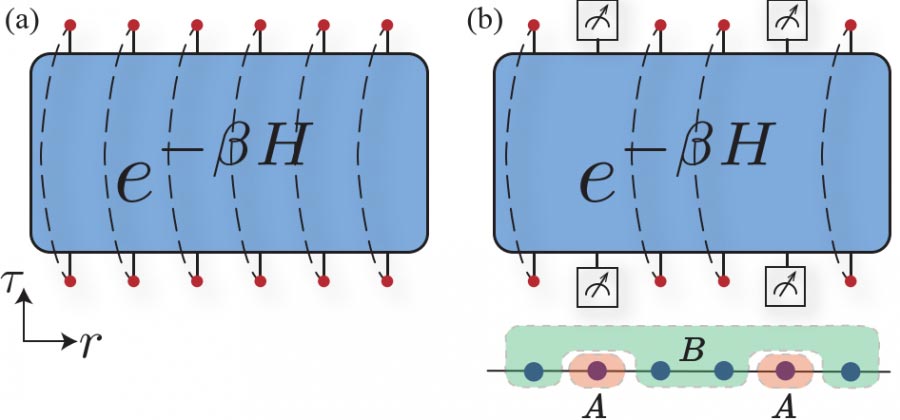
Researchers have addressed this challenge by developing ‘entanglement microscopy’, an innovative protocol based on large-scale quantum Monte Carlo simulation that can successfully extract the quantum entanglement information in small regions of quantum systems. By focusing on these microscopic areas, this method reveals how particles interact and organize themselves in intricate ways, especially near critical points in quantum phase transitions—special states where quantum systems undergo profound changes in behavior.

Their exploration focused on two prominent models at two-dimension: the transverse field Ising model and fermionic t-V model that realizes the Gross-Neveu-Yukawa transition of Dirac fermions, each revealing fascinating insights into the nature of quantum entanglement. They discovered that at the Ising quantum critical point, entanglement is short-range, meaning particles are connected only over small distances. This connection can abruptly vanish due to changes in distance or temperature—a phenomenon known as ‘sudden death’. In contrast, their investigation of the fermionic transition revealed a more gradual decline in entanglement even at larger separations, indicating that particles can maintain connections despite being far apart.
Intriguingly, the team discovered that in two-dimensional Ising transitions, three-party entanglement was absent, yet present in one-dimensional systems. This implies that system dimensionality significantly affects entanglement behavior. To simplify, low-dimensional systems are akin to a small group of friends where deep connections (complex multi-particle entanglement) are more probable. Conversely, high-dimensional systems, comparable to larger, more complex social networks, often suppress such connections. These findings provide important understanding of how entanglement structure alters with increasing system complexity.

Applications and Impact
This breakthrough has significant implications for advancing quantum technologies. By providing a clearer understanding of entanglement, it could help optimize quantum computing hardware and algorithms, enabling faster problem-solving in fields like cryptography and artificial intelligence. It also opens the door to designing next-generation quantum materials with applications in energy, electronics, and superconductivity. Furthermore, this tool could deepen our understanding of fundamental physics and improve quantum simulations in chemistry and biology.
The findings are detailed in the paper ‘Entanglement microscopy and tomography in many-body systems’, published in the journal Nature Communications.
Reference: “Entanglement microscopy and tomography in many-body systems” by Ting-Tung Wang, Menghan Song, Liuke Lyu, William Witczak-Krempa and Zi Yang Meng, 2 January 2025, Nature Communications.
DOI: 10.1038/s41467-024-55354-z
Never miss a breakthrough: Join the SciTechDaily newsletter.
Follow us on Google and Google News.
24 Comments
Looking forward to hyperresolution limit theorem negging, even if at first it is a color by number sort of image:
0 (gray) Never admit the cation is here
1 (bondi) HCP of things in this place don’t exist
2 (Klein Blue) Planar triple bond orbital always conjugated in 8 ways
3 (tan) ignore Raman shift under 503.218255 eV
4 (black) Don’t not pass GO, do not collect 200 meV phonons.
Deleting comments cannot conceal the facts.
Is the Nature journal a publication that respects science?
Subatomic particles in the quantum world often defy the familiar rules of the physical world. The fact repeatedly suggests that the familiar rules of the physical world are pseudoscience. In the familiar rules of the physical world, two sets of cobalt-60 can form the mirror image of each other by rotating in opposite directions, and can receive heavy rewards.
Please witness the grand performance of some so-called academic publications (including PRL, Nature, Science, etc.). https://scitechdaily.com/microscope-spacecrafts-most-precise-test-of-key-component-of-the-theory-of-general-relativity/#comment-854286. Some so-called academic publications (including PRL, Nature, Science, etc.) are addicted to their own small circles and have long deviated from science. They hardly know what ashamed is.
“This phenomenon, famously called ‘spooky action at a distance’ by Albert Einstein …”
Einstein was apparently surprised by the cos^2 result (squaring of the dot-product) by the Born rule.
Why the Born rule is considered “spooky” is a weird mystery apparently only appreciated by science outreach people.
I should add that when unidirectional (non-homogenous) analyzer magnets (Stern Gerlach) are used in a 120-degree field-angle EPR-type setup, the projection (dot-product) angle between the magnets operating on electron spins is divided by two. Polarizers operating on light would not require dividing the projection angle by two. This could affect the “spookiness” aspect, making magnets “spookier” than polarizers. The reason is not obvious, particularly given some descriptions of other setups where the magnet angle selections are different than 120 degrees apart. Absent those particular situations, polarizers would appear to be simply enough bi-directional in effect compared to non-homogenous magnets being unidirectional in effect.
Also, it could be a lack of noise effects that was considered “spooky,” since “at a distance” was also invoked.
“The reason is not obvious, particularly given some descriptions of other setups where the magnet angle selections are different than 120 degrees apart.”
A magnet example with a 45 degree angle versus a 135 degree angle supposedly has 15% versus 85% agreement, based on cosines squared for 22.5 and 67.5 degree. Without the angle-halving factored in the agreement would be down to 50%, which seems maximally uncorrelated, but “anti-correlation” correlations don’t seem unreasonable to me at the moment.
None of that has anything to do with the distance between detectors and the source, of course, if that’s where the spookiness comes in.
Writers have remarked that one detector can be closer to the source than the other detector, and thus it is triggered faster and has an answer first, as if that’s a big deal.
The more I look at it, it’s something about the distance between detectors and the distance between detectors and the source, which includes variations in the delays to both detections, that is critical to “spookiness,”
Again, it seems science propagandists feel that a lack of information distortion in the results reported in some experiment is “spooking” them.
A lot of writers seem to think that changing a detector setting after the electrons are in-flight, even after a shorter-path detector has already triggered, is important. Apparently, it somehow disrupts the “fabric of spacetime,” also known by a select few illuminates as “the fabric with no woof.”
Apparently the “natural” way to preserve space-time fails to reproduce the statistics observed in any EPR experiment given sufficient a number of runs.
The “natural” way involves the same 3-bit instructions being given to each electron in a pair, with 8 possible 3-bit instruction sets, disagreements should happen 33.3% of the time, excluding the 000=BBB and 111=GGG instructions.
As a result, it seems applying the Born rule result, (cos^2(60 degrees)) = 25% is apparently considered un-natural and spooky by some, even absent any timing concerns. Not enough agreements or something. Go figure. Mermin has a book titled “Boojums …” that seems to think it’s relevant in chapter 10. Maybe it’s a form of quantum Spoonerism.
Whether or not there was a causality violation where detections agree after one detection already happened and the other used a late-switched detector setting seems to imply a single electron’s spin can send a bit of information affected by the late switch. Whether or not that is true, one would still need to know the result from the other detector for any meaningful information, one detector lamp is not enough.
“a single electron’s spin can send a bit of information affected by the late switch (affecting a closer-to-the-source detector of the two before the late-switch at the other end occurs)”
That’s a causality violation, so it has a zero likelihood, in my opinion, and regardless of that it still requires knowing both detector results. Another sign that a lack of distortion in science results deeply troubles science communicators, if you ask me.
The most interesting experiments involve splitting a beam of light to form two entangled beams, then taking one beam and passing it through an image mask that rotates the unmasked light beam before destroying it. Somehow the other beam shows the mask pattern that the unmasked beam never saw, without the need to recombine the beams. It takes some number of photons over some amount of time to fully illuminate the mask image. Optics keep the beams collimated. The possibility of collimated feedback running from the image at the mask back to the splitter, affecting a splitting bias over time, can’t be ignored as an explanation
The field projection angle-halving effect with SG magnets vs. polarizers seems at the moment to be due to the magnet field being partly responsive to the electron field over a significant amount of space and time, allowing a sort of “meeting in the middle” compromise with the electron spin, while the polarizer fields are relatively stationary near-field effects where no such compromise with light is possible.
My guess is that Einstein surely changed his mind eventually about entanglement being spooky, but the Conscientious Science Hasbara Journalist Rulebook nonetheless still enjoys spooking everyone as much as possible.
Can’t be wrapping up this discussion of space-time fabrics without mentioning experiments that appear to show “negative time” effects.
Such experiments are apparently best explained by allowing the speed of light to depend on the strength of gravitational binding between masses and further on the degree of gravitational focus (gravitational entanglement) between them. Gravitational entanglement would show up as a degree of synchronization of kinetic spins in the nuclei of the two masses, allowing the most efficient exchange of gravitational flows. In the case of using heavy metal vapors all the nuclei would have the same spin orientation, which will also tend to also best align and strengthen the electromagnetic couplings between the atoms. My take on it for now, anyway.
Your understanding of the laws of physics is telling the public through facts that some so-called academic publications (including PRL, Nature, Science, etc.) are deeply sinful.
The most interesting entanglement experiments may be those involving splitting a light beam into a signaling beam and an idler beam, where the signaling photons are destroyed after putting them through a masking pattern, but the idler beam shows the masking pattern without needing recombination with the signaling beam.
It takes a finite amount of time and a lot of focused photons, so there is no obvious way to be sure the masking pattern is not being focused back to the splitter to bias it.
My “spooky” physics concepts inevitably arise from things that are too probabilistic, complicated and personal, not necessarily subjective, for me to sensibly explain. The word “Jungian” seems to fit reality a lot for me. I am a futurist-oriented person, interested in predictions, read a ton of science fiction, often with time travel, during my youth. The idea of splitting reality into multiple versions was interesting, lots of multiverse ideas are interesting.
Sometimes I get the impression that emotions can be as self-defeating, or unconsciously subversive, as over-thinking something. Thinking about being wrong, particularly if it is for some external invisible reason, particularly if that reason involves exotic technology, is about as “spooky” as it gets for me.
“(T)here is no obvious way to be sure the masking pattern is not being focused back to the splitter to bias it.”
Destroying the beam after the mask is applied might be considered a way to remove any possibility of mask pattern feedback to the splitter, but the feedback signal could be “out of band” light thermally or reflectively generated in part by the mask.
It’s politics. Some might say that “spooking” is an attempt to drive people toward religion and thus has a good excuse.
The probabilistic aspect of detection formula needed when both magnets are not aligned together complementarily with the same detector setting numbers could be the “spooky” part, but being probabilistic apparently means that the bit rate for spin bits is effectively 1/2.
At the moment it seems the reason for squaring of the field-to-magnet vector projection (squaring the dot product) is done because each detection at each end of the field is independent and independent probabilities are to be multiplied.
The probabilistic aspect is still interesting although it seems to operate as a low pass filter on information flow that cuts complete spin information rate in half whereas doubling that would be much more intriguing but still avails only one bit per spin pair.
In a similar way, it seems it would be conceivably much more interesting to have a double-angle effect to project as an end-to end effect amplifier, instead of a single or half-angle effect.
Ultimately it seems that if one spin in a pair really cares about the other spin so much after they separate, the faster detector’s indicator should decide detection on both ends, but the possibility of frustrated detector consistency still remains more conceivable to me.
Moving one S-G magnet while it’s carrying an electron of the pair is an interesting problem, but I can’t imagine why the electron at the opposite detector should respond any more meaningfully to that far-end interaction within the far-end magnet than it does in any other case of setting the magnets.
Fortunately, or not, “sinful” isn’t a legal concept. The Bible is not a credible source for anything significant affecting science or history, especially considering all the popular divisive political variants that make Christians their own worst enemies.
Being misinformed and misinformative is part of free speech, though. The legal rules for advertising are stricter than the legal rules for the “news” and the rules for official broadcast carrier “news” are stricter than rules for free speech that explores significant controversies and other differences.
Some believe a broadcast news carrier must edit comments to fit the rules for news carriers (also known as “entertainers” when they transform mysteriously and magically into entertainers). Most cases are the stuff of super-bowl slip-ups, there lacks a way to accommodate random people saying random things on common carrier channels without a delay. Shadow bans on controversial comments/commenters may eventually reflect badly on a carrier if the controversy is relevant.
Naturally some things that could be found in comments almost anywhere that are so personal/subjective they call for some level of response unless it’s clear the “room” tolerates the particular level of “discord” involved.
Impressionable children or the like should not be allowed to comment on a general website or be a basis for censorship there, but commonly it happens, supposedly because good laws will support it.
A balance with diverse informed (or sensibly-backed) perspectives should be allowed.
Conspiracy as a system norm affecting history and the present in ways unknown should never be ruled out or censored. The merits of a major system re-build should never be ruled out or censored. Maliciousness within the consensus should never be considered adequately ruled out, just as political, academic and journalistic rent-seeking, and other group profit motives, should never be considered adequately ruled out.
In “Naturally some things that …” I should have left that “that” out.
What you see or touch about an elephant will be different, and what different individuals see or touch will be even more different. It is a nature phenomenon, not the essence of nature.
If we can map the entanglement or trace it then would it be possible to use engagement as communication transfer .