
Physicists at Stockholm University and the Max Planck Institute for Physics have turned to plasmas in a proposal that could revolutionize the search for the elusive dark matter.
Dark matter is a mysterious substance that makes up 85% of the matter in the universe. Originally introduced to explain why the Strong Force (which holds together protons and neutrons) is the same backward and forwards in time, the so-called axion would provide a natural explanation for dark matter. Rather than discrete particles, axion dark matter would form a pervasive wave flowing throughout space.
The axion is one of the best explanations for dark matter but has only recently been the focus of large-scale experimental efforts. Due to this renaissance, there has been a rush to come up with new ideas for how to look for the axion in all the areas where it could be hiding.
“Finding the axion is a bit like tuning a radio: you have to tune your antenna until you pick up the right frequency. Rather than music, experimentalists would be rewarded with ‘hearing’ the dark matter that the Earth is traveling through. Despite being well motivated, axions have been experimentally neglected during the three decades since they were named by coauthor Frank Wilczek,” says Dr. Alexander Millar, postdoctoral at the Department of Physics, Stockholm University, and author of the study.
The key insight of the research team’s new study is that inside a magnetic field axions would generate a small electric field that could be used to drive oscillations in the plasma. A plasma is a material where charged particles, such as electrons, can flow freely as a fluid. These oscillations amplify the signal, leading to a better “axion radio.” Unlike traditional experiments based on resonant cavities, there is almost no limit on how large these plasmas can be, thus giving a larger signal. The difference is somewhat like the difference between a walkie-talkie and a radio broadcast tower.
“Without the cold plasma, axions cannot efficiently convert into light. The plasma plays a dual role, both creating an environment which allows for efficient conversion, and providing a resonant plasmon to collect the energy of the converted dark matter,” says Dr. Matthew Lawson, postdoctoral at the Department of Physics, Stockholm University, also author of the study.
“This is totally a new way to look for dark matter and will help us search for one of the strongest dark matter candidates in areas that are just completely unexplored. Building a tuneable plasma would allow us to make much larger experiments than traditional techniques, giving much stronger signals at high frequencies,” says Dr. Alexander Millar.
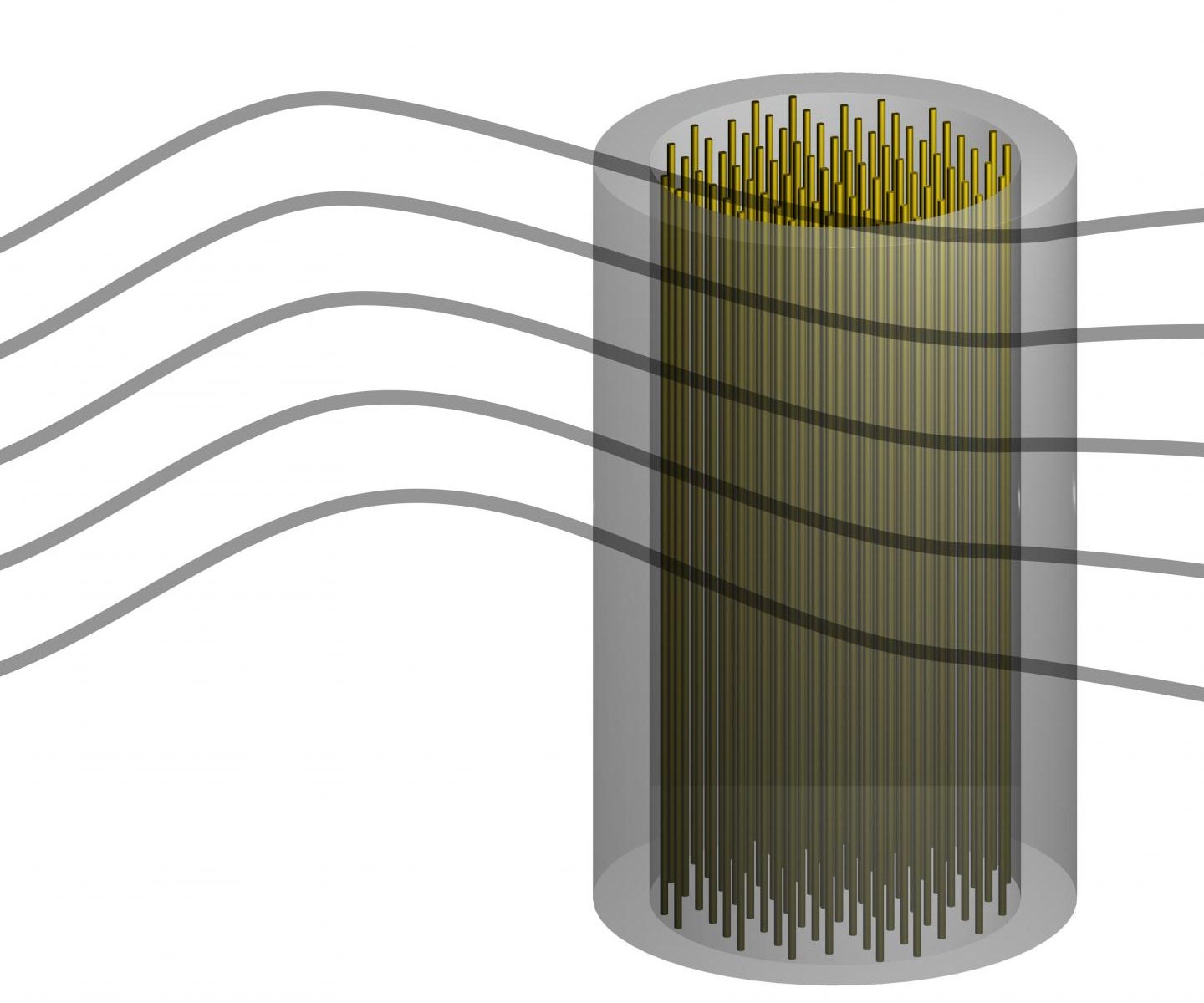
To tune this “axion radio” the authors propose using something called a “wire metamaterial,” a system of wires thinner than hair that can be moved to change the characteristic frequency of the plasma. Inside a large, powerful magnet, similar to those used in Magnetic Resonance Imaging machines in hospitals, a wire metamaterial turns into a very sensitive axion radio.
Searching for dark matter with plasmas will not remain just an interesting idea. In close collaboration with the researchers, an experimental group at Berkeley has been doing research and development on the concept with the intent of building such an experiment in the near future.
“Plasma haloscopes are one of the few ideas that could search for axions in this parameter space. The fact that the experimental community has latched onto this idea so quickly is very exciting and promising for building a full-scale experiment,” says Dr. Alexander Millar.
Reference: “Tunable Axion Plasma Haloscopes” by Matthew Lawson, Alexander J. Millar, Matteo Pancaldi, Edoardo Vitagliano and Frank Wilczek, 1 October 2019, Physical Review Letters.
DOI: 10.1103/PhysRevLett.123.141802
Never miss a breakthrough: Join the SciTechDaily newsletter.
Follow us on Google and Google News.
2 Comments
“Dark matter is a mysterious substance that makes up 85% of the matter in the universe. ”
I laughed so hard my tin foil hat fell off.
Stop already dark matter seriously.