

KIMS and KAIST have developed a catalyst synthesis process and precision control technology to optimize carbon dioxide conversion efficiency.
As climate change and carbon emissions become increasingly urgent global issues, the need for efficient technologies to convert carbon dioxide (CO₂) into valuable resources, such as chemical fuels and compounds, has grown. In response, Dr. Dahee Park’s research team from the Nano Materials Research Division at the Korea Institute of Materials Science (KIMS) has partnered with Professor Jeong-Young Park’s team from the Department of Chemistry at KAIST to develop a catalyst technology that significantly improves the efficiency of CO₂ conversion.
Traditional CO₂ conversion technologies have struggled with commercialization due to their low efficiency and high energy demands. In particular, single-atom catalysts (SACs) present challenges related to complex synthesis methods and difficulty in maintaining stable bonding with metal oxide supports—an essential factor for stabilizing catalyst particles and improving durability. These limitations have hindered their overall performance, making advancements in this field crucial.
Innovations in Catalyst Technology
To overcome these limitations, the research team developed single- and dual-single-atom catalyst (DSAC) technologies and introduced a simplified process to enhance catalyst efficiency. This achievement utilizes electronic interactions between metals in the dual-single-atom catalysts (DSACs), achieving higher conversion rates and excellent selectivity (the ability of a catalyst to direct the production of desired products) compared to existing technologies.
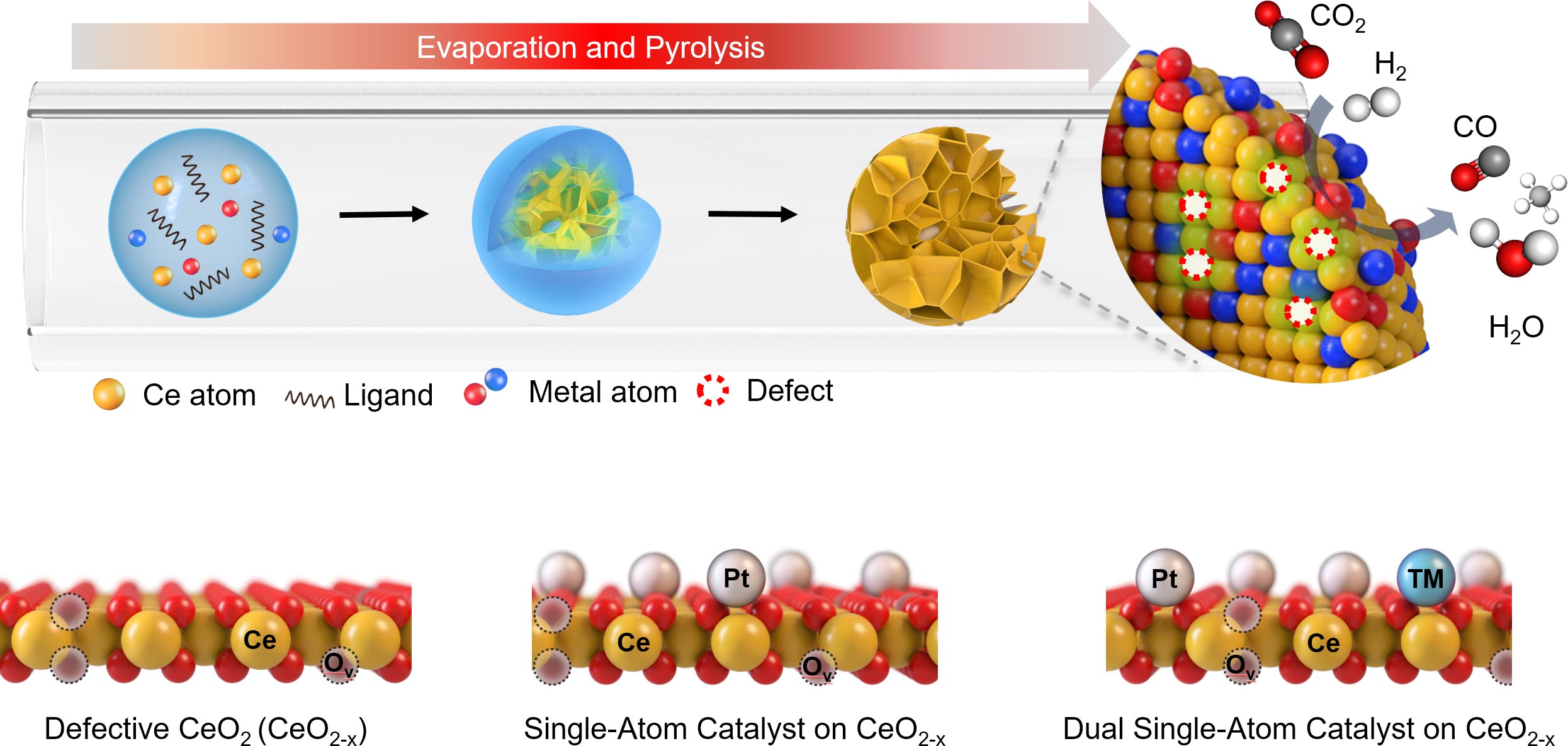
This technology involves a catalyst design approach that precisely controls oxygen vacancies and defect structures within metal oxide supports, significantly enhancing the efficiency and selectivity of carbon dioxide (CO2) conversion reactions. Oxygen vacancies facilitate the adsorption of CO2 on the catalyst surface, while single and dual-single-atom catalysts assist in the adsorption of hydrogen (H2).
The combined action of oxygen vacancies, single atoms, and dual-single atoms enables the effective conversion of CO2 with H2 into desired compounds. Notably, dual-single-atom catalysts (DSACs) utilize electronic interactions between two metal atoms to actively regulate the reaction pathway and maximize efficiency.
Simplified Production Process and Commercial Potential
The research team applied the aerosol-assisted spray pyrolysis method to synthesize catalysts through a simplified process, also demonstrating its potential for mass production. This process involves transforming liquid materials into aerosols (fine mist-like particles) and introducing them into a heated chamber, where the catalyst is formed without the need for complex intermediate steps.
This method enables the uniform dispersion of metal atoms within the metal oxide support and precise control of defect structures. By precisely controlling these defect structures, the team was able to stably form single- and dual-single-atom catalysts (DSACs). Leveraging DSACs, they reduced the use of single-atom catalysts by approximately 50% while achieving over twice the CO2 conversion efficiency compared to conventional methods and an exceptionally high selectivity of over 99%.
This technology can be applied across various fields, including chemical fuel synthesis, hydrogen production, and the clean energy industry. Furthermore, the simplicity and high production efficiency of the catalyst synthesis method (aerosol-assisted spray pyrolysis) make it highly promising for commercialization.
Dr. Dahee Park, the lead researcher, stated, “This technology represents a significant achievement in drastically improving the performance of CO2 conversion catalysts while enabling commercialization through a simplified process. It is expected to serve as a core technology for achieving carbon neutrality.” Professor Jeong-Young Park from KAIST added, “This research provides a relatively simple method for synthesizing a new type of single-atom catalyst that can be used in various chemical reactions. It also offers a crucial foundation for the development of CO2 decomposition and utilization catalysts, which is one of the most urgent research areas for addressing global warming caused by greenhouse gases.”
Reference: “Insights into the synergy effect in dual single-atom catalysts on defective CeO2 under CO2 hydrogenation” by Dahee Park, Seunghwa Hong, Jaebeom Han, YongJoo Kim, Minhee Park, Byunghyun Lee, Yejin Song, Hye Young Koo, Sangsun Yang, Won Bo Lee and Jeong Young Park, 24 December 2024, Applied Catalysis B: Environment and Energy.
DOI: 10.1016/j.apcatb.2024.124987
This research was conducted with support from the Korea Institute of Materials Science’s core projects, as well as funding from the Ministry of Science and ICT, the Ministry of Trade, Industry and Energy, and the National Research Council of Science and Technology.
Never miss a breakthrough: Join the SciTechDaily newsletter.
Follow us on Google and Google News.
2 Comments
The catalyst of the week. This may ultimately lead to improved catalysts, but I think that the discoveries being announced are over-hyping the immediate utility and benefit.
Stop it please with this Clickbait. These researchers have “solved” nothing.
Converting CO2 by reacting it with H2 is ridiculously energy- INEFFICIENT. It’s all just greenwashing by Big Fossil to give us an excuse to keep buying their crap and emitting CO2.