
Close Menu
    Facebook X (Twitter) Instagram
    SciTechDaily
    • Biology
    • Chemistry
    • Earth
    • Health
    • Physics
    • Science
    • Space
    • Technology
    Facebook X (Twitter) Pinterest YouTube RSS
    SciTechDaily
    Home»Health»Riding the Wave: How Water and Salt Power Immune Cells Through the Body
    Health

    Riding the Wave: How Water and Salt Power Immune Cells Through the Body

    By Francis Crick InstituteDecember 6, 2023No Comments4 Mins Read
    Facebook Twitter Pinterest Telegram LinkedIn WhatsApp Email Reddit
    Share
    Facebook Twitter LinkedIn Pinterest Telegram Email Reddit
    Immune Cells Journey Through Body
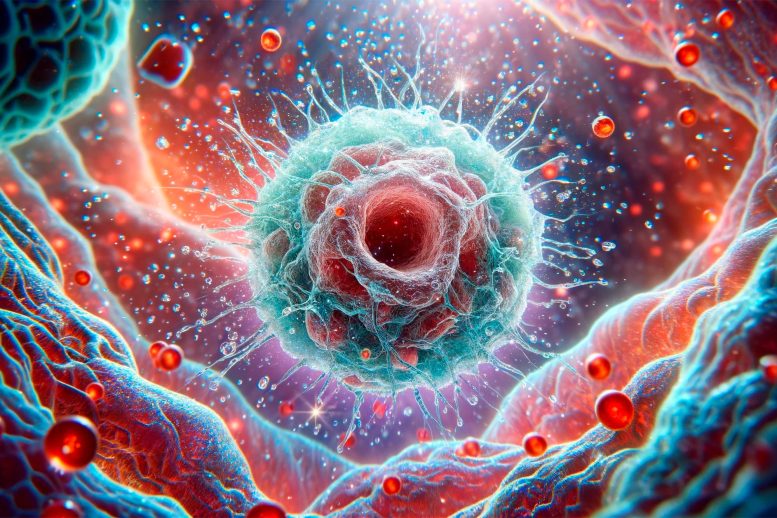
    A collaborative study led by the Francis Crick Institute has uncovered the crucial role of the WNK1 protein in T cell mobility. By facilitating water and ion influx, WNK1 enables T cells to move efficiently towards infection sites, a process potentially applicable to various cell types and relevant in cancer research. Credit: SciTechDaily.com

    Recent research reveals that the WNK1 protein’s role in controlling water and ion flow into T cells is key to their migration, offering new insights into cell movement and potential cancer treatment strategies.

    Researchers at the Francis Crick Institute, working with Imperial College London, King’s College London, and the University of Cambridge, have shown that an influx of water and ions into immune cells allows them to migrate to where they’re needed in the body.  

    Our bodies respond to illness by sending out chemical signals called chemokines, which tell immune cells called T cells where to go to fight the infection. This process had already been associated with a protein called WNK1, which activates channels on the cell surface, allowing ions (salts like sodium or potassium) to move into cells. Until now, it was not clear why ion influx was needed for T cells to move. 

    Through a study published today (December 6) in Nature Communications, the researchers imaged mouse T cells and observed that, following a chemokine signal, WNK1 is activated at the front of the cells, called the ‘leading edge’.

    The team showed that the activation of WNK1 opens channels on the leading edge, resulting in an influx of water and ions. They propose that this flow of water causes the cells to swell on the front side, creating space for the ‘actin cytoskeleton’ – the scaffolding inside the cell that holds its structure – to grow into. This propels the whole cell forward and the process repeats again.

    The researchers used gene editing to stop mice producing WNK1, or an inhibitor to prevent WNK1’s activity, observing that the T cells in these mice slowed down or stopped moving completely.

    Importantly, they found that they could make up for the loss of WNK1 and make the cells speed up by dropping them into a watery solution, which causes the cells to take up water and swell. This shows that the uptake of water, controlled by the WNK1 protein is key for the cells to migrate.

    The researchers believe that the mechanism they’ve discovered could be involved in lots of different cell types beyond immune cells.

    Victor Tybulewicz, Group Leader of the Immune Cell Biology Laboratory & Down Syndrome Laboratory at the Crick, said: “Through this research, we’ve unraveled one of the mysteries of T cell movement, showing that WKN1 causes water and ions to flow into T cells, giving them the space to grow their scaffolding and move forward. Although we looked at T cells, it’s likely that this process is happening in many of our cells and even in diseases like cancer, which is important as when cancer cells spread, it is harder to treat.”

    Leon de Boer, former postdoctoral researcher at the Crick and now at the Karolinska Institute in Sweden, said: “This process has been speculated about for decades, but advances in technology have finally allowed us to show how WNK1 helps T cells migrate around the body – water comes in almost like a jet engine moving the cell forward. I am excited that researchers are starting to investigate WNK1 inhibitors to treat diseases like cancer. In my new project, I’m looking at how properties of membranes help cancer cells to move around the body.”

    Reference: “T cell migration requires ion and water influx to regulate actin polymerization” 6 December 2023, Nature Communications.
    DOI: 10.1038/s41467-023-43423-8

    Never miss a breakthrough: Join the SciTechDaily newsletter.
    Follow us on Google and Google News.

    Cancer Cell Biology Francis Crick Institute Immunology Infectious Diseases
    Share. Facebook Twitter Pinterest LinkedIn Email Reddit

    Related Articles

    Researchers Identify How to Predict Cytokine Storm in COVID-19 Patients

    Researchers Unravel the Network of Molecules That Influence COVID-19 Severity

    SARS-CoV-2 Antibodies Provide Lasting COVID-19 Immunity

    Every COVID-19 Case Seems Different – These Scientists Are Solving this Puzzle

    Sticky Webs of DNA Released From Immune Cells May Drive Lung Pathology in Severe COVID-19

    Research Shows Exposure to Common Cold Coronaviruses Can Teach the Immune System to Recognize SARS-CoV-2

    Common Molecular Feature of Antibodies That Neutralize SARS-CoV-2 Discovered, Boosting COVID-19 Vaccine Prospects

    COVID-19 Treatment May Lie in Pangolin Genetics – May Possess Evolutionary Advantage Against Coronavirus

    Cancer Cells Can Become Invisible to the Immune System – Here’s How

    Leave A Reply Cancel Reply

    • Facebook
    • Twitter
    • Pinterest
    • YouTube

    Don't Miss a Discovery

    Subscribe for the Latest in Science & Tech!

    Trending News

    Mezcal “Worm” in a Bottle Mystery: DNA Testing Reveals a Surprise

    New Research Reveals That Your Morning Coffee Activates an Ancient Longevity Switch

    This Is What Makes You Irresistible to Mosquitoes

    Shockingly Powerful Giant Octopuses Ruled the Seas 100 Million Years Ago

    Scientists Stunned by New Organic Molecules Found on Mars

    Rewriting Dinosaur Evolution: Scientists Unearth Remarkable 150-Million-Year-Old Stegosaur Skull

    Omega-3 Supplements Linked to Cognitive Decline in Surprising New Study

    First-of-Its-Kind Discovery: Homer’s Iliad Found Embedded in a 1,600-Year-Old Egyptian Mummy

    Follow SciTechDaily
    • Facebook
    • Twitter
    • YouTube
    • Pinterest
    • Newsletter
    • RSS
    SciTech News
    • Biology News
    • Chemistry News
    • Earth News
    • Health News
    • Physics News
    • Science News
    • Space News
    • Technology News
    Recent Posts
    • Male Birth Control Breakthrough: Scientists Find Way To Turn Sperm Production Off and Back On
    • A Common Vitamin Could Hold the Key to Treating Fatty Liver Disease
    • New Research Shows Vitamin B12 May Hold the Key to Healthy Aging
    • Scientists Map Thousands of Brain Connections With RNA Barcodes
    • This Gene Tweak Turns Strawberries Into Healthier, Tastier Superfruit
    Copyright © 1998 - 2026 SciTechDaily. All Rights Reserved.
    • Science News
    • About
    • Contact
    • Editorial Board
    • Privacy Policy
    • Terms of Use

    Type above and press Enter to search. Press Esc to cancel.