
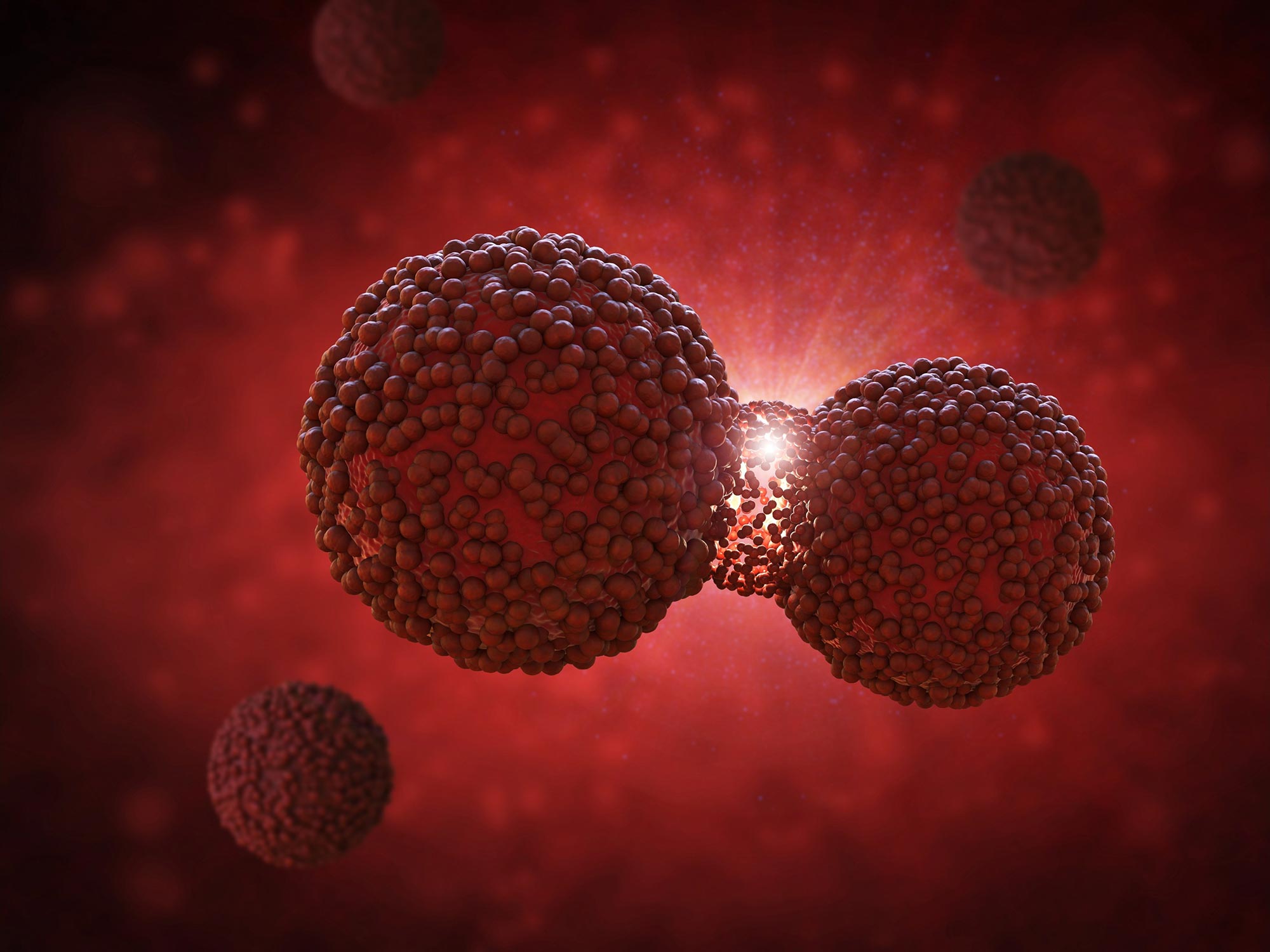
Scientists have uncovered how rogue DNA rings may help spark glioblastoma at its earliest stages.
An international research team has shown that rogue rings of DNA that exist outside chromosomes, called extrachromosomal DNA, or ecDNA, can drive the growth of many glioblastomas, the most common and most aggressive brain cancer in adults. The results point to opportunities to diagnose glioblastoma earlier, follow its course more closely, and treat it more effectively.
The findings, published in Cancer Discovery, are the first to indicate that ecDNA carrying cancer-driving genes often appears at the very start of glioblastoma development, and in some patients even before the tumor has fully formed. This early presence may help explain the cancer’s rapid expansion, capacity to adapt, and resistance to therapy.
The study was led by Dr Benjamin Werner at Queen Mary University of London and Professor Paul Mischel at Stanford University, both members of Cancer Grand Challenges’ team eDyNAmiC, with Professor Charlie Swanton at The Francis Crick Institute.
Tackling cancer’s toughest challenges
Glioblastoma is one of the most challenging cancers to treat, with median survival remaining at around 14 months and little improvement in recent decades. New approaches for earlier detection and more effective treatment are urgently needed.
ecDNA is emerging as a potentially important player in many adult and pediatric cancers, including glioblastoma, but its role is complex and mysterious. The Cancer Grand Challenges initiative – founded by Cancer Research UK and the National Cancer Institute in the US – identified understanding ecDNA as one of the toughest challenges facing the field today. In 2022, they funded team eDyNAmiC – a $25m international, cross-disciplinary consortium of experts in cancer, clinical research, evolutionary biology, computer science and mathematics – to decipher ecDNA’s role and identify ways to target it. The current study marks an important advance in team eDyNAmiC’s work.
Excavating a tumor’s past
In their new study, team eDyNAmiC and their collaborators integrated genomic and imaging data from patients with glioblastoma with advanced computational modelling of the evolution of ecDNAs in space and time.
“We studied the tumors much like an archaeologist would. Rather than taking a single sample, we excavated multiple sites around the tumor, allowing us to build computational models describing how they evolved. We simulated millions of different scenarios to reconstruct how the earliest ecDNAs emerged, spread, and drove tumor aggressiveness, giving us a clearer picture of the tumor’s origins and progression,” explains senior author Dr Benjamin Werner, a group leader at the Barts Cancer Institute, Queen Mary University of London.
The analysis revealed that most ecDNA rings contained EGFR, a potent cancer-driving gene. EGFR ecDNA appeared early in the cancer’s evolution – even before tumor formation in some patients. It also frequently gained extra changes, such as the EGFRvIII variant, that made the cancer more aggressive and resistant to therapies.
A window of opportunity
“These subtle mechanisms show that there may be a window of opportunity to detect and treat the disease between the first appearance of EGFR ecDNA and the emergence of these more aggressive variants,” suggests Dr Magnus Haughey, a postdoctoral researcher in Dr Werner’s group and one of the paper’s lead authors. “If scientists can develop a reliable test to detect early EGFR ecDNA – for example through a blood test – it could enable them to intervene before the disease becomes harder to treat.”
The study confirmed that ecDNA can carry more than one cancer gene at a time, each of which may uniquely shape how tumors evolve and respond to treatment. This highlights the potential value of tailoring treatments based on a tumor’s ecDNA profile.
Yet many mysteries remain. The researchers now plan to study how different treatments affect the number and types of ecDNA in glioblastoma. Team eDyNAmiC will continue to investigate the role of ecDNAs across a range of cancer types to uncover further opportunities to diagnose cancers earlier, track their progress more precisely, and design smarter treatments.
Charlie Swanton, Deputy Clinical Director and head of the Cancer Evolution and Genome Instability Laboratory at The Francis Crick Institute and chief clinician at Cancer Research UK, says: “These findings suggest that ecDNA is not just a passenger in glioblastoma, but an early and powerful driver of the disease. By tracing when and how ecDNA arises, we open up the possibility of detecting glioblastoma much earlier and intervening before it becomes so aggressive and resistant to therapy. I hope this might help to drive a new era in how we diagnose, track and treat this devastating cancer.”
Paul Mischel, MD, the Fortinet Founders Professor and professor and vice chair of research in the pathology department at Stanford Medicine, says: “These findings reveal an important new insight into the role of ecDNA in tumor development and progression. Previous work from our collaborative team and other researchers, has shown that ecDNA can arise early in tumor development, including at the stage of high-grade dysplasia, and it can also arise later to drive tumor progression and treatment resistance. The findings here show that in glioblastoma, there is an early event driven by ecDNA that could potentially be more actionable, raising the possibility that glioblastoma is another cancer for which earlier detection and intervention based upon ecDNA may be possible.”
Director of Cancer Grand Challenges, Dr David Scott, says: “This study exemplifies the bold, boundary-pushing science Cancer Grand Challenges was created to support. By unravelling the evolutionary history of ecDNA in glioblastoma, team eDyNAmiC is not only deepening our understanding of one of the most devastating cancers but also illuminating new paths for earlier detection and treatment. It’s a powerful reminder that when we bring together diverse disciplines and global talent, we can begin to solve the toughest problems facing cancer research.”
Reference: “Extrachromosomal DNA–Driven Oncogene Spatial Heterogeneity and Evolution in Glioblastoma” by Imran Noorani, Magnus Haughey, Jens Luebeck, Andrew Rowan, Eva Grönroos, Francesco Terenzi, Ivy Tsz-Lo Wong, Davide Pradella, Marta Lisi, Jeanette Kittel, Natasha Sharma, Chris Bailey, Clare E. Weeden, Donald M. Bell, Eric Joo, Vittorio Barbè, Matthew G. Jones, King L. Hung, Emma L. Nye, Mary Green, Lucy Meader, Emma J. Norton, Mark Fabian, Nnennaya Kanu, Mariam Jamal-Hanjani, Thomas Santarius, Andrea Ventura, James A.R. Nicoll, Delphine Boche, Howard Y. Chang, Vineet Bafna, Weini Huang, Paul S. Mischel, Charles Swanton and Benjamin Werner, 8 September 2025, Cancer Discovery.
DOI: 10.1158/2159-8290.CD-24-1555
Funding: Francis Crick Institute, Cancer Research UK, NIH/National Cancer Institute
Never miss a breakthrough: Join the SciTechDaily newsletter.
Follow us on Google and Google News.