
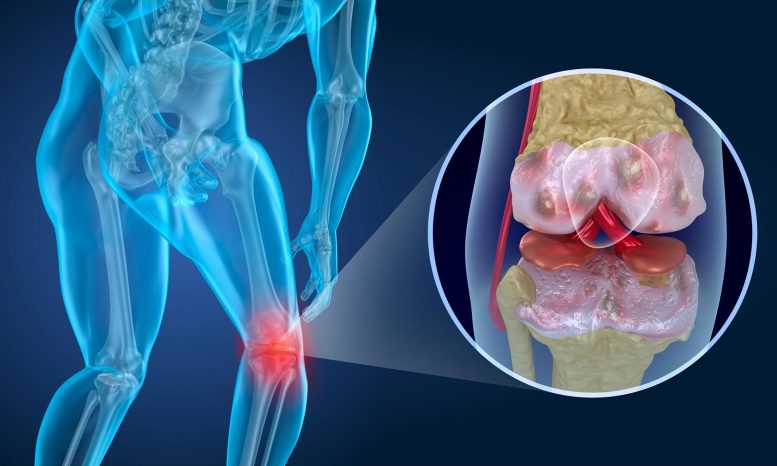
Stem cell therapy using patients’ own mesenchymal stem cells can safely heal knee osteoarthritis without tumor risk.
A study released in STEM CELLS Translational Medicine has confirmed the safety of a novel type of cellular therapy for knee pain caused by osteoarthritis. Conducted by a multi-institutional team of researchers in Japan who had developed the new therapy, the study was designed to confirm that their treatment – which involves transplanting the patient’s own mesenchymal stem cells (MSCs) into the affected knee – did not cause tumors.
The results showed that five years after transplantation, osteoarthritis-related tears to the knee meniscus had healed and, just as importantly, none of the patients experienced any serious side effects from the treatment. The meniscus is a crescent-shaped cartilage in the knee joint that plays a role in shock absorption. Age-related damage to the meniscus often leads to the progression of osteoarthritis of the knee.
Chronic knee pain is a major issue for the aging, affecting approximately 25 percent of all adults, according to the Centers for Disease Control and Prevention (CDC). Osteoarthritis is the most common cause of this condition in people aged 50 and older. Along with pain, which can be debilitating, knee problems can significantly affect the person’s mobility and quality of life.
Knee replacement surgery is the gold standard of treatment, with the majority of people experiencing a dramatic reduction in pain and, thus, improvement in their ability to live a normal life. However, though rare, such surgery does come with risks, such as the possibility of infection.
Promise of Cellular Therapies in Knee Injury Treatment
Cellular therapies are showing great potential as a less invasive way to treat difficult-to-heal knee injuries. The team behind the current study, which included researchers from Tokyo Medical and Dental University, Kyoto University and Kazusa DNA Research Institute, recently developed a therapy involving the transplantation of MSCs derived from the knee’s soft tissue (the synovium) into the injured meniscus. MSCs are multipotent adult stem cells present in the umbilical cord, bone marrow, fat, dental and other body tissues. Their ability to secrete biologically active molecules that exert beneficial effects on injured tissues makes them a promising target in regenerative medicine.
But some stem cell treatments have been known to cause tumors, which is why the team wanted to ensure that their therapy was free of any negative side effects. In particular, they wanted to investigate the safety of any MSCs that might show a type of chromosomal disorder called trisomy 7.
“Trisomy 7 occurs frequently in patients with severe knee disease such as osteoarthritis. The detection of trisomy 7 in epithelial cells has been associated with tumor formation. However, the safety of these cells after transplantation has not been investigated. That’s what we wanted to learn from this study,” said corresponding author Ichiro Sekiya, M.D., Ph. D., director and professor of the Center for Stem Cell and Regenerative Medicine (CSCRM) at Tokyo Medical and Dental University.
Five-Year Follow-Up Confirms Safety and Healing
Mitsuru Mizuno, DVM, Ph.D., assistant professor with CSCRM, served as the study’s lead investigator. He reported on the results. “We recruited 10 patients for the study and transplanted their own stem cells into the affected knee joints, then followed up with MRIs over the next five years. The images revealed that tears in the patients’ knee meniscus were obscured three years after transplantation. We also identified trisomy 7 in three of the patients, yet no serious adverse events including tumor formation were observed in any of them.”
Dr. Sekiya added, “Keep in mind that these were autologous MSCs used in our study, which means that the transplanted MSCs came from the patients themselves. Any problems that might arise in the case of allogeneic cells, which are donated by someone other than the patient, still need to be determined.
“Nevertheless, we believe that these data suggest that MSCs with trisomy 7 are safe for transplantation into human knees and show much promise in treating osteoarthritis.”
“This study highlights the ability of a patient’s own stem cells to potentially heal torn cartilage in the knee,” said Anthony Atala, M.D., Editor-in-Chief of STEM CELLS Translational Medicine and director of the Wake Forest Institute for Regenerative Medicine. “These outcomes suggest a potential approach that could change the overall physical health of patients who suffer from osteoarthritis and experience debilitating joint pain. We look forward to the continuation of this research to further document clinical efficacy.”
Reference: “Transplantation of human autologous synovial mesenchymal stem cells with trisomy 7 into the knee joint and 5 years of follow-up” by Mitsuru Mizuno, Kentaro Endo, Hisako Katano, Naoki Amano, Masaki Nomura, Yoshinori Hasegawa, Nobutake Ozeki, Hideyuki Koga, Naoko Takasu, Osamu Ohara, Tomohiro Morio and Ichiro Sekiya, 3 August 2021, STEM CELLS Translational Medicine.
DOI: 10.1002/sctm.20-0491
Never miss a breakthrough: Join the SciTechDaily newsletter.
Follow us on Google and Google News.
5 Comments
Why are you hiding the fact that these are ADULT STEM CELLS!?
Oh, thats right because your $$$ would dry up from the govt because of the great lie that we need to kill children in the womb in order to make our lives better and easier!?!
Fetuses are not children.
ANY cell can become a stem cell. Look it up if you don’t believe me. It’s basic 8th grade science. That’s where we all learned that neither Zygots or fetuses are babies. Look that up too while you’re at it. I thought it was an excellent article and that it gave hope to people who had not had much for a long time.
So it is 3 years since this article was written. What progress has been made in making this technology available to patients?
The lack of follow-up/through is a major weakness in SciTechDaily.
I think you should realise that the heart begins to beat 22 days after conception and carries on until we die. Therefore a foetus should not be used for experimentation. Would we think it acceptable to use any human being for the same purpose. I think not !!!