
Close Menu
    Facebook X (Twitter) Instagram
    SciTechDaily
    • Biology
    • Chemistry
    • Earth
    • Health
    • Physics
    • Science
    • Space
    • Technology
    Facebook X (Twitter) Pinterest YouTube RSS
    SciTechDaily
    Home»Space»Satellite Observations Reveal Glaciers of Frozen Water on Mars
    Space

    Satellite Observations Reveal Glaciers of Frozen Water on Mars

    By Niels Bohr Institute, University of CopenhagenApril 8, 2015No Comments3 Mins Read
    Facebook Twitter Pinterest Telegram LinkedIn WhatsApp Email Reddit
    Share
    Facebook Twitter LinkedIn Pinterest Telegram Email Reddit
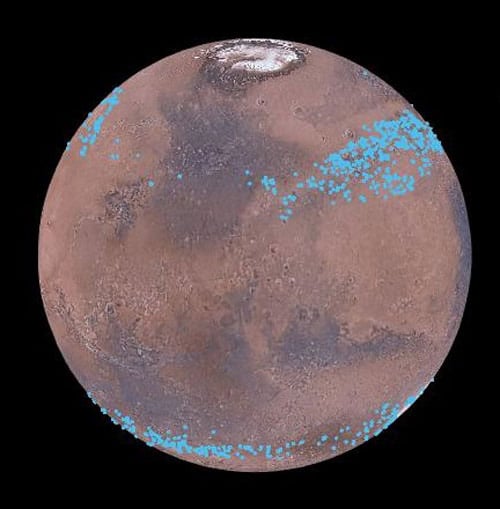
    Mars Has Glacier Belts Consisting of Frozen Water
    Mars has distinct polar ice caps, but Mars also has belts of glaciers at its central latitudes – between the blue lines, in both the southern and northern hemispheres. A thick layer of dust covers the glaciers, so they appear as the surface of the ground, but radar measurements show that there are glaciers composed of frozen water underneath the dust. Credit: Mars Digital Image Model, NASA/Nanna Karlsson

    Using satellite data, scientists at the Niels Bohr Institute have observed the shape of glaciers just below the surface of Mars.

    New studies have now calculated the size of the glaciers and thus the amount of water in the glaciers. It is the equivalent of all of Mars being covered by more than one meter of ice. The results are published in the scientific journal, Geophysical Research Letter.

    Several satellites orbit Mars and on satellite images, researchers have been able to observe the shape of glaciers just below the surface. For a long time scientists did not know if the ice was made of frozen water (H2O) or of carbon dioxide (CO2) or whether it was mud.

    Using radar measurements from the NASA satellite, Mars Reconnaissance Orbiter, researchers have been able to determine that is water ice. But how thick was the ice and do they resemble glaciers on Earth?

    A group of researchers at the Niels Bohr Institute have now calculated this using radar observations combined with ice flow modeling.

    Data combined with modeling

    “We have looked at radar measurements spanning ten years back in time to see how thick the ice is and how it behaves. A glacier is after all a big chunk of ice and it flows and gets a form that tells us something about how soft it is. We then compared this with how glaciers on Earth behave and from that we have been able to make models for the ice flow,” explains Nanna Bjornholt Karlsson, a postdoc at the Center for Ice and Climate at the Niels Bohr Institute at the University of Copenhagen.

    Nanna Bjornholt Karlsson explains that earlier studies have identified thousands of glacier-like formations on the planet. The glaciers are located in belts around Mars between the latitudes 300-500 – equivalent to just south of Denmark’s location on Earth. The glaciers are found on both the northern and southern hemispheres.

    From some locations on Mars they have good detailed high-resolution data, while they only have more sparse data from other areas. But by supplementing the sparse data with information about the flow and form of the glaciers from the very well-studied areas, they have been able to calculate how thick and voluminous the ice is across the glacier belts.

    Could cover the entire planet

    “We have calculated that the ice in the glaciers is equivalent to over 150 billion cubic meters (36 cubic miles) of ice – that much ice could cover the entire surface of Mars with 1.1 meters (3.6 feet) of ice. The ice at the mid-latitudes is therefore an important part of Mars’ water reservoir,” explains Nanna Bjornholt Karlsson.

    That the ice has not evaporated out into space could actually mean that the thick layer of dust is protecting the ice. The atmospheric pressure on Mars is so low that water ice simply evaporates and becomes water vapor. But the glaciers are well protected under the thick layer of dust.

    Reference: “Volume of Martian mid-latitude glaciers from radar observations and ice-flow modelling” by N. B. Karlsson, L. S. Schmidt and C. S. Hvidberg, 18 March 2015, Geophysical Research Letters.
    DOI: 10.1002/2015GL063219


    Never miss a breakthrough: Join the SciTechDaily newsletter.
    Follow us on Google and Google News.

    Mars Mars Reconnaissance Orbiter Niels Bohr Institute Planetary Science University of Copenhagen
    Share. Facebook Twitter Pinterest LinkedIn Email Reddit

    Related Articles

    New HiRISE Image of a “Fresh” Crater Near Sirenum Fossae

    Research Shows Billions of Planets in the Milky Way Have the Potential for Life

    NASA’s Mars Reconnaissance Orbiter Completes 40,000 Mars Orbits

    Irregularly Shaped Boulder Rolls Down Martian Hill, Lands Upright

    Orbiter Examines Clues to Possible Water Flows on Mars

    Mars Reconnaissance Orbiter Examines a New Impact Crater

    Scientists Find Evidence for Granite on Mars

    Data Indicates Temperatures Rise and Fall Twice a Day on Mars

    Mars Orbiter Shows McLaughlin Crater May Have Once Held a Groundwater-Fed Lake

    Leave A Reply Cancel Reply

    • Facebook
    • Twitter
    • Pinterest
    • YouTube

    Don't Miss a Discovery

    Subscribe for the Latest in Science & Tech!

    Trending News

    Monster Storms on Jupiter Unleash Lightning Beyond Anything on Earth

    Scientists Create “Liquid Gears” That Spin Without Touching

    The Simple Habit That Could Help Prevent Cancer

    Millions Take These IBS Drugs, But a New Study Finds Serious Risks

    Scientists Unlock Hidden Secrets of 2,300-Year-Old Mummies Using Cutting-Edge CT Scanner

    Bread Might Be Making You Gain Weight Even Without Eating More Calories

    Scientists Discover Massive Magma Reservoir Beneath Tuscany

    Europe’s Most Active Volcano Just Got Stranger – Here’s Why Scientists Are Rethinking It

    Follow SciTechDaily
    • Facebook
    • Twitter
    • YouTube
    • Pinterest
    • Newsletter
    • RSS
    SciTech News
    • Biology News
    • Chemistry News
    • Earth News
    • Health News
    • Physics News
    • Science News
    • Space News
    • Technology News
    Recent Posts
    • Simple Blood Test May Predict Alzheimer’s Years Before Brain Scans Show Signs
    • Scientists Say Adding This Unusual Seafood to Your Diet Could Reverse Signs of Aging
    • U.S. Waste Holds $5.7 Billion Worth of Crop Nutrients
    • Scientists Say a Hidden Structure May Exist Inside Earth’s Core
    • Doctors Surprised by the Power of a Simple Drug Against Colon Cancer
    Copyright © 1998 - 2026 SciTechDaily. All Rights Reserved.
    • Science News
    • About
    • Contact
    • Editorial Board
    • Privacy Policy
    • Terms of Use

    Type above and press Enter to search. Press Esc to cancel.