
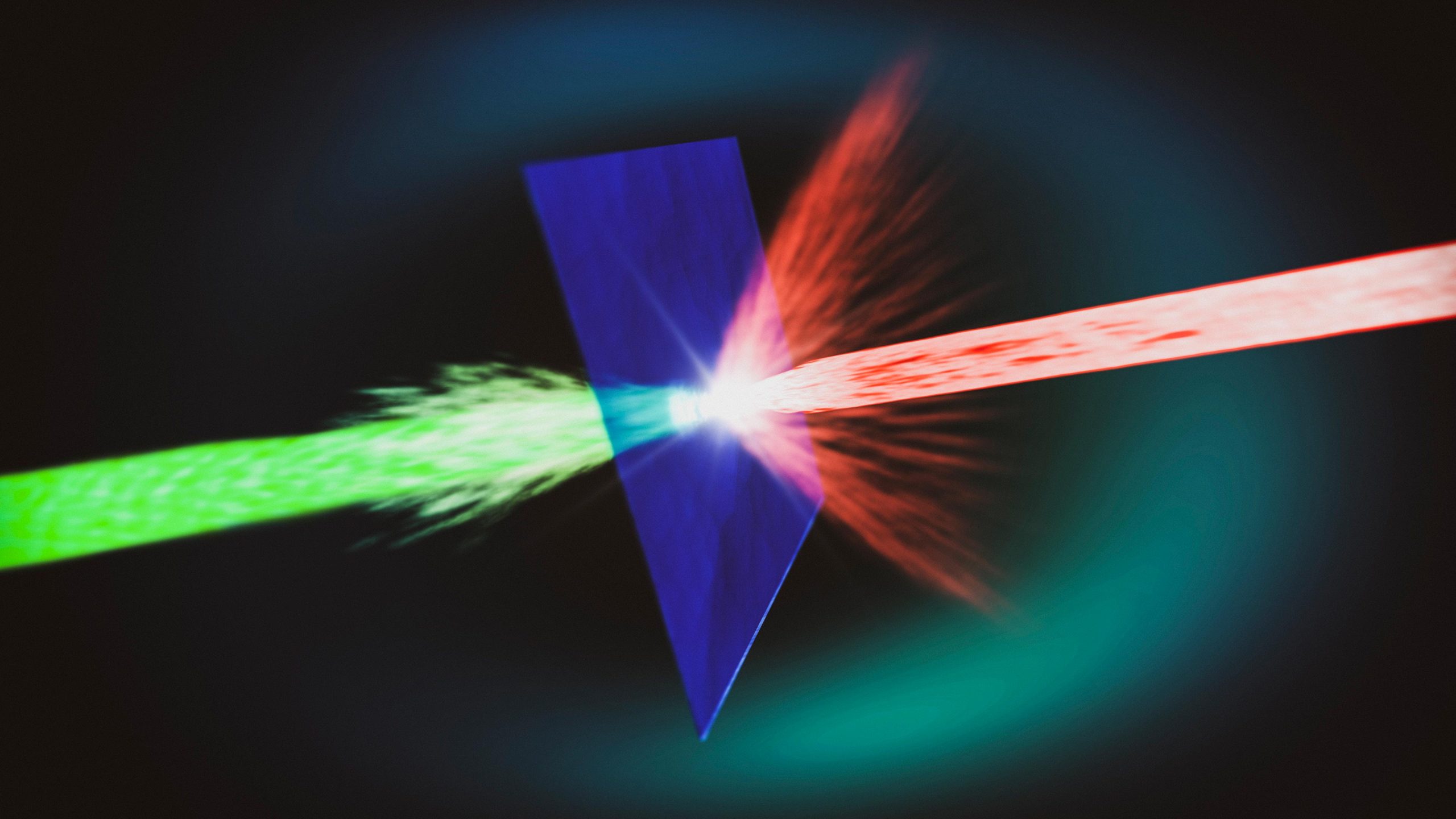
Scientists have unlocked a revolutionary way to generate proton beams using high-powered lasers and a simple stream of water.
Unlike conventional methods requiring large, costly accelerators, this approach uses laser-plasma accelerators to produce ultra-fast proton beams in a compact space.
A Breakthrough in Proton Beam Acceleration
Scientists have developed a novel method to generate fast, bright proton beams using a high-repetition-rate laser-plasma accelerator. Their research, published in Nature Communications, overcomes long-standing challenges and pushes this technology toward practical applications — all with the help of a simple stream of water.
“These exciting results pave the way for new applications of relativistic high-power lasers for applications in medicine, accelerator research, and inertial fusion,” said Siegfried Glenzer, professor of photon science and the director of the High Energy Density Science division at the Department of Energy’s SLAC National Accelerator Laboratory.
The Need for New Types of Proton Beams
Proton beams are high-speed streams of charged particles that can precisely target materials, making them valuable for a wide range of applications. Unlike X-rays, which affect a broader area, proton beams deposit their energy at specific locations, making them useful for treating cancer, fabricating semiconductors, and conducting advanced scientific research. However, producing these ultra-fast, high-energy beams remains a challenge.
Traditional particle accelerators, such as synchrotrons, use powerful electromagnets to accelerate, steer, and focus particle beams. While these systems have been crucial for scientific discoveries, their large size and high costs make them impractical for widespread use in industry and healthcare. Some advanced medical centers already use proton beams to treat tumors, selectively destroying cancerous cells while minimizing damage to surrounding tissue. However, more compact and cost-effective proton beam sources could significantly expand access to this technology, enabling new medical treatments and industrial applications.
The Promise of Laser-Plasma Acceleration
Enter laser-plasma accelerators (LPAs). LPAs use high-intensity lasers to strike a target, generating charged particle beams that reach comparable speeds to those produced using traditional accelerators – but in a fraction of the distance. Scientists are exploring LPAs as a compact, cost-effective way to generate proton beams, but several technical challenges have hindered their progress.
One challenge arises from the high-intensity laser, which destroys the targets after each pulse, requiring a new target for every shot. Another issue is the beam divergence – proton beams produced by LPAs typically spread out like a floodlight rather than maintaining a narrow focus. Both the need for target replacement and the beam divergence significantly reduce the efficiency of LPA systems.
Just Add Water
In this recent study, researchers made an unexpected breakthrough, simultaneously resolving multiple problems although they had only aimed to address one.
Working at the STFC Rutherford Appleton Laboratory’s Central Laser Facility, the team tested a novel target, developed by researchers at SLAC, to tackle the inefficiency of replacing targets after each laser pulse. Instead of using a traditional solid target, they introduced a thin sheet of water – a self-regenerating stream that replenishes after each shot. When the laser struck the water, it generated a proton beam as anticipated.
A Self-Focusing Surprise
But then, something surprising happened. The evaporated water formed a vapor cloud around the target, which interacted with the proton beam to create magnetic fields. These fields naturally focused the beam, resulting in a brighter, more tightly aligned proton beam.
Compared to similar experiments with solid targets, the water sheet reduced the proton beam’s divergence by an order of magnitude and increased the beam’s efficiency by a factor of one hundred. The proton beam exhibited remarkable stability, consistently operating at five pulses per second over hundreds of laser shots.
“This effect was completely unexpected,” said Griffin Glenn, a Stanford University PhD student involved in designing the water sheet target and conducting data analysis and the second author on the paper. The multitude of variables in this experiment – including the detailed properties of the laser, water sheet, and the vacuum environment – made such predictions impossible.
However, after observing the phenomenon, the team used experimental data to model and gain a deeper understanding of the underlying forces driving the effect. The team’s findings suggest that this approach could be scaled to higher-energy systems, enabling even brighter and more energetic proton beams.
Shifting the Paradigm
“This work has shifted the whole paradigm,” Glenzer said. “Finally, we are no longer totally reliant on simulations. We can now drive the physics from an experimental point of view, testing different laser intensities, target densities, and environmental pressures. The entire physics regime is in front of us.”
Notably, the proton beam consistently delivered the equivalent of 40 Gray with each shot, a standard radiation dosage used in proton therapies never before achieved with LPAs operating at this repetition rate. Furthermore, the results were achieved using an easily accessible low-energy laser system, marking a major advance toward preparing LPAs for practical applications in medicine and industry.
Reference: “Stable laser-acceleration of high-flux proton beams with plasma collimation” by M. J. V. Streeter, G. D. Glenn, S. DiIorio, F. Treffert, B. Loughran, H. Ahmed, S. Astbury, M. Borghesi, N. Bourgeois, C. B. Curry, S. J. D. Dann, N. P. Dover, T. Dzelzainis, O. C. Ettlinger, M. Gauthier, L. Giuffrida, S. H. Glenzer, R. J. Gray, J. S. Green, G. S. Hicks, C. Hyland, V. Istokskaia, M. King, D. Margarone, O. McCusker, P. McKenna, Z. Najmudin, C. Parisuaña, P. Parsons, C. Spindloe, D. R. Symes, A. G. R. Thomas, N. Xu and C. A. J. Palmer, 24 January 2025, Nature Communications.
DOI: 10.1038/s41467-025-56248-4
This research took place at the UK STFC Rutherford Appleton Laboratory’s Central Laser Facility and was funded in part by the DOE Office of Science, DOE National Nuclear Security Administration, and the National Science Foundation.
Never miss a breakthrough: Join the SciTechDaily newsletter.
Follow us on Google and Google News.
1 Comment
Great! Will that reduce the inflation?