
A new peptide-based drug-delivery strategy may bring scientists closer to an oral form of insulin.
For more than 100 years, scientists have pursued the idea of delivering insulin as a pill. This goal has remained difficult to achieve because insulin breaks down in the digestive system and the intestine lacks a natural transport pathway that allows the hormone to enter the bloodstream.
Because of these biological barriers, many people with diabetes still depend on daily insulin injections, which can place a significant burden on long-term treatment and quality of life.
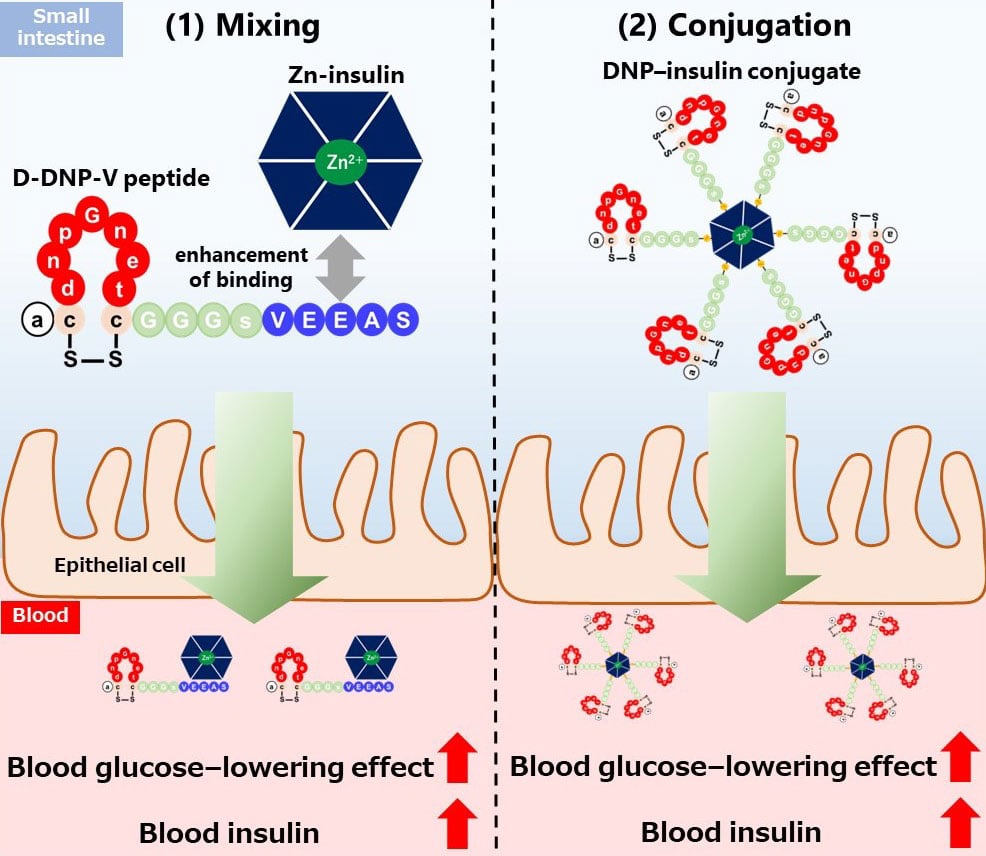
Researchers at Kumamoto University, led by Associate Professor Shingo Ito, have now developed a promising drug delivery strategy designed to overcome these obstacles. Their approach uses a cyclic peptide that can pass through the small intestine. The molecule, called the DNP peptide, helps insulin move across the intestinal barrier and into the body after oral administration.
Two Complementary Strategies for Oral Delivery
The researchers established two effective approaches to facilitate the intestinal absorption of insulin:
- Mixing method (interaction-based): In this approach, a modified “D-DNP-V peptide” was mixed with zinc-stabilized insulin hexamers. When given orally in several diabetes models, including chemically induced (STZ mice) and genetic (Kuma mice) models, the treatment quickly lowered blood glucose levels to the normal range. With once-daily dosing, stable glycemic control was maintained for three straight days.
- Conjugation method (covalent-based): In the second approach, the team used click chemistry to directly attach the DNP peptide to insulin, creating a “DNP–insulin conjugate.” This version produced glucose-lowering effects similar to those seen with the mixing method, supporting the idea that the peptide actively drives intestinal transport of insulin.
Overcoming the Dose Barrier
One of the biggest challenges in developing oral insulin has been the need for very large doses, often more than ten times the amount used in an injection. In contrast, this platform reached a pharmacological bioavailability of about 33–41% compared with subcutaneous injection.
That finding suggests a major reduction in the amount of insulin required for oral use and represents an important step toward real-world clinical application.
Perspective
“Insulin injections remain a daily burden for many patients,” said Associate Professor Shingo Ito. “Our peptide-based platform offers a new route to deliver insulin orally and may be applicable to long-acting insulin formulations and other injectable biologics.”
The findings were published in the international journal Molecular Pharmaceutics.
The research team is now moving forward with translational studies. Planned work includes testing the system in large animal models and evaluating its performance in human intestinal systems.
Reference: “Small Intestine-Permeable Cyclic Peptide-Based Technology Enables Efficient Oral Delivery and Glycemic Efficacy of Zinc-Stabilized Insulin Hexamer and Its Analogs in Diabetic Mice” by Shoma Chikamatsu, Kosei Sakaguchi, Masataka Michigami, Kimi Araki, Shoen Kume, Midori Tokuyasu, Takeshi Masuda, Ikuo Fujii, Sumio Ohtsuki and Shingo Ito, 24 November 2025, Molecular Pharmaceutics.
DOI: 10.1021/acs.molpharmaceut.5c00902
Funding: Japan Society for the Promotion of Science, Japan Agency for Medical Research and Development, Center for Clinical and Translational Research, Japan Science and Technology Agency, Kumamoto University
Never miss a breakthrough: Join the SciTechDaily newsletter.
Follow us on Google and Google News.
3 Comments
Very exited about the discovery as this eould assist and lower defaulting as pstients tend to be afraid of injecting themselves as well as I’m very exited regarding the tumour story that I don’t understand clearly. Thnx
Loving ❤️ this discovery!! I myself do not suffer from diabetes however many members of family and friends suffer from the effects of this debilating disease!!
Good to know a pill will be available when my time comes 😊 thanks so much once again to the scientists who lovingly work endless hours to help the world’s people’s to end suffering and disease you truly are the “HEROS” of the little people’s love ❤️ DIANE MOREAU
We are very tired of type 1 diabetes. So why science could not bring any solution to diabetics specially type 1 which is killing and suffering alot of people world wide. Why governments and health institutes did not give more attention than before.
How long time people will wait to hear stories of future cure which are boring and intangible.
The world should work very hard than any time of tge past now at this moment because young adults are being affected and disturbed their life so as they are becoming hopeless as todays way of managing T1D are very inconvenient to the victims of this disease.