
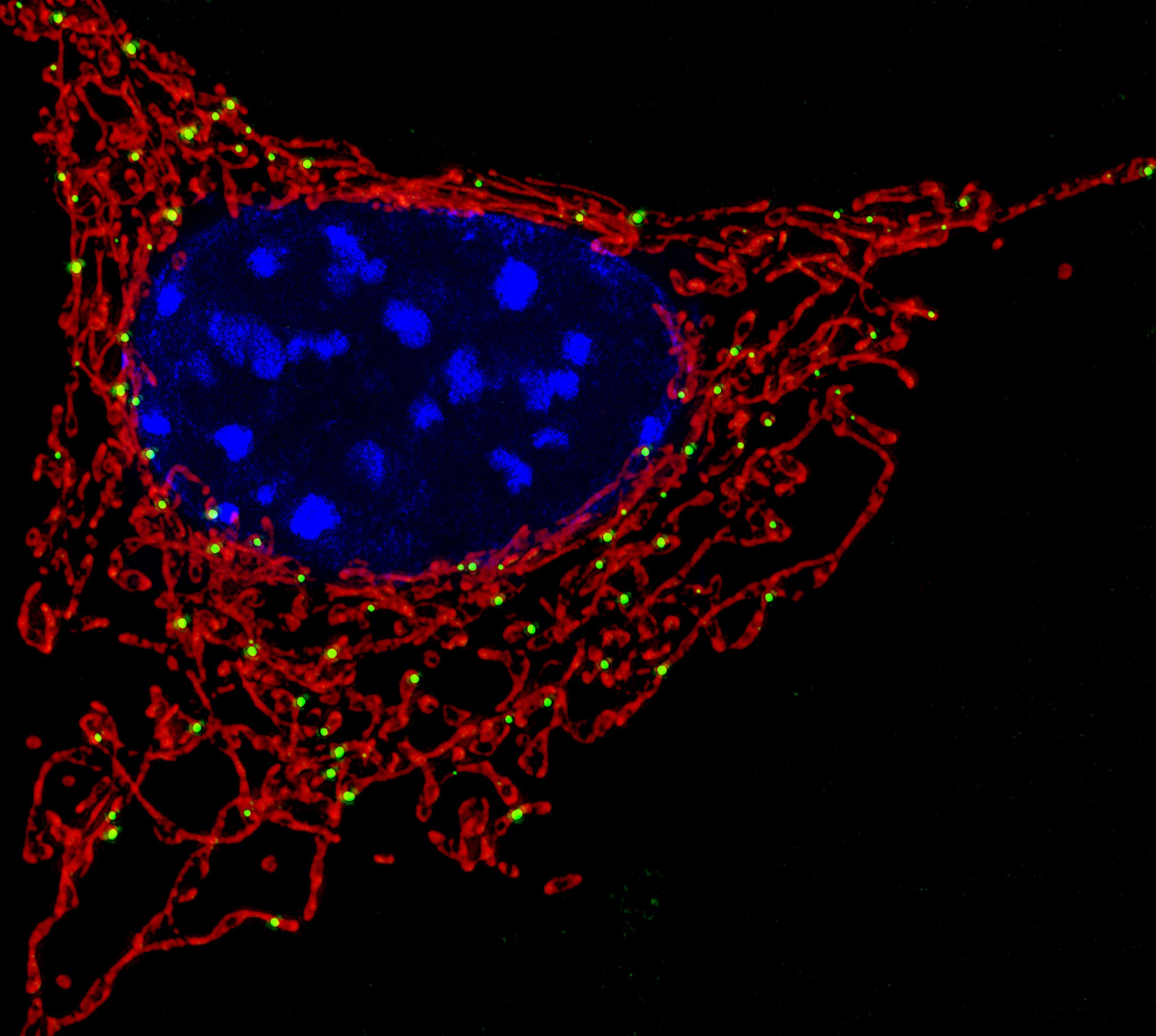
For many years, scientists thought that mitochondria, the energy-generating cores of living cells, functioned similarly to home batteries, producing energy via a chemical process within a single chamber or cell. UCLA researchers have now demonstrated that mitochondria are made up of many separate bioelectric units that create energy in an array, much like a Tesla electric car battery, which packs thousands of battery cells to manage energy securely and allow quick access to extremely high current.
“Nobody had looked at this before because we were so locked into this way of thinking; the assumption was that one mitochondrion meant one battery,” said Dr. Orian Shirihai, a professor of medicine in endocrinology and pharmacology at the David Geffen School of Medicine at UCLA and senior author of the study published on October 14, 2019, in EMBO Journal. It is also not a coincidence that this has taken place in California, where an electric vehicle revolution has made its impact everywhere on the University of California, Los Angeles campus.
Mitochondria are a type of organelle, which are microscopic structures within a cell that conduct certain activities. Except for red blood cells, all cells in the human body contain one or more — sometimes thousands — mitochondria. These organelles have a smooth outer membrane and a wrinkled inner membrane with folds called cristae that stretch toward the center of the mitochondrion. Up until recently, scientists believed that the inner membrane’s wrinkled structure served just to expand the surface area for energy generation.
“Electric vehicle engineers told me about the advantages of having many small battery cells instead of one large one; if something happens to one cell, the system can keep working, and multiple small batteries can provide a very high current when you need it,” Shirihai said.
Tesla vehicles, for instance, are powered by 5,000 to 7,000 small battery cells, depending on the car model. The small batteries, arranged in a large grid, let the vehicles rapidly charge, efficiently cool, and quickly use a large amount of power to accelerate.
Shirihai, using conventional microscopy, had been seeing that cells function well with a small number of very long mitochondria, which did not match the idea of many small batteries. He started to wonder whether each mitochondria really was a single large battery.
Shirihai and colleagues faced a difficult challenge to develop an approach to map the voltage on the membrane of mitochondria in living cells at a resolution never seen before. Two students, Dane Wolf and Mayuko Segawa, optimized a form of high-resolution microscopy to visualize the interior of mitochondria and watch energy production and voltage distribution inside the organelle.
“What the images told us was that each of these cristae is electrically independent, functioning as an autonomous battery,” Shirihai said. “One cristae can get damaged and stop functioning while the others maintain their membrane potential.”
Between each cristae, where the inner membrane of the mitochondria loops back outward, clusters of proteins form the boundaries of each cristae. Researchers knew that without these proteins, mitochondria were more sensitive to damage. Now, Shirihai has explained why: The proteins normally divide each cristae from their neighbors, acting as electrical insulators. In cells lacking those proteins, Shirihai found that each mitochondria became one giant battery.
“The battery experts I had originally talked to were very excited to hear that they were right,” Shirihai said. “It turns out that mitochondria and Teslas, with their many small batteries, are a case of convergent evolution.”
The discovery may help lead to a new understanding of mitochondria’s roles in aging, disease and medical complications, the researchers said. The authors note that many medical conditions are associated with severe disturbances in cristae structure.
###
Dr. Shirihai is a co-corresponding author of the paper, along with Marc Liesa, assistant professor of medicine at UCLA. Wolf and Segawa are the first authors.
Funding for the study was provided by the National Institutes of Health, National Cancer Institute, National Institute of Diabetes and Digestive and Kidney Diseases, Deutsche Forschungsgemeinschaft, and Heinrich Heine University Düsseldorf.
Reference: “Individual cristae within the same mitochondrion display different membrane potentials and are functionally independent” by Dane M Wolf, Mayuko Segawa, Arun Kumar Kondadi, Ruchika Anand, Sean T Bailey, Andreas S Reichert, Alexander M van der Bliek, David B Shackelford, Marc Liesa and Orian S Shirihai, 14 October 2019, EMBO Journal.
DOI: 10.15252/embj.2018101056
Never miss a breakthrough: Join the SciTechDaily newsletter.
Follow us on Google and Google News.
1 Comment
mitochondrion; (pl. mitochondria)