
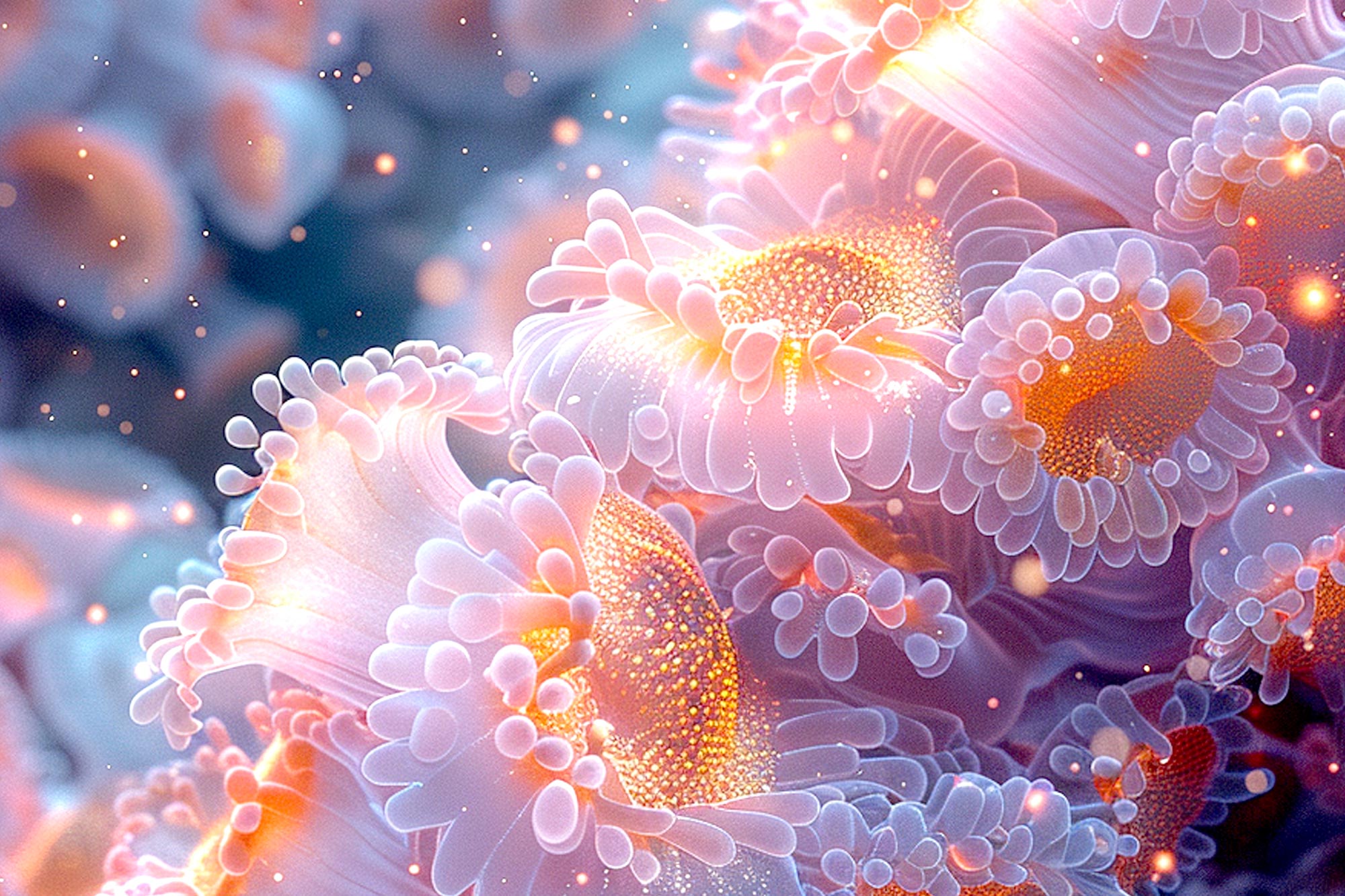
Most coral reefs do not thrive in nutrient-poor “marine deserts” as once believed, but instead flourish in nutrient-rich waters.
Coral reefs are among the most frequently featured subjects in nature documentaries, admired worldwide for their striking beauty and rich biodiversity. They are often portrayed as vibrant oases thriving in the middle of clear, blue oceans that are otherwise low in nutrients and plankton. Although such reef systems do exist, a new study published in Current Biology challenges this widely accepted view, commonly referred to as “Darwin’s Paradox.”
The research reveals that while coral reefs are indeed some of the most productive ecosystems on the planet, their presence in nutrient-poor waters is uncommon. Most reefs actually thrive in areas where nutrients are more abundant. Importantly, the idea behind “Darwin’s Paradox” is not based on Charles Darwin’s work, despite the attribution. The study, partially funded by the U.S. National Science Foundation, calls for a reexamination of long-standing assumptions about coral reef ecology.
Debunking the Darwin Myth
The narrative of Darwin’s paradox has evolved over the past few decades and has since become a staple in mainstream media and high-profile publications.
“While the narrative is really compelling, it is both factually and historically wrong, which can have important implications for how we manage coral reef ecosystems,” said senior author Simon Brandl, assistant professor at the University of Texas Marine Science Institute.
The oases in the desert hypothesis implies that reefs are closed systems that are largely independent from conditions in the surrounding waters.
“Our findings suggest that the majority of the world’s coral reefs exist in conditions where surrounding waters may very well be able to sustain much of the fabulous productivity on reefs,” Brandl said.

This has large implications, since links between the reefs and surrounding oceans may be modified by a variety of human impacts, including nutrient runoff and global warming effects that may alter nutrient and phytoplankton distributions throughout the tropics.
To better understand coral reef systems and their global distribution, the authors tested both parts of the alleged paradox: high productivity (i.e., oases) and limited resources available in surrounding waters (i.e., deserts). To examine productivity, they analyzed the net primary production of coral reefs against a wide range of other ecosystems, demonstrating that the productivity of coral reefs is only matched by coastal wetlands, while most other habitats on Earth, including forests, rivers, and lakes, or even coastal upwelling zones, lag far behind.
Measuring Nutrient Levels Around Reefs
To test the surrounding “desert” component, the authors measured both direct food sources of coral reef organisms (i.e., phytoplankton) and their nutrient sources in tropical ocean waters using both satellite data and empirical measurements. Remarkably, they found that most coral reef systems thrive in intermediate or elevated nutrient concentrations and in areas where chlorophyll a—a green pigment used by phytoplankton to absorb sunlight and an indicator of the level of photosynthesis by phytoplankton—is twice the median range for tropical oceans and double for oligotrophic oceans or “deserts.” In fact, 80% of coral reefs occur in conditions that scientists would generally classify as nutrient-enriched.
Poignantly, not only the paradox’s meaning, but also its attribution to Darwin is fundamentally wrong. Using a combination of manual review and text mining, the authors show that Darwin’s cited work does not include any mention of coral reef productivity or the role of surrounding oceans, nor would Darwin have had an understanding of ocean conditions deep enough to arrive at the alleged conclusion.
Attribution to Darwin was likely made (and persisted) due to his gravity and name recognition, and it likely persisted because a large-scale in-depth global review has not been completed until now. This demonstrates that scientists must not be afraid to rethink and challenge existing knowledge.
“With this study, we hope to cast a more quantitative light on coral reefs and what allows them to be so productive,” said Brandl.
Their persistence across a broad range of oceanic conditions indicates that linkages between reef animals and their prey are more complex and context-dependent than previously thought. As human impact continues to enrich coastal oceans with nutrients and rising temperatures change plankton communities surrounding reefs, additional effort should be put into understanding these linkages and energy flow.
“Our analysis shows that coral reefs are truly unique in their capacity to produce an abundance of life, but how this occurs depends on where these reefs are located and, unfortunately, how human impact will change local conditions,” Brandl said.
Reference: “Rethinking Darwin’s coral reef paradox and the ubiquity of “marine oases”” by Renato A. Morais, Larissa Patricio-Valerio, Pauline Narvaez, Valeriano Parravicini and Simon J. Brandl, 5 June 2025, Current Biology.
DOI: 10.1016/j.cub.2025.05.033
The work was supported by RAMS’s Branco Weiss Fellowship Society in Science, PSL Junior Fellowship, and a U.S. National Science Foundation Award to Brandl.
Never miss a breakthrough: Join the SciTechDaily newsletter.
Follow us on Google and Google News.