
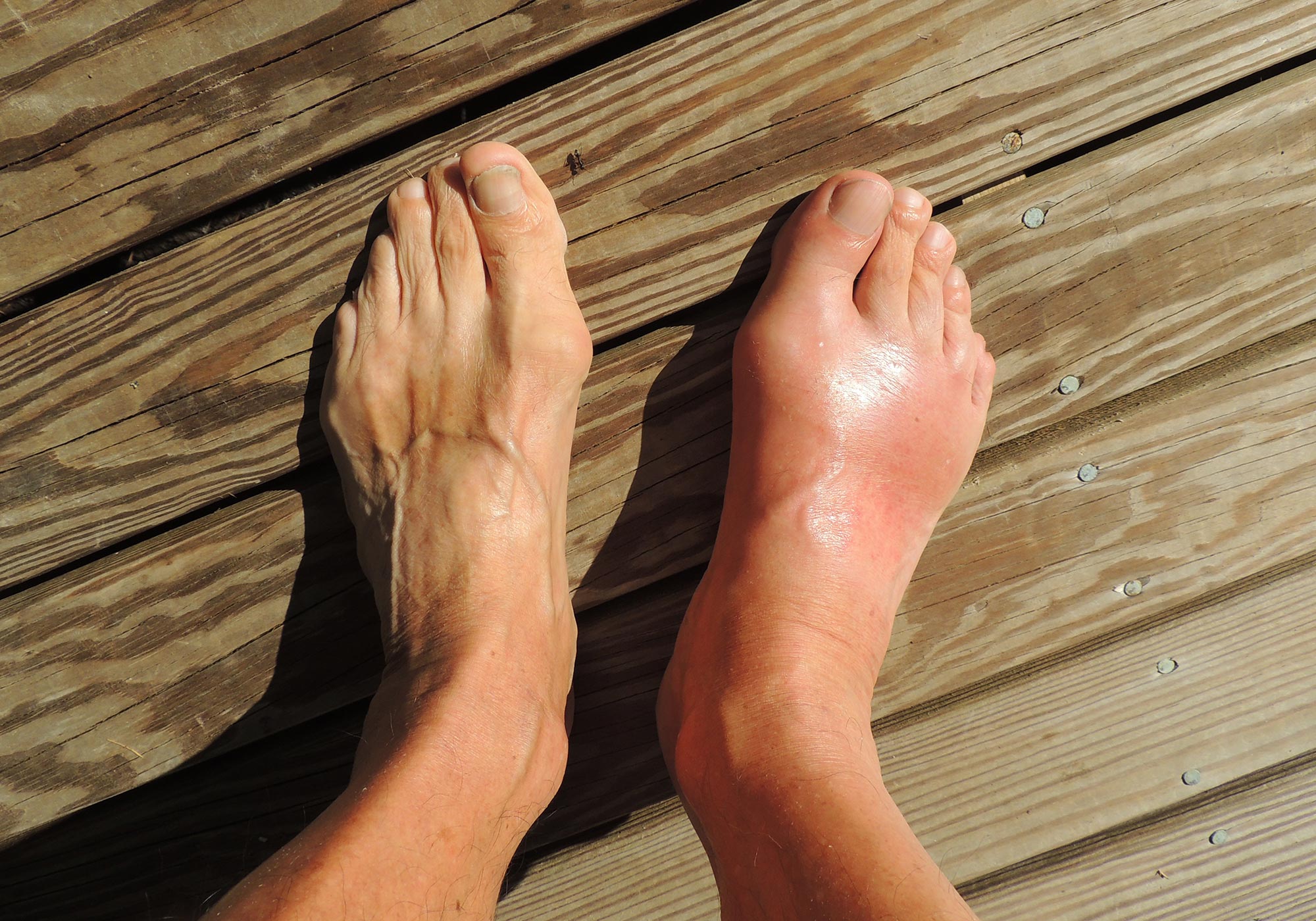
Should doctors rethink the standard gout treatment?
Gout happens when excess uric acid in the body forms urate crystals that collect in and around joints, triggering sudden attacks of intense pain and inflammation. To prevent those flares and lower the risk of long-term joint damage, kidney stones, and tophi, doctors often use urate-lowering drugs. A common first-line option is a xanthine oxidase inhibitor such as febuxostat, which reduces the body’s production of uric acid. But new research suggests that, in some patients, a different approach may work better even at a low dose.
In a clinical trial published in Arthritis & Rheumatology, researchers compared low-dose benzbromarone with low-dose febuxostat in 196 men with gout whose main problem was poor uric acid excretion through the kidneys.
The prospective, single-center, open-label study randomly assigned participants to receive either benzbromarone 25 mg daily or febuxostat 20 mg daily for 12 weeks.
Before treatment began, participants completed a 14-day washout period and followed a low-purine diet. During the trial, all participants also took oral sodium bicarbonate to alkalinize the urine, which can help reduce the risk of stone formation.
Effectiveness in Lowering Uric Acid
The researchers wanted to see how many patients reached the standard blood urate target of less than 6 mg/dL by week 12.
Low-dose benzbromarone performed better.
By the end of the study, 61% of patients in the benzbromarone group reached that target, compared with 32% in the febuxostat group. Benzbromarone also led to lower average serum urate levels over the full study period, and more patients in that group reached the stricter target of less than 5 mg/dL by week 12 (24% versus 9%).
Safety and Side Effects
Safety outcomes were broadly similar between the two groups, with no serious adverse events reported. Rates of gout flares and kidney stones did not differ significantly. Liver-related lab abnormalities were actually less common with benzbromarone in this trial. Transaminase elevation above the upper limit of normal occurred in 4% of patients taking benzbromarone, compared with 15% of those taking febuxostat.
Most gout guidelines favor xanthine oxidase inhibitors first, regardless of why uric acid is elevated. This trial instead focused on a more targeted group: patients whose hyperuricemia was driven mainly by reduced kidney excretion of uric acid.
Limitations and Considerations
The study also has important limits. It was conducted at a single center, lasted only 12 weeks, and included only relatively young, generally healthy men without moderate kidney disease. The results, therefore, may not apply to women, older patients, people with more serious kidney impairment, or populations outside the study setting. Benzbromarone is also not approved in the United States, due to the risk of idiosyncratic hepatotoxicity, which limits how widely these findings can be applied in American practice.
Still, the results point to a potentially important treatment strategy. “The results suggest that low dosing of benzbromarone may warrant stronger consideration as a safe and effective therapy to achieve serum urate target in gout,” the authors wrote.
Reference: “Superiority of Low-Dose Benzbromarone to Low-Dose Febuxostat in a Prospective, Randomized Comparative Effectiveness Trial in Gout Patients With Renal Uric Acid Underexcretion” by Fei Yan, Xiaomei Xue, Jie Lu, Nicola Dalbeth, Han Qi, Qing Yu, Can Wang, Mingshu Sun, Lingling Cui, Zhen Liu, Yuwei He, Xuan Yuan, Ying Chen, Xiaoyu Cheng, Lidan Ma, Hailong Li, Aichang Ji, Shuhui Hu, Zijing Ran, Robert Terkeltaub and Changgui Li, 7 July 2022, Arthritis & Rheumatology.
DOI: 10.1002/art.42266
Never miss a breakthrough: Join the SciTechDaily newsletter.
Follow us on Google and Google News.
2 Comments
Hi, I’m also suffering from gout is now affecting my hand, elbow and knees.
Please advise if possible
Long time gout sufferer