
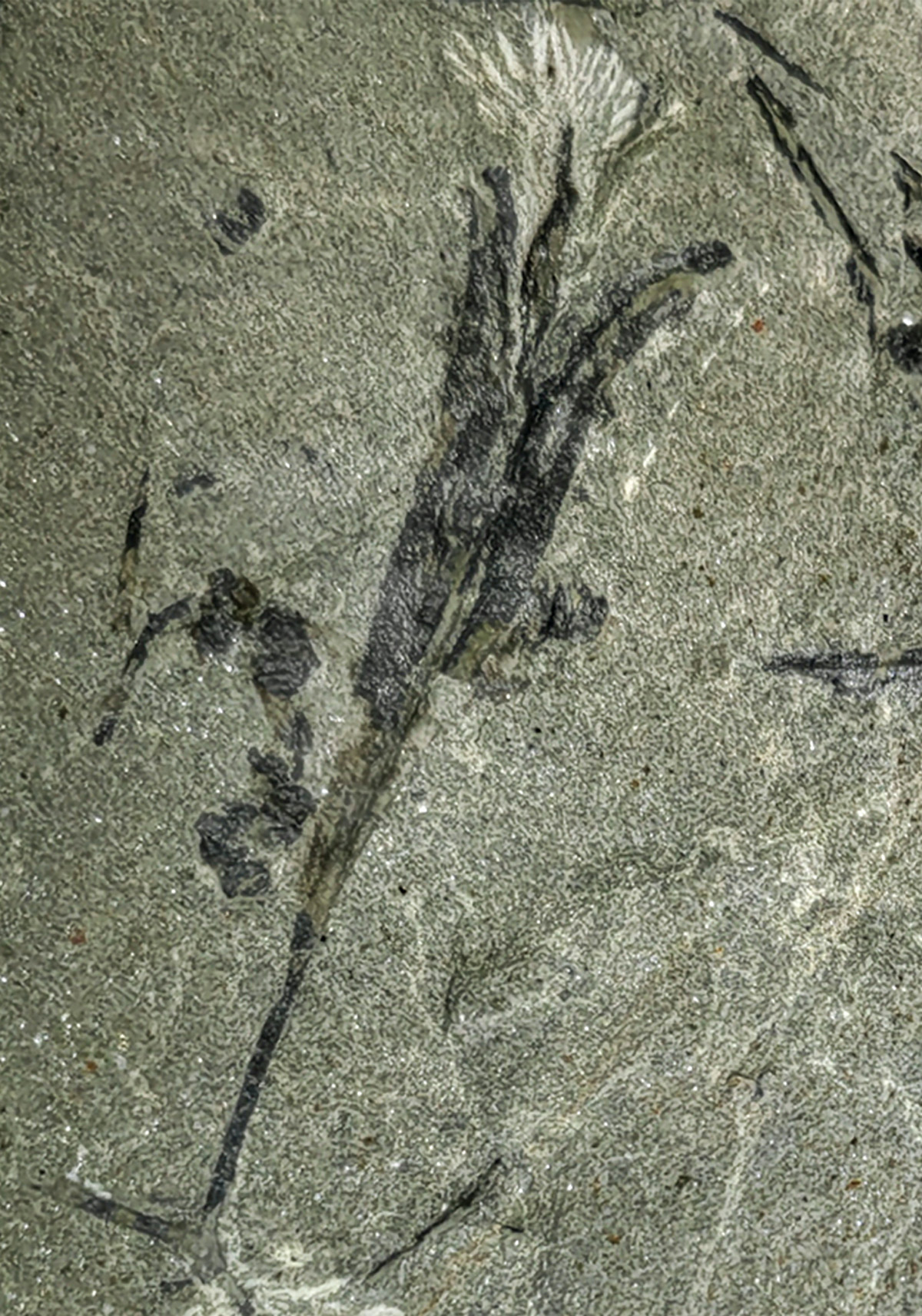
Researchers have uncovered a new plant seed fossil called Alasemenia, which is among the earliest known examples of a winged seed.
Researchers have uncovered one of the earliest known examples of a winged seed, providing valuable insights into the origins and early evolution of wind dispersal strategies in plants.
The study, recently published in eLife, details the second-earliest known winged seed – Alasemenia – from the Late Devonian epoch, roughly 360–385 million years ago. The authors use what the editors call solid mathematical analysis to demonstrate that Alasemenia’s three-winged seeds are more adapted to wind dispersal than one, two, and four-winged seeds.
Wind dispersal in plant seeds is a natural mechanism that allows plants to spread their seeds through the air to new areas. This helps reduce competition for resources, increasing the plant’s chances of survival. Examples of wind dispersal strategies include tumbleweeds, parachutes such as dandelions and milkweeds, and winged seeds like those of the maple tree, often called ‘helicopter’ seeds.
Evolutionary Significance of the Late Devonian
The earliest-known plant seeds date back to the Late Devonian epoch. “This period marks a significant evolutionary milestone in plant history, as they transitioned from spore-based reproduction, as with ferns and mosses, to seed-based reproduction,” explains lead author Deming Wang, a professor at the Key Laboratory of Orogenic Belts and Crustal Evolution, Department of Geology, Peking University, Beijing, China. “However, little is known about wind dispersal in seeds during this time, as most fossils lack wings and are typically surrounded by a protective cupule.”
Cupules are cup-shaped structures that partly enclose seeds, much like in acorns or chestnuts (although the Devonian cupules do not share the same origin with these modern ones), and could be associated with other dispersal methods, such as water transport.
To better understand early wind dispersal mechanism, Wang and colleagues studied several seed fossils from the Late Devonian, sourced from the Jianchuan mine in Xinhang Town, Anhui Province, China. From this, they identified a new fossil seed, Alasemenia.
They first described the characteristics of Alasemenia by carefully analyzing the fossil samples, including making slices to view the seed’s internal structures. They found that Alasemenia seeds are about 25–33 mm long and clearly lack a cupule, unlike most other seeds of the period. In fact, this is one of the oldest-known records of a seed without a cupule, 40 million years earlier than previously believed.
Structural Analysis of Alasemenia
Each seed is covered by a layer of integument, or seed coat, which radiates outwards to form three wing-like lobes. These wings taper toward the tips and curve outward, creating broad, flattened structures that would have helped the seeds catch the wind.
The team then compared Alasemenia to the other known winged seeds from the Late Devonian: Warstenia and Guazia. Both of these seeds have four wings – Guazia’s being broad and flat, and Warstenia’s being short and straight. They performed a quantitative mathematical analysis to determine which seed had the most effective wind dispersal. This revealed that having an odd number of wings, as in Alasemenia, grants a more stable, high spin rate as the seeds descend from their branches, allowing them to catch the wind more effectively and therefore disperse further from the parent plant.
“Our discovery of Alasemenia adds to our knowledge of the origins of wind dispersal strategies in early land plants,” says senior author Pu Huang, an assistant research fellow at the Nanjing Institute of Geology and Paleontology, Chinese Academy of Sciences, Nanjing, China. “Combined with our previous knowledge of Guazia and Warsteinia, we conclude that winged seeds as a result of integument outgrowth emerged as the first form of wind dispersal strategy during the Late Devonian, before other methods such as parachutes or plumes.”
“The three-winged seeds seen in Alasemenia during the Late Devonian would have subsequently been followed by two-winged seeds during the Carboniferous period, and then single-winged seeds during the Permian,” adds Wang.
Reference: “Alasemenia, the earliest ovule with three wings and without cupule” by Deming Wang, Jiangnan Yang, Le Liu, Yi Zhou, Peng Xu, Min Qin and Pu Huang, 8 October 2024, eLife.
DOI: 10.7554/eLife.92962
Never miss a breakthrough: Join the SciTechDaily newsletter.
Follow us on Google and Google News.