
Close Menu
    Facebook X (Twitter) Instagram
    SciTechDaily
    • Biology
    • Chemistry
    • Earth
    • Health
    • Physics
    • Science
    • Space
    • Technology
    Facebook X (Twitter) Pinterest YouTube RSS
    SciTechDaily
    Home»Science»Scientists Discover Giant, Prehistoric Salmon With Tusk-Like Teeth
    Science

    Scientists Discover Giant, Prehistoric Salmon With Tusk-Like Teeth

    By PLOSApril 25, 2024No Comments4 Mins Read
    Facebook Twitter Pinterest Telegram LinkedIn WhatsApp Email Reddit
    Share
    Facebook Twitter LinkedIn Pinterest Telegram Email Reddit
    Oncorhynchus rastrosus
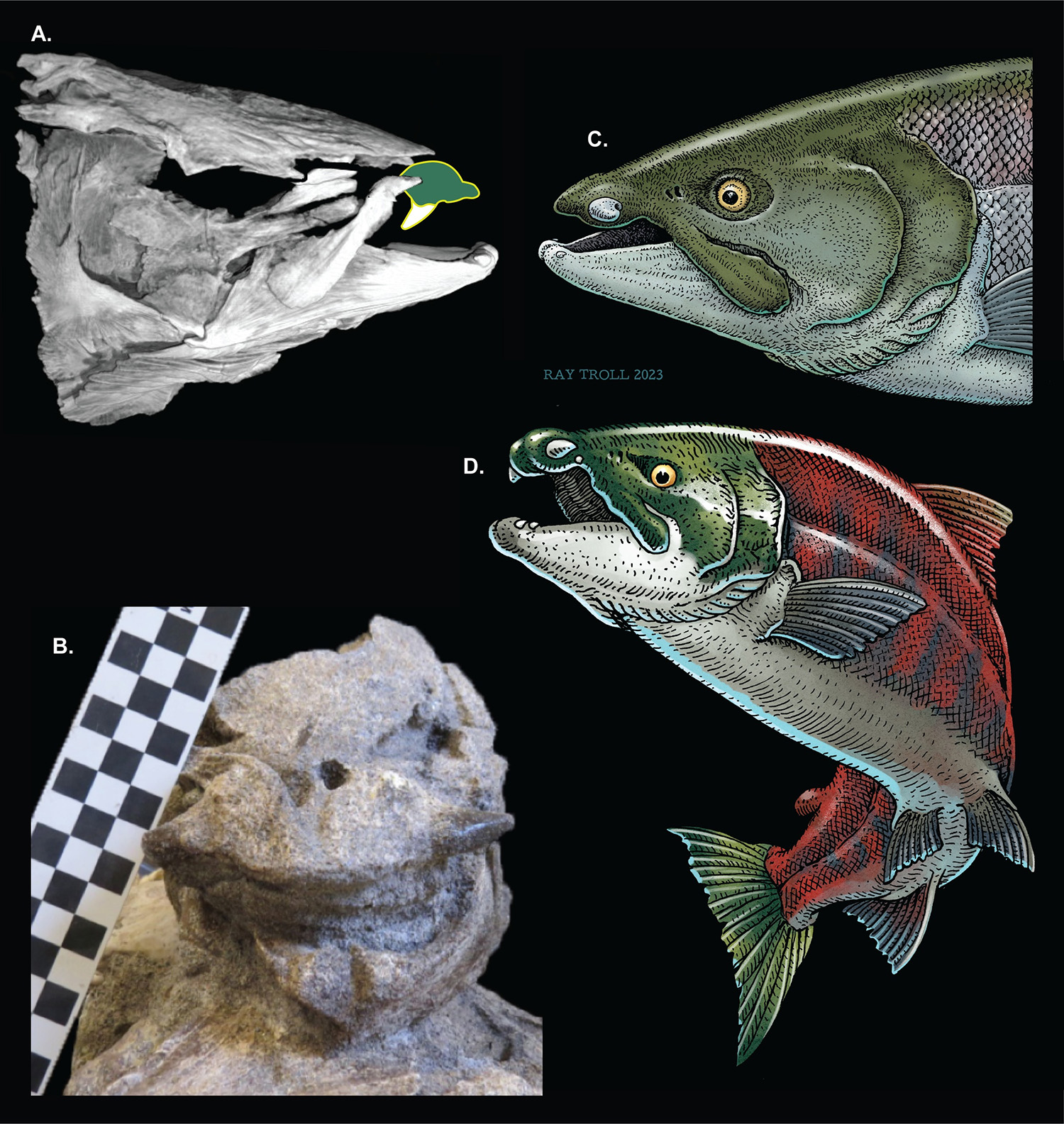
    Oncorhynchus rastrosus. (A) CT model of Holotype, UO F-26799, skull in right lateral view with a stylized drawing of the originally proposed “sabertoothed” position of the isolated premaxilla; (B) UO_A in anterior view of skull, prior to complete preparation and CT scan; (C) Artist’s rendering skull of male iconic fish with accurate spike-tooth configuration; (D) Artist’s rendering of complete female iconic fish with accurate spike-tooth configuration. Scale bar blocks = 1 cm each. Credit: Claeson et al., 2024, PLOS ONE, CC-BY 4.0

    Paleontologists suggest that the teeth could have served purposes such as defense, competitive combat, or as tools for digging.

    Oncorhynchus rastrosus, a giant species of salmon that lived in the North American Pacific Northwest a few million years ago, sported a pair of front teeth that projected out from the sides of its mouth like tusks, according to a study recently published in the open-access journal PLOS ONE by Kerin Claeson from the Philadelphia College of Osteopathic Medicine, USA, and colleagues.

    O. rastrosus, first described in the 1970s, has been estimated to reach up to 2.7 meters (8.9 feet) long, making it the largest member of the Salmonidae family ever discovered. Initially, researchers thought its oversized front teeth pointed backward into the mouth like fangs, in large part because fossils of the teeth were found apart from the rest of the skull.

    This led to the common name “saber-toothed salmon.” But through new CT scans and analysis of various Oncorhynchus rastrosus fossils collected over the years, researchers have now been able to confirm that the teeth actually pointed sideways out of the fish’s mouth, similar to a warthog. As a result, the authors say, the species should be renamed the “spike-toothed salmon.”
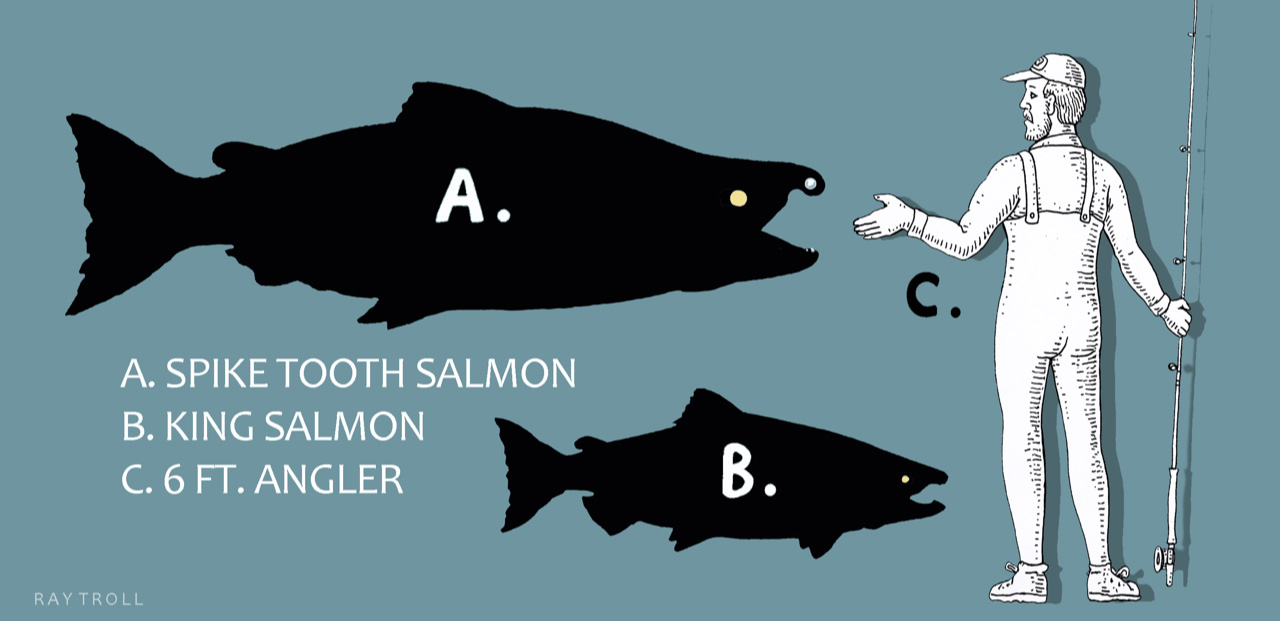
    Comparative Size of the Spike Tooth Salmon to the Largest Living Salmon and a 6ft Fisherman
    Comparative size of the Spike-Tooth Salmon to the largest living salmon and a 6ft. fisherman. Credit: Ray Troll, CC-BY 4.0

    Potential Uses for Distinctive Teeth

    While it’s unclear exactly what these teeth may have been used for, the researchers believe they were likely used for fighting — either against other spiked-toothed salmon or as a defense against predators — or as a tool for digging out nests. It’s also possible the teeth were used for multiple purposes, the authors note. But the teeth likely weren’t used for catching prey, since Oncorhynchus rastrosus is believed to have been a filter-feeder that dined on plankton.

    Kerin Claeson, lead author and professor of anatomy at Philadelphia College of Osteopathic Medicine, adds: “We have known for decades that these extinct salmon from Central Oregon were the largest to ever live. Discoveries like ours show they probably weren’t gentle giants. These massive spikes at the tip of their snouts would have been useful to defend against predators, compete against other salmon, and ultimately build the nests where they would incubate their eggs.”

    Edward Davis, associate professor of earth sciences at the University of Oregon and director of Condon Collection at the UO’s Museum of Natural and Cultural History, adds: “I’m delighted that we have been able to put a new face on the giant spike-tooth salmon, bringing knowledge from the field in Oregon to the world.”

    Brian Sidlauskas, professor and curator of fishes at Oregon State University, adds: “We also stress that females and males alike possessed the enormous, tusk-like teeth. Therefore, the sexes were equally fearsome.”

    Reference: “From sabers to spikes: A newfangled reconstruction of the ancient, giant, sexually dimorphic Pacific salmon, †Oncorhynchus rastrosus (SALMONINAE: SALMONINI)” by Kerin M. Claeson, Brian L. Sidlauskas, Ray Troll, Zabrina M. Prescott and Edward B. Davis, 24 April 2024, PLOS ONE.
    DOI: 10.1371/journal.pone.0300252

    This work was supported by the National Science Foundation (1948340 and 2228394, awarded to ED).

    Never miss a breakthrough: Join the SciTechDaily newsletter.
    Follow us on Google and Google News.

    Fish Fossils Paleontology PLOS
    Share. Facebook Twitter Pinterest LinkedIn Email Reddit

    Related Articles

    More Than 80 Feet Long – Newly Discovered Ichthyosaur May Be the Largest Marine Reptile Ever

    Debunking the Myth: Was Spinosaurus Really a “7-Ton Heron From Hell?”

    Unveiling Europe’s Oldest Hippo: A Middle Pleistocene Mystery Solved

    Scientists Discover Ancient Parasites in 200-Million-Year-Old Fossil Poop

    Scientists Identify 240-Million-Year-Old Mystery Ancient Marine Reptile

    Dinosaur “Mummies” Might Not Be Unusual – Unhealed Carnivore Damage on Dinosaur Skin

    Surprising Diversity of Cretaceous Reptiles at Argentina Fossil Site – Revealed by Discovery of Ancient Teeth

    Enormous Ancient Fish Discovered by Accident – Bizarre-Looking and “Absolutely Massive!”

    Paleontologists Discover Never-Before-Seen Ancient Fish Species

    Leave A Reply Cancel Reply

    • Facebook
    • Twitter
    • Pinterest
    • YouTube

    Don't Miss a Discovery

    Subscribe for the Latest in Science & Tech!

    Trending News

    Enormous Prehistoric Insects Puzzle Scientists

    Scientists Develop Bioengineered Chewing Gum That Could Help Fight Oral Cancer

    After 37 Years, the World’s Longest-Running Soil Warming Experiment Uncovers a Startling Climate Secret

    NASA Satellite Captures First-Ever High-Res View of Massive Pacific Tsunami

    ADHD Isn’t Just a Deficit: Study Reveals Powerful Hidden Strengths

    Scientists Discover Stem Cells That Could Regrow Teeth and Bone

    Early Cannabis Use May Stall Key Brain Skills in Teens

    Popular Vitamin D Supplement Has “Previously Unknown” Negative Effect, Study Finds

    Follow SciTechDaily
    • Facebook
    • Twitter
    • YouTube
    • Pinterest
    • Newsletter
    • RSS
    SciTech News
    • Biology News
    • Chemistry News
    • Earth News
    • Health News
    • Physics News
    • Science News
    • Space News
    • Technology News
    Recent Posts
    • Ancient Document Confirms “Legendary” African King Actually Existed
    • First-of-Its-Kind Discovery: Homer’s Iliad Found Embedded in a 1,600-Year-Old Egyptian Mummy
    • Beyond Inflammation: Scientists Uncover New Cause of Persistent Rheumatoid Arthritis
    • Cancer-Like Mutations Found in the Brain May Be Driving Alzheimer’s Disease
    • A Simple Molecule Could Unlock Safer, Easier Weight Loss
    Copyright © 1998 - 2026 SciTechDaily. All Rights Reserved.
    • Science News
    • About
    • Contact
    • Editorial Board
    • Privacy Policy
    • Terms of Use

    Type above and press Enter to search. Press Esc to cancel.