
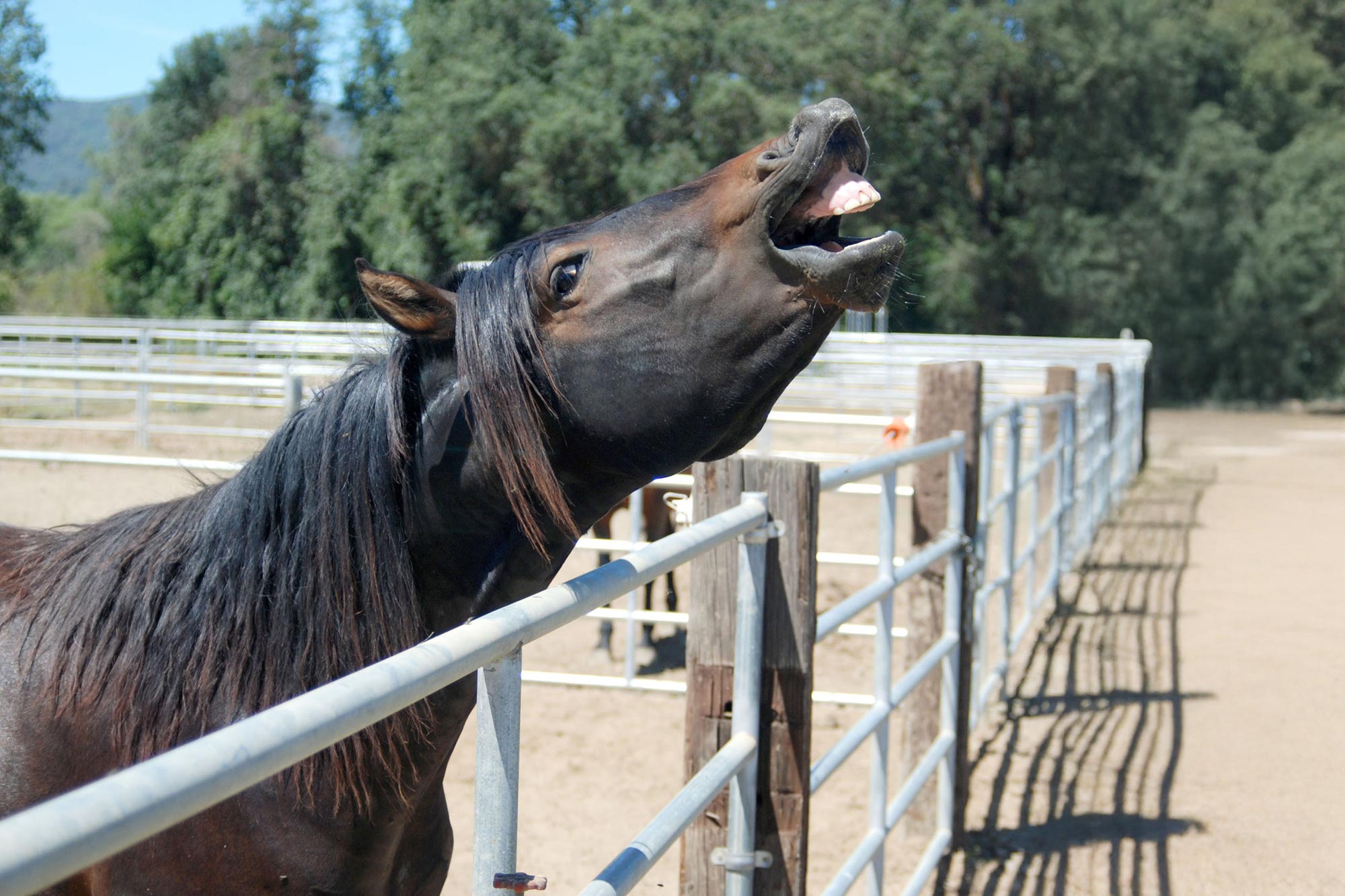
Horses secretly whistle and sing at the same time—turning every whinny into a two-layered message.
A horse’s whinny stands out because it blends both high and low sounds at the same time. In a study published today (February 23) in the Cell Press journal Current Biology, researchers revealed how horses manage this unusual feat. They create deep tones by vibrating their vocal folds, similar to the way people produce sound when singing. At the same time, they generate a high-pitched sound by whistling through their larynx. According to the research team, this dual sound production likely evolved so horses can communicate more than one message in a single call.
“We now finally know how the two fundamental frequencies that make up a whinny are produced by horses,” says author Elodie Briefer of the University of Copenhagen. “In the past, we found that these two frequencies are important for horses, as they convey different messages about the horses’ own emotions. We now have compelling evidence that they are also produced through distinct mechanisms.”

Solving the Mystery of Horse Vocal Communication
Horses have lived alongside humans for more than 4,000 years, yet scientists still know relatively little about how they communicate vocally. In general, large mammals tend to produce lower-pitched sounds because their larger larynx creates deeper tones. However, horses do not fully follow this pattern. Their whinnies include surprisingly high frequencies despite their size.
To understand why, researchers closely examined how a whinny is physically produced. They determined that the sound involves a rare vocal phenomenon called “biphonation,” which means a single call contains two separate frequencies, one low and one high.
The lower frequency comes from vibrating vocal folds, much like a person singing or a cat meowing. The source of the higher frequency, however, had remained unclear until now. To pinpoint it, the team analyzed the horses’ vocal anatomy, reviewed clinical data, and conducted detailed acoustic measurements.
“Solving this biomechanical puzzle required combining approaches from veterinary medicine to acoustic physics,” says author Romain Lefèvre of the University of Copenhagen.
Recording of a horse whinny. Credit: Elodie Briefer
The Discovery of Laryngeal Whistling in Horses
The researchers found that the high-frequency portion of the whinny is produced by what is known as a laryngeal whistle. This works similarly to a human whistle, but instead of forming the sound with the lips, the airflow creates turbulence inside the horse’s larynx.
While small rodents such as rats and mice are known to produce laryngeal whistles, horses are the first large mammal identified using this method. They are also the only animals known to combine this internal whistle with vocal fold vibration at the same time.
Helium Experiments Confirm the Dual Sound Mechanism
To confirm their findings, scientists conducted experiments using excised larynx experiments. They passed air through larynges taken from deceased horses and then replaced the air with helium before switching back again. Because sound travels faster in helium, whistle frequencies shift higher when helium is used, while sounds produced by vibrating vocal folds stay the same.
Exactly as predicted, the high frequency component rose when helium flowed through the larynx, but the low frequency did not change.
“When we blew helium through the larynges for the first time, the frequency shift was immediately obvious, and we knew we’d solved the mystery,” says author William Tecumseh Fitch of the University of Vienna. “We were thrilled!”
Why Biphonation May Have Evolved
These results clarify how the two overlapping pitches, known as biphonation, are physically created. The team believes this ability likely evolved to allow horses to send multiple independent signals at once.
The researchers also observed that Przewalski’s horses, a close relative of domesticated horses, produce whinnies that include biphonation. In contrast, more distant relatives such as donkeys and zebras appear to lack the high frequency element. This suggests that horses developed specialized vocal adaptations, giving them a broader and more complex range of calls than many other mammals.
“Understanding how and why biphonation has evolved is an important step towards elucidating the origins of the amazing vocal diversity of mammalian vocal behavior,” says author David Reby of the University of Lyon/Saint-Etienne.
Reference: “The high fundamental frequency in horse whinnies is generated by an aerodynamic whistle” by Romain Adrien Lefèvre, Lucie Barluet de Beauchesne, Florent Sabarros, Sabrina Briefer Freymond, Alessandra Ramseyer, Matthieu Keller, David Reby, William Tecumseh Fitch and Élodie Floriane Briefer, 23 February 2026, Current Biology.
DOI: 10.1016/j.cub.2026.01.004
This work was supported by the Swiss National Science Foundation, the Austrian Science Fund, and Institut Universitaire de France.
Never miss a breakthrough: Join the SciTechDaily newsletter.
Follow us on Google and Google News.