
Close Menu
    Facebook X (Twitter) Instagram
    SciTechDaily
    • Biology
    • Chemistry
    • Earth
    • Health
    • Physics
    • Science
    • Space
    • Technology
    Facebook X (Twitter) Pinterest YouTube RSS
    SciTechDaily
    Home»Biology»Scientists Discover How Behavioral Rhythms Are Fine-Tuned In the Brain
    Biology

    Scientists Discover How Behavioral Rhythms Are Fine-Tuned In the Brain

    By Kanazawa UniversityMay 22, 2021No Comments4 Mins Read
    Facebook Twitter Pinterest Telegram LinkedIn WhatsApp Email Reddit
    Share
    Facebook Twitter LinkedIn Pinterest Telegram Email Reddit
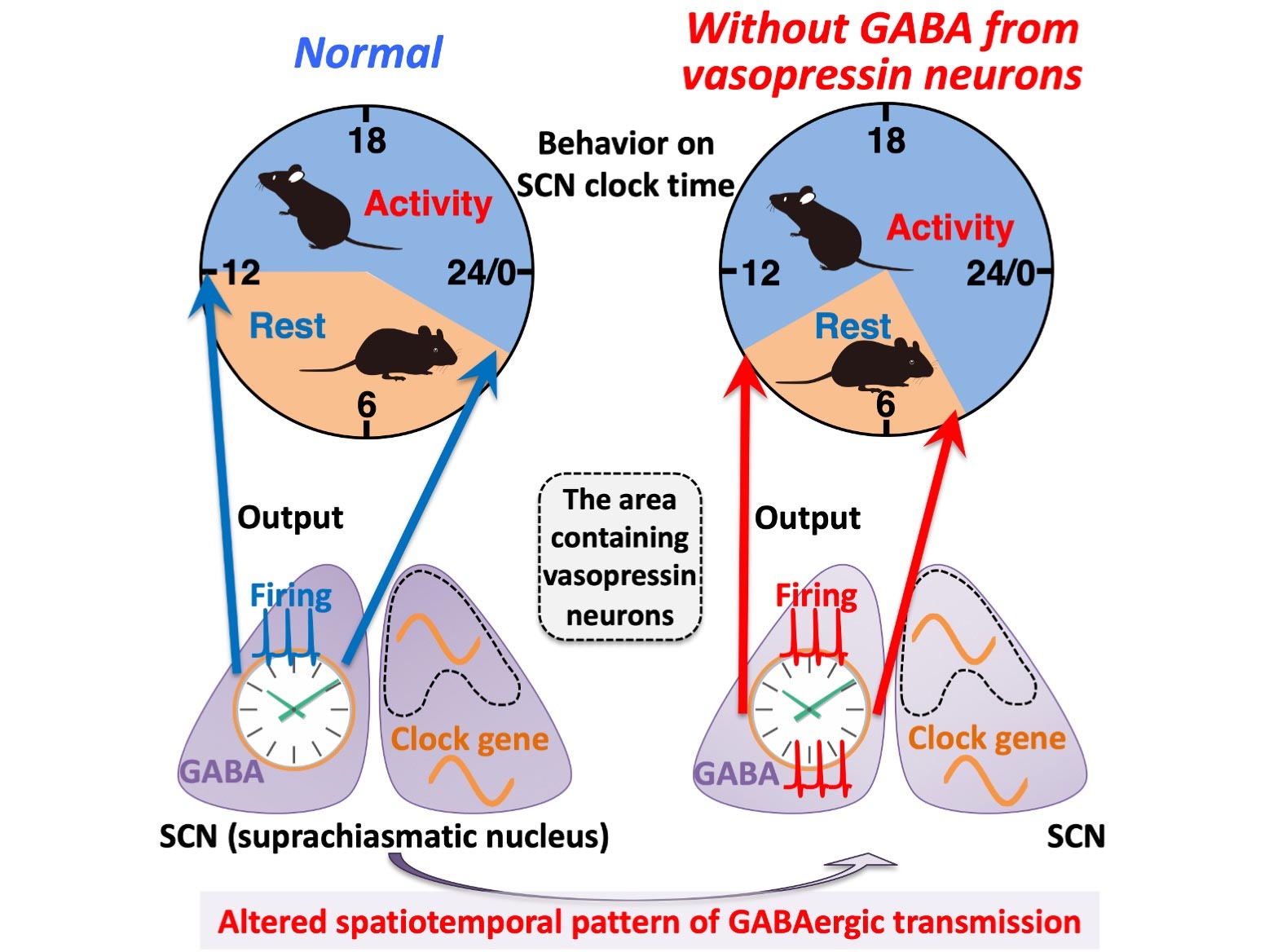
    Deficiency of GABAergic Transmission From Vasopressin Neurons on Circadian Rhythms
    A schema summarizing the effects caused by the deficiency of GABAergic transmission from vasopressin neurons on circadian rhythms at multiple levels. Without GABA release from vasopressin neurons, the spatiotemporal pattern of GABAergic transmission alters within the SCN. Such an alteration does not significantly disturb the spatiotemporal organization of molecular clocks measured with clock gene expression and intracellular calcium, but it does cause an aberrant bimodal pattern of the SCN firing (electrical activity) rhythm that may lead to the increased interval between the morning and evening locomotor activities. Thus, GABAergic transmission of vasopressin neurons regulates the SCN neuronal activity rhythm to modulate the time at which SCN molecular clocks enable circadian behavior. Credit: Kanazawa University

    Researchers led by a team at Kanazawa University report that vasopressin neurons in the brain’s circadian rhythm control center are critical for regulating the timing of output from the molecular clock of the center, and thus circadian behaviors.

    Our bodies and behaviors often seem to have rhythms of their own. Why do we go to the bathroom at the same time every day? Why do we feel off if we can’t go to sleep at the right time? Circadian rhythms are a behind-the-scenes force that shape many of our behaviors and our health. Michihiro Mieda and his team at Kanazawa University in Japan are researching how the brain’s circadian rhythm control center regulates behavior.

    Termed the superchiasmatic nucleus, or SCN, the control center contains many types of neurons that transmit signals using the molecule GABA, but little is known about how each type contributes to our bodily rhythms. In their newest study, the researchers focused on GABA neurons that produce arginine vasopressin, a hormone that regulates kidney function and blood pressure in the body, and which the team recently showed is also involved in regulating the period of rhythms produced by the SCN in the brain.

    To examine the function of these neurons, and only these neurons, the researchers first created mice in which a gene needed for GABA signaling between neurons was deleted only in vasopressin-producing SCN neurons. “We removed a gene that codes for a protein that allows GABA to be packaged before it is sent to other neurons,” explains Mieda. “Without packaging, none of the vasopressin neurons could send out any GABA signals.”

    This means that these neurons could no longer communicate with the rest of the rhythm control center using GABA. On the surface, the results were simple. The mice showed longer periods of activity, beginning activity earlier and ending activity later than control mice. So, lack of the packaging gene in the neurons disrupted the molecular clock signal, right? In fact, the reality was not so simple. Closer examination showed that the molecular clock progresses correctly. So, what was happening?

    The researchers used calcium imaging to examine the clock rhythms within the vasopressin neurons. They found that while the rhythm of activity matched the timing of behavior in control mice, this relationship was disturbed in the mice whose GABA transmission from the vasopressin neurons was missing. In contrast, the rhythm of SCN output, i.e. SCN neuronal electrical activity, in the modified mice had the same irregular rhythm as their behavior. “Our study shows that GABA signaling from vasopressin neurons in the suprachiasmatic nucleus help fix behavioral timing within the constraints of the molecular clock,” says Mieda.

    Credit: “GABA from vasopressin neurons regulates the time at which suprachiasmatic nucleus molecular clocks enable circadian behavior” by Takashi Maejima, Yusuke Tsuno, Shota Miyazaki, Yousuke Tsuneoka, Emi Hasegawa, Md Tarikul Islam, Ryosuke Enoki, Takahiro J. Nakamura and Michihiro Mieda, 9 February 2021, Proceedings of National Academy of Sciences.
    DOI: 10.1073/pnas.2010168118

    Funding: MEXT, JSPS, The Japan Agency for Medical Research and Development, The Takeda Science Foundation, The Uehara Memorial Foundation, The Yamada Science Foundation, The Japan Foundation for Applied Enzymology, The Daiichi Sankyo Foundation

    Never miss a breakthrough: Join the SciTechDaily newsletter.
    Follow us on Google and Google News.

    Behavioral Science Circadian Rhythm Kanazawa University Molecular Biology Neuroscience Physiology Sleep Science
    Share. Facebook Twitter Pinterest LinkedIn Email Reddit

    Related Articles

    Neuroscientists Discover Why Moms Take Risks to Protect Their Infants

    Circadian Rhythm: Resetting the Biological Clock by Flipping a Switch

    How Stress and the Circadian Clock Affect Sleep

    New Research Shows the Moon Influences Our Sleep

    Researchers Discover How the Brain Paralyzes You While You Sleep

    Scientists Discover Why We Need Sleep – “Important Work Is Being Done”

    Timing of Exercise During the Day May Rewind or Fast Forward Our Body Clocks

    Intense Brain Activity Drives Need for Sleep, Not Just How Long You’ve Been Awake

    Sleeping Longer On Weekends Doesn’t Erase Sleep Debt

    Leave A Reply Cancel Reply

    • Facebook
    • Twitter
    • Pinterest
    • YouTube

    Don't Miss a Discovery

    Subscribe for the Latest in Science & Tech!

    Trending News

    Why Popular Diabetes Drugs Like Ozempic Don’t Work for Everyone: The “Genetic Glitch”

    Scientists Stunned After Finding Plant Thought Extinct for 60 Years

    Scientists Discover Tiny New Spider That Hunts Prey 6x Its Size

    Natural Component From Licorice Shows Promise for Treating Inflammatory Bowel Disease

    Scientists Warn: Popular Sweetener Linked to Dangerous Metabolic Effects

    Monster Storms on Jupiter Unleash Lightning Beyond Anything on Earth

    Scientists Create “Liquid Gears” That Spin Without Touching

    The Simple Habit That Could Help Prevent Cancer

    Follow SciTechDaily
    • Facebook
    • Twitter
    • YouTube
    • Pinterest
    • Newsletter
    • RSS
    SciTech News
    • Biology News
    • Chemistry News
    • Earth News
    • Health News
    • Physics News
    • Science News
    • Space News
    • Technology News
    Recent Posts
    • 100,000-Year-Old Neanderthal Fossils in Poland Reveal Unexpected Genetic Connections
    • Unexpected Hormone Discovery Could Change How We Treat Arthritis
    • Scientists Supercharge “Natural Killer” Cells To Break Through Cancer’s Defenses
    • Simple “Gut Reset” May Prevent Weight Gain After Ozempic or Wegovy
    • 2.8 Days to Disaster: Scientists Warn Low Earth Orbit Could Suddenly Collapse
    Copyright © 1998 - 2026 SciTechDaily. All Rights Reserved.
    • Science News
    • About
    • Contact
    • Editorial Board
    • Privacy Policy
    • Terms of Use

    Type above and press Enter to search. Press Esc to cancel.