
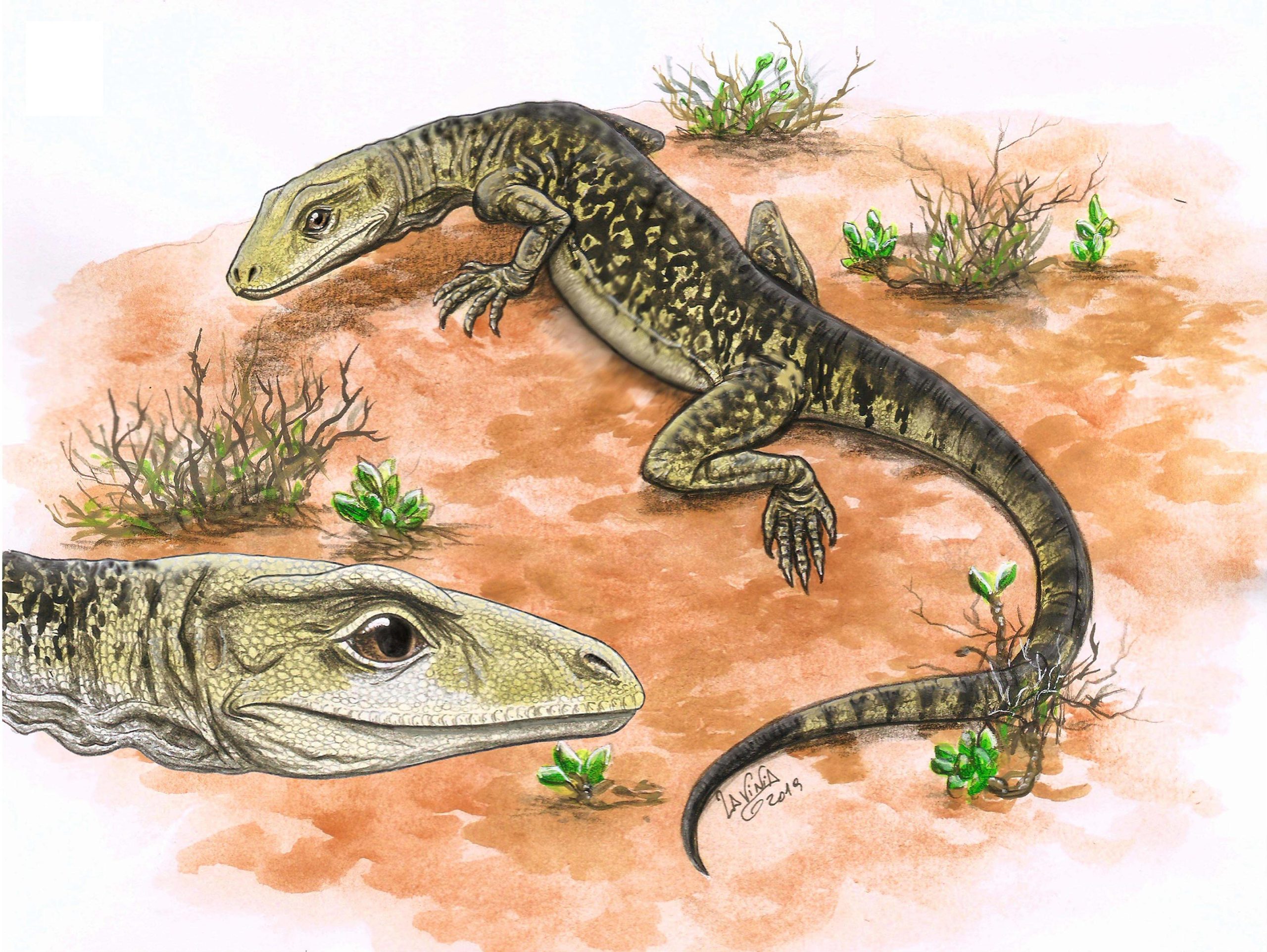
A 205-million-year-old fossil, Cryptovaranoides microlanius, was confirmed as the oldest modern lizard, shifting Squamata origins back by 35 million years. Challenges to its classification were dismissed after rigorous reanalysis.
A tiny fossil specimen discovered in Triassic-aged rocks near Bristol has been confirmed as the oldest modern-type lizard, dating back 205 million years. Initially identified by researchers from the University of Bristol, this specimen shifts the timeline for the origins of modern lizards by millions of years.
Confirmation of Lizard Identity Amid Controversy
Recently, the University of Bristol team’s findings came under question. However, new analyses published in Royal Society Open Science prove that the fossil is related to modern anguimorphs such as anguids and monitors. The discovery shifts the origin of the whole lizard-snake group, called Squamata, back by 35 million years.
In the original study, Dr. David Whiteside, Dr. Sofia Chambi-Trowell, and Professor Mike Benton named the little critter Cryptovaranoides microlanius, meaning ‘hidden lizard, small butcher’ because of its identification as a lizard and its sharp teeth, probably used for cutting up prey animals for food. The Bristol team identified many anatomical features of the skull and skeleton that allowed them to place it well within Squamata and even close to the Anguimorpha.

Debunking the Rival Theory
“We knew our paper would be controversial,” explained Dr Whiteside. “But we were confident that we had looked at every possible feature and compared it with everything we could.”
Professor Benton said: “We were therefore surprised, perhaps even shocked, that in 2023 another team of academics suggested that Cryptovaranoides was not a lizard or even a lizard relative, but in fact an archosauromorph, more closely related to crocodilians and dinosaurs.”

Establishing Scientific Consensus
In checking their original work and the questions posed in the rival paper, the Bristol team explored all the data, including the original specimen as well as the X-ray scans that show the details hidden within the rock. “We had the marvellous images from those CT scans as well as further access to the fossil which enabled us to check all their suggestions,” said Dr Chambi-Trowell. “We found that most of the concerns raised were wrong.”
Professor Benton added: “All the details of the skull, the jaws, the teeth, and the limb bones confirm that Cryptovaranoides is a lizard, not an archosauromorph.
“In our new paper, we provide great detail of every criticism made and we provide more photographs of the specimen and 3D images from the scans, so everyone can check the detail.”
Dr Whiteside concluded: “The result of all this had to be tested by a phylogenetic analysis.
“This is where we code hundreds of anatomical features in Cryptovaranoides and other modern and fossil lizards, as well as various archosauromorphs.
“We ran the analysis time after time, and it gave our original result, that the little Bristol reptile is indeed the world’s oldest modern-type lizard.”
Reference: “Late Triassic †Cryptovaranoides microlanius is a squamate, not an archosauromorph” by David I. Whiteside, Sofía A. V. Chambi-Trowell and Michael J. Benton, 31 October 2024, Royal Society Open Science.
DOI: 10.1098/rsos.231874
Never miss a breakthrough: Join the SciTechDaily newsletter.
Follow us on Google and Google News.
5 Comments
Joe Biden?
This study omitted several pertinent taxa, and it is not the oldest squamate. Details here: https://pterosaurheresies.wordpress.com/2024/11/28/late-triassic-cryptovaranoides-is-a-squamate-again-but-still-not-the-oldest/
Velociraptor has bird teeth and it is a bird but still would not change people call it dinosaur some how it’s a thecodont which mean crocodilian teeth a crocodilian type animal even with million evidence they would not believe it .does it has a third eye usual that the anwser
Protothecodont with overlapping scale never herd about that only tuatara and lizard has that the tuatara is not a lizard they like the lizard have third eye foramen on top of skull the thecodont lack a third eye foramen.protothecodont I do not know the turtle is protothecodont
The pterosaur heresies I been on that site I got some good imformation .pterosaur is not a dinosaur it has serrated teeth like the nile crocodile today dinosaur it has long carpal long toes like a gator these feature have scientific name in dinosaur it has pygostyle like tetanuran allso gator too the temporal fenestra looks modern crocodilian the Australian. it’s unique occified tendon simular to duckbill dinosaur .pterosaur could not fly it was like sea turtle lifestyle the most advance pterosaur has whale nose like spinosaurus.the early pterosaur lack kink jaw .its primitive dinosaur with advance feature like fuse sternum