
Close Menu
    Facebook X (Twitter) Instagram
    SciTechDaily
    • Biology
    • Chemistry
    • Earth
    • Health
    • Physics
    • Science
    • Space
    • Technology
    Facebook X (Twitter) Pinterest YouTube RSS
    SciTechDaily
    Home»Health»Scientists Discover Possible Treatment for Charcot-Marie-Tooth Disease
    Health

    Scientists Discover Possible Treatment for Charcot-Marie-Tooth Disease

    By Michael W Sereda, Max Planck InstituteAugust 13, 2018No Comments3 Mins Read
    Facebook Twitter Pinterest Telegram LinkedIn WhatsApp Email Reddit
    Share
    Facebook Twitter LinkedIn Pinterest Telegram Email Reddit
    Treatment for Charcot Marie Tooth Disease Discovered
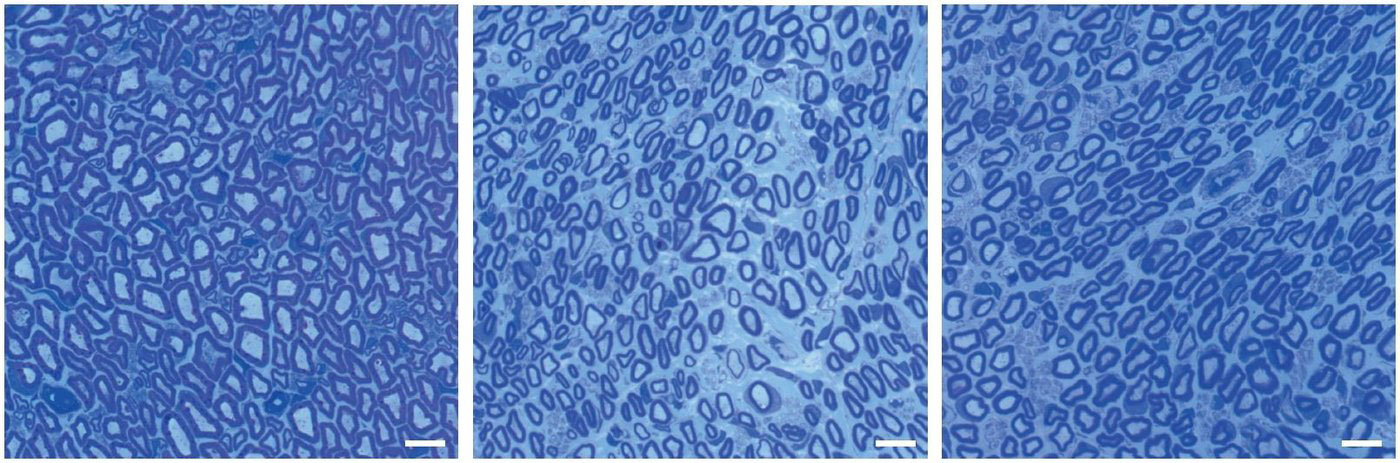
    Compared to healthy rats (left), rats with the Charcot-Marie-Tooth disease (central) show less myelin surrounding the axons, visible as missing blue rings. Animals treated with Lecithin (right) show an increase in myelinated filaments. © Max-Planck-Institute for Experimental Medicine

    Charcot-Marie-Tooth disease is the most common hereditary neuropathy and affects more than two million people worldwide. Researchers at the Max-Planck-Institute for Experimental Medicine and the University Medical Center of Göttingen now hope to use lecithin, a harmless dietary supplement to treat the incurable illness.

    In Germany alone, at least 30,000 people suffer from Charcot-Marie-Tooth neuropathy, which belongs to the class of rare diseases. Due to a genetic defect that causes a duplication of the PMP22 gene, patients develop a slowly progressive impairment of their peripheral nerves. Early symptoms, like walking difficulties or deformed feet, can already occur during childhood. Later, muscle weakness in the legs and arms occurs, but also numbness, prickling, or pain. In rare cases, patients may be forced to use wheelchairs.

    The axons, projections of nerve cells in the peripheral nervous system, are surrounded by supporting cells over their entire length. These Schwann cells produce a fatty layer, the myelin, around the axons, which allows for a faster transfer of electric signals. Using genetically modified rats, scientists at the Max-Planck-Institute for Experimental Medicine, the University Medical Center in Göttingen, as well as neuroscientists from Leipzig, Würzburg, Heidelberg, and Aachen now discovered that diseased Schwann cells show a decreased fat metabolism during their development which causes the impaired myelination. “The production of myelin is extremely laborious for Schwann cells. A disruption, like the one the Charcot-Marie-Tooth disease causes, leaves the nerve fibers without myelin, which limits their functionality,” explains Robert Fledrich, the first author of the study.

    Schwann cells use phospholipids for the myelination

    Using lecithin, the reduced fat production of Schwann cells might be circumvented and the disturbed myelination in Charcot-Marie-Tooth disease might be improved. Lecithin is produced from soy or yolk and consists of phospholipids. It is a harmless dietary supplement and the main ingredient of myelin. Initially the scientists were able to show that the phospholipids in genetically modified rats were absorbed by the Schwann cells and used for the production of myelin.

    Therapy studies with diseased rats that were given lecithin in various doses not only showed that a treatment with phospholipids promotes the myelination. “It significantly eases the course of the disease regardless of the start of the therapy”, explains Ruth Stassart, co-leader of the study. “The promising data from the animal testing and especially the already proven compatibility of with humans, promote Lecithin as a therapeutic agent for the Charcot-Marie-Tooth disease as well as possibly for similar demyelinating diseases”, adds Michael Sereda, a neurologist at the Department of Clinical Neurophysiology and group leader at the Max-Planck-Institute, who directed the study.

    Reference: “Targeting myelin lipid metabolism as a potential therapeutic strategy in a model of CMT1A neuropathy” by R. Fledrich, T. Abdelaal, L. Rasch, V. Bansal, V. Schütza, B. Brügger, C. Lüchtenborg, T. Prukop, J. Stenzel, R. U. Rahman, D. Hermes, D. Ewers, W. Möbius, T. Ruhwedel, I. Katona, J. Weis, D. Klein, R. Martini, W. Brück, W. C. Müller, S. Bonn, I. Bechmann, K. A. Nave, R. M. Stassart and M. W. Sereda, 2 August 2018, Nature Communication.
    DOI: 10.1038/s41467-018-05420-0

    Never miss a breakthrough: Join the SciTechDaily newsletter.
    Follow us on Google and Google News.

    Disease Max Planck Institute Medicine
    Share. Facebook Twitter Pinterest LinkedIn Email Reddit

    Related Articles

    New Production Process Could Help Eradicate Malaria Related Deaths

    Study Shows Parkinson’s Disease Involves Degeneration of the Olfactory System

    Triple Sugar Molecule Protects Against the Pneumococcal Strain ST8

    Max Planck Scientists Discover a New Genetic Disease Mechanism

    New Research Provides Hope for Better Wound Healing for Diabetics

    Protein NLRP12 Protects Against Colon Cancer

    VPM1002 Tuberculosis Vaccine in Phase II Trial

    Transplants Without the Need for Lifelong Immunosupression

    Nose Spray for Panic Attacks? Intranasal Neuropeptide S Lowers Anxiety

    Leave A Reply Cancel Reply

    • Facebook
    • Twitter
    • Pinterest
    • YouTube

    Don't Miss a Discovery

    Subscribe for the Latest in Science & Tech!

    Trending News

    Scientists Uncover Potential Brain Risks of Popular Fish Oil Supplements

    Scientists Discover a Surprising Way To Make Bread Healthier and More Nutritious

    After 60 Years, Scientists Uncover Unexpected Brain Effects of Popular Diabetes Drug Metformin

    New Research Uncovers Hidden Side Effects of Popular Weight-Loss Drugs

    Scientists Rethink Extreme Warming After Surprising Ocean Discovery

    Landmark Study Links Never Marrying to Significantly Higher Cancer Risk

    Researchers Discover Unknown Beetle Species Just Steps From Their Lab

    Largest-Ever Study Finds Medicinal Cannabis Ineffective for Anxiety, Depression, PTSD

    Follow SciTechDaily
    • Facebook
    • Twitter
    • YouTube
    • Pinterest
    • Newsletter
    • RSS
    SciTech News
    • Biology News
    • Chemistry News
    • Earth News
    • Health News
    • Physics News
    • Science News
    • Space News
    • Technology News
    Recent Posts
    • Scientists Uncover Dangerous Connection Between Serotonin and Heart Valve Disease
    • Scientists Discover a “Protector” Protein That Could Help Reverse Hair Loss
    • Powerful Lasers Reveal How Matter Becomes Plasma in Trillionths of a Second
    • A Simpler Path to Super-Resolution: Scientists Reinvent Microscopy
    • Scientists Uncover Hidden Genetic Cause of Diabetes in Babies
    Copyright © 1998 - 2026 SciTechDaily. All Rights Reserved.
    • Science News
    • About
    • Contact
    • Editorial Board
    • Privacy Policy
    • Terms of Use

    Type above and press Enter to search. Press Esc to cancel.