
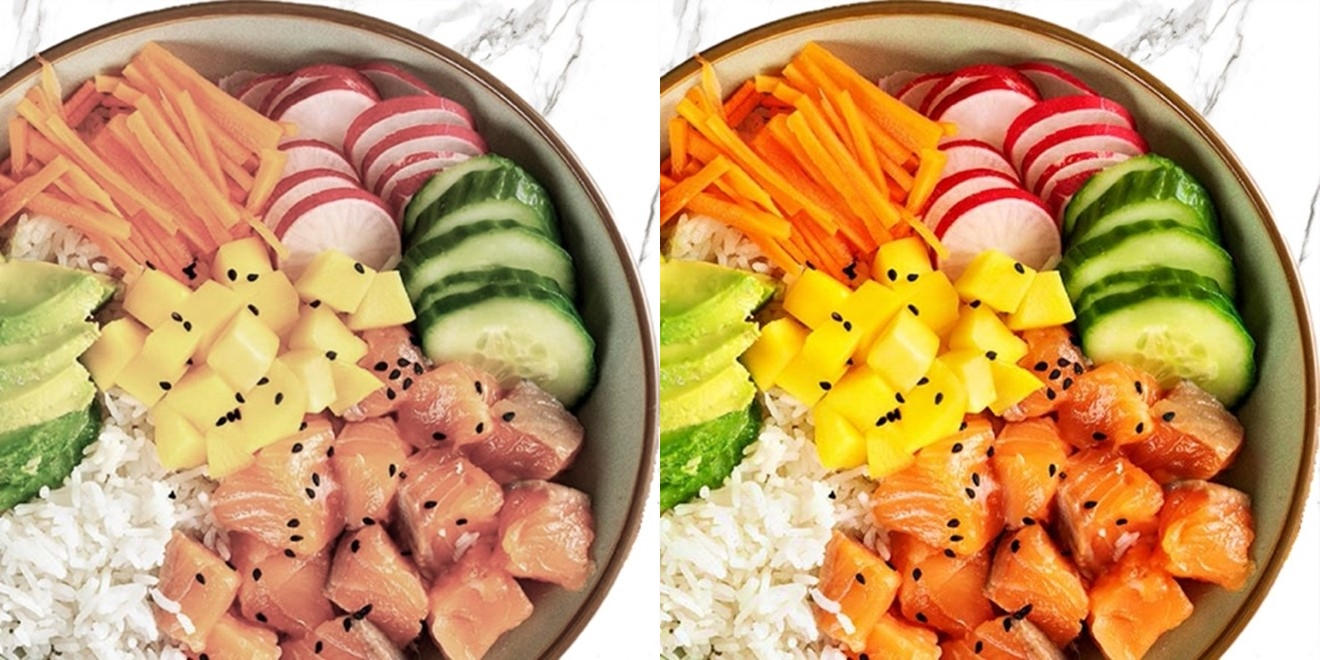
How Does Color Impact How You Perceive Food?
According to recent research, a restaurant may boost sales by using an appealing photo of a burger or other menu item, especially if the correct filter is used. According to the study, food seems fresher and tastier in photos with a high color saturation, which increases viewers’ willingness to buy menu items.
Color saturation is a term used to describe how vibrant and rich the reds, greens, and blues are in a picture. However, the visual distance of the food in the image and even whether customers expect to eat alone or with others affect how effectively color saturation works to make food appetizing.
These findings provide a straightforward way to boost sales in the competitive restaurant industry, according to Stephanie Liu, the study’s lead author and an associate professor of hospitality management at The Ohio State University.
“On Instagram, it means using the ‘X-Pro II’ filter on your food photos rather than the ‘Earlybird’ filter,” Liu said. “It is not difficult and doesn’t cost a dime, so it is an easy win for restaurant marketers.”
The findings were recently published in the Journal of Business Research. The scientists conducted two online studies.
In one study, 267 participants were instructed to imagine themselves looking through options on an online platform for ordering food. Photos of poke bowls, a Hawaiian dish containing raw, marinated fish pieces, vegetables, and sauce served over rice, were presented to the participants. They were from a fictitious called restaurant Poke Kitchen.
Participants in the study were randomly allocated to see one of four distinct images, each with different color saturation and visual distance.
The photos with high color saturation were edited with professional graphic design software to be 130% more saturated than the low-saturation photos. The up-close photos were 130% larger in radius and appeared nearer to the observer than the more distant photo.
Visual Distance and the Effectiveness of Color Saturation
Participants were asked to rate how fresh the food in each photo looked, how tasty it looked and how likely they would be to purchase it. The food in the more highly saturated photos looked fresher and tastier to participants, and that led them to be more likely to purchase the food, results showed.
But color saturation had a stronger effect when the food appeared more distant in the photos, Liu said.
“When the food is shown close up, it is already easy for the viewers to imagine how fresh and tasty the food would be,” she said. “Color saturation is not as necessary.”
The second study involved 222 online participants. In this case, the participants were asked to imagine they were browsing Instagram and came across images of pizza from a fictitious restaurant near their home named Pizza City. They were shown photos either high or low in color saturation.
People in the study were also told they would either be eating alone or with family that night and were again asked to rate the pizza on perceived freshness and tastiness and on whether they would likely purchase the menu item.
As in the previous study, the food in the color-saturated photo was always seen as fresher and tastier and one that people would be more likely to buy. But that effect was stronger for people who were told they would be eating alone and weaker for those who would be eating with family.
“When people are eating with others, the social experience is a big part of what people look forward to,” Liu said. “But when they anticipate eating alone, they focus more on the food itself. They want the food to be fresher and tastier and that’s why color saturation is more important in this context.”
Importance of Social Media Food Photos
These findings are more important now than ever before, with people ordering online and looking at photos to help them decide what to eat, Liu said.
“Restaurants have to post pictures of their food on social media and online ordering platforms,” she said. “They should be paying as much attention, or maybe more, to the photos they post as they do to the text. Color saturation is one key element they need to focus on.”
Reference: “Marketing online food images via color saturation: A sensory imagery perspective” by Stephanie Q. Liu, Laurie Luorong Wu, Xi Yu and Huiling Huang, 13 July 2022, Journal of Business Research.
DOI: 10.1016/j.jbusres.2022.06.061
Never miss a breakthrough: Join the SciTechDaily newsletter.
Follow us on Google and Google News.