
Close Menu
    Facebook X (Twitter) Instagram
    SciTechDaily
    • Biology
    • Chemistry
    • Earth
    • Health
    • Physics
    • Science
    • Space
    • Technology
    Facebook X (Twitter) Pinterest YouTube RSS
    SciTechDaily
    Home»Biology»Scientists Discover the Secret to This Bizarre Creature’s Extraordinarily Long Life
    Biology

    Scientists Discover the Secret to This Bizarre Creature’s Extraordinarily Long Life

    By American Association for the Advancement of ScienceOctober 13, 2025No Comments3 Mins Read
    Facebook Twitter Pinterest Telegram LinkedIn WhatsApp Email Reddit
    Share
    Facebook Twitter LinkedIn Pinterest Telegram Email Reddit
    Naked Mole Rat Tunnel
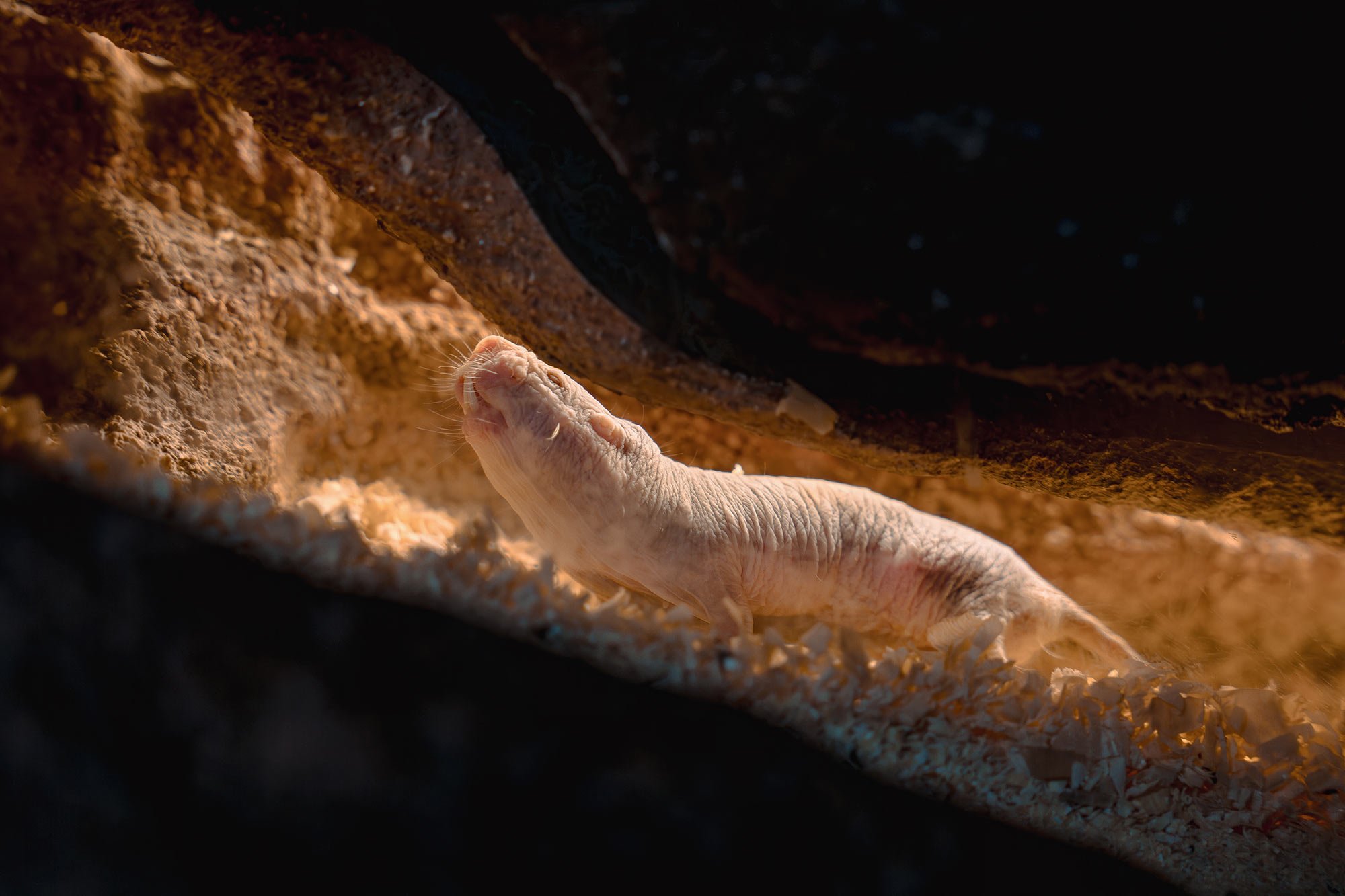
    Scientists have uncovered that four subtle amino acid changes in the naked mole-rat’s cGAS enzyme may hold the key to its extraordinary lifespan. Credit: Shutterstock

    A few tiny molecular tweaks may explain why naked mole-rats live nearly ten times longer than similar species.

    Researchers believe the key to the naked mole-rat’s remarkable lifespan may come down to small but significant differences in just four amino acids. A recent study found that evolutionary changes in cGAS, an enzyme in the innate immune system that detects DNA to trigger immune responses, may give these animals a superior ability to repair age-related genetic damage. In contrast, cGAS in other species, including mice and humans, can actually hinder DNA repair.

    Despite their wrinkled, unremarkable appearance, the naked mole-rat (Heterocephalus glaber) is one of the longest-living rodents known, surviving for nearly 40 years, about ten times longer than other mammals of similar size. Interestingly, their genetic profile is more closely aligned with humans than with mice, making them a valuable subject for research into the molecular factors that promote longevity. One of the most important factors linked to a long life is the stability of an organism’s genome.

    Still, scientists are only beginning to understand how naked mole-rats preserve the integrity of their DNA, especially through their unique repair systems that protect their cells from the ravages of time.

    The Role of cGAS and DNA Repair

    Homologous recombination (HR) is a critical DNA repair pathway, and defects in HR are linked to premature aging. In humans and mice, the DNA sensor cGAS (cyclic guanosine monophosphate–adenosine monophosphate synthase) can suppress HR repair, potentially promoting cancer and shortening lifespan.

    Yu Chen and colleagues investigated whether cGAS similarly inhibits HR in long-lived naked mole-rats. Chen et al. found that, in naked mole-rats, four specific amino acid substitutions in mole-rat cGAS reduce ubiquitination and degradation, allowing the protein to persist for longer and at higher levels after DNA damage. This increased abundance strengthens interactions with key repair factors, FANCI and RAD50, thereby boosting HR repair.

    Extending Lifespan Through Molecular Engineering

    When cGAS was depleted from naked mole-rat cells, DNA damage accumulated. The authors further showed that fruit flies engineered to express human cGAS containing the four naked mole-rat–specific mutations lived longer than flies expressing unaltered human cGAS. The findings suggest that these specific evolutionary amino acid mutations in naked mole-rat cGAS not only enhance DNA repair but may also contribute directly to the extraordinary longevity of the species.

    “The findings from Chen et al. describe an unexpected role for naked mole-rat cGAS in the nucleus that influences longevity, write John Martinez and colleagues in a related Perspective. “Further research will be required to establish the roles that cGAS may play in the nucleus in other organisms, both short- and long-lived, but the answer may be substantially more complex than originally predicted.”

    Reference: “A cGAS-mediated mechanism in naked mole-rats potentiates DNA repair and delays aging” by Yu Chen, Zhixi Chen, Hao Wang, Zhen Cui, Kai-Le Li, Zhiwei Song, Lingjiang Chen, Xiaoxiang Sun, Xiaoyu Xu, Yixue Zhang, Li Tan, Jian Yuan, Rong Tan, Min-Hua Luo, Fang-Lin Sun, Haipeng Liu, Ying Jiang and Zhiyong Mao, 9 October 2025, Science.
    DOI: 10.1126/science.adp5056

    Never miss a breakthrough: Join the SciTechDaily newsletter.
    Follow us on Google and Google News.

    American Association for the Advancement of Science DNA Longevity Molecular Biology
    Share. Facebook Twitter Pinterest LinkedIn Email Reddit

    Related Articles

    New Repair Mechanism for Alcohol-Induced DNA Damage Discovered

    Online DNA Services Vulnerable to Genetic Hacking

    Re-Cracking the Genetic Code – We May Have Only Begun to Scratch the Surface

    Dangerous Toxin Genetically Engineered Into a High-Resolution Biosensor

    Yale Researchers Track How Cells Repair Rips in DNA

    UCLA Study Shows DNA Patterns Can Unlock How Glucose Metabolism Drives Cancer

    Key Differences in Seemingly Synonymous Parts of the Genetic Code

    Sequencing DNA From Individual Cells Yields Dramatic New Information

    Sirtuin Protein SIRT6 Linked to Longevity in Mammals

    Leave A Reply Cancel Reply

    • Facebook
    • Twitter
    • Pinterest
    • YouTube

    Don't Miss a Discovery

    Subscribe for the Latest in Science & Tech!

    Trending News

    AI Could Detect Early Signs of Alzheimer’s in Under a Minute – Far Before Traditional Tests

    What if Dark Matter Has Two Forms? Bold New Hypothesis Could Explain a Cosmic Mystery

    This Metal Melts in Your Hand – and Scientists Just Discovered Something Strange

    Beef vs. Chicken: Surprising Results From New Prediabetes Study

    Alzheimer’s Breakthrough: Scientists Discover Key Protein May Prevent Toxic Protein Clumps in the Brain

    Quantum Reality Gets Stranger: Physicists Put a Lump of Metal in Two Places at Once

    Scientists May Have Found the Key to Jupiter and Saturn’s Moon Mystery

    Scientists Uncover Brain Changes That Link Pain to Depression

    Follow SciTechDaily
    • Facebook
    • Twitter
    • YouTube
    • Pinterest
    • Newsletter
    • RSS
    SciTech News
    • Biology News
    • Chemistry News
    • Earth News
    • Health News
    • Physics News
    • Science News
    • Space News
    • Technology News
    Recent Posts
    • Students Found an Ancient Star That Shouldn’t Be in the Milky Way
    • Astronomers Solve 50-Year Mystery and Reveal Hidden Culprit Behind Strange X-Ray Emissions
    • One of the Universe’s Largest Stars May Be Getting Ready To Explode
    • Scientists Discover Enzyme That Could Supercharge Ozempic-Like Weight Loss Drugs
    • Asthma and Depression Don’t Mix the Way Scientists Expected
    Copyright © 1998 - 2026 SciTechDaily. All Rights Reserved.
    • Science News
    • About
    • Contact
    • Editorial Board
    • Privacy Policy
    • Terms of Use

    Type above and press Enter to search. Press Esc to cancel.